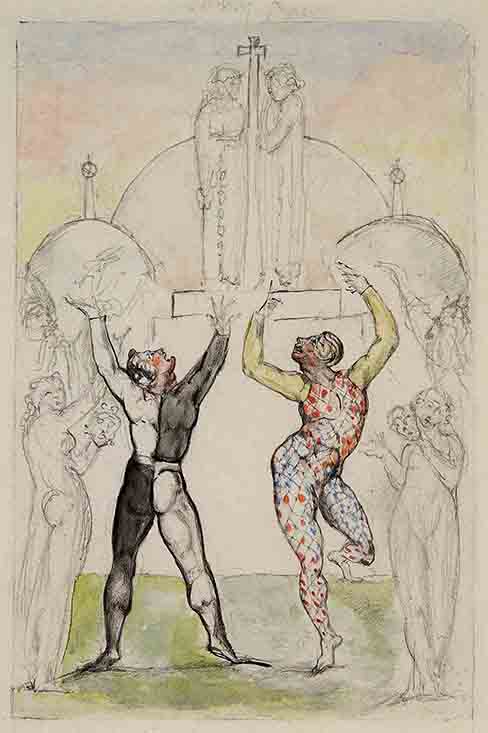
Who treads the path and why. And those who do not, those who prefer Vanity Fair, what is their fate.
Is there meaning at all in the universe, right or wrong, up or down. None, says the physicist. All is an illusion, even consciousness itself. No free will, all choice mere fanciful thinking along a harsh and desolate path of deterministic rigour, our route set as firmly as a locomotive on rails of steel.
No choice is truly made, no change possible say those brilliant minds which describe and measure the physical universe. And yet such minds can tell us nothing of intrinsic meaning. Assuming that any such concept can be said to exist.
Is he wrongheaded then, our pilgrim. No heaven no hell. The path mere conceit, leading nowhere. Was John Bunyan’s hero on a road to nowhere, or can the seeker find peace and meaning.
The world over, seekers follow the same path. Whatever their race or culture, the means are similar and the end identical. Called by different names, the discerning traveler shuns the narrow dogma of priest and the guardian of orthodoxy, and seeks out nirvana, peace, god through a life which becomes ever more silent. Contemplation tells them that the physicist is wrong.
It is clear to such people that consciousness does exist. If that phenomena is merely subjective, in objective terms most would agree that this ghost, this ephemeral and fleeting flicker, is at least a shared illusion and therefore undeniable whatever its “reality” or otherwise.
There comes a time when our traveler has read enough, having listened diligently to the conflicting noise of the opinionated and self anointed. He has studied at worthy and ancient universities. He is no stranger to Wittgenstein and Erasmus, Confucius and Lao Tzu once influenced his thinking.
Or there again, the traveler may be a man of no education, unlearn-ed even. No one is disqualified from the search for meaning.
But all eventually find that the path leads inward and that Vanity Fair offers no lasting reward. And certainly no peace.
Such men will not care whether good and evil can be said to exist objectively. It exists for them and that is enough. The great men of learning who deny meaning can be safely be ignored. For those who seek, a god will be found to exist – even the atheist will find something wondrous and immaterial to believe in.
As to himself, he neither worshipped a god nor washed the feet of the poor. He sought sanctity in no one’s eyes, least of all his own.
He supposed, if and when he thought of the matter, that the external world was beyond the pale, let alone a god who encouraged Jew and Arab to slaughter each other’s babies and invented evolution. Or didn’t.
The world never changed, nothing new under the sun and probably never would be. So forget worship – if a creator did exist he was either a very poor programmer or a vicious sadist. Perhaps both.
But callous our pilgrim was not, nonetheless. If there was sanctity it was to be sought in right thinking and the eradication of suffering. It’s just that he was not up to the job of bringing about the latter.
And so his own path was to mind his own business and try at least to do no harm. For he knew he could do no good.
And so his path led inwards into silence and meditation.
It seemed to him highly probable that merchant moguls, kings, emperors and politicians were, for the most part, unlikely to be skilled in such arts. Those who “do” in the world, especially those who “do down” don’t spend much time in self reflection or questioning.
If they did, he suspected the world might be an altogether better place but on the whole he remained convinced the world would go to hell in a handcart and he determined no to go with it.
There is a reality to meditation and meditation leads to reality. Or to put it another way, we humans do not as a species see the error of our ways and fail to see the futility of our customary pursuits. Nor do we understand that less is often more.
Meditation has a curious effect, practiced daily and diligently. It sorts the world out, it sifts the chaff from the wheat. It cures the soul and in and of itself seems to lead to right thinking and an appreciation that reality is not as simple as it seems.
And so for some, it becomes pointless to think more, to read more, to listen more. Shut out the Tower of Babel, switch off the talking heads. Think right thoughts, even if you do not have the inclination or aptitude to pursue right deeds.
And it reaches the point where you look at the collective madness of our species and simply resign.
If that sounds selfish it is certainly better than succumbing to the insanity of killing babies, screwing the poor, or entering politics.
ILLUSTRATION TO JOHN BUNYAN’S “THE PILGRIM’S PROGRESS” (COMPOSED C. 1824-27) William Blake
 Weltanschauung
I was conflicted about whether to ‘like’ this post, my friend. If I’m honest, I disagree with most of it (which will come as no surprise to you).
LikeLike
Well thank you both for the like and the comment John! I had lunch with a Belgian friend in Bruges last week. He is a nuclear physicist and would also disagree with many if my “beliefs”. Nonetheless we have enjoyed each other’s company for many years. On Saturday I am having dinner with my favourite evangelical vicar, of whom I am very fond. And yet I have no time for his god nor he for my “paganism”.
LikeLiked by 2 people
Yes, what you say fits with what I was thinking about all this, that there are such subtleties of “belief” and other thoughts about the nature of reality that we can easily misconstrue where someone else is coming from (and I certainly agree with some of your views). I tried writing a longer reply, then realised it would take more unpacking and I was too short on time, so I deleted all but the first bit, which now sounds a bit brash. It might lead me to write another blog post of my own as a reflection on this one, if I ever get through my to-do list! One thing I do want to say is that I’m really happy that meditation is obviously doing you a lot of good. That’s priceless. All the best, mate.
LikeLiked by 1 person
As always, I am provoked beyond measure, by your relentless consideration of the circumstances within which we find ourselves these days. There can be little doubt that the availability of information and opinion resulting from the digital revolution shows us just how diverse the flow of information has become when it comes to philosophical thinking about the most profound questions of our time.
You present your ideas and your reflections on the state of the world with such potency and directness that even lettersquash has to exclaim his disagreement with some of your conclusions. In my view, your insistence on the state of the world is much closer to reality than we would like to admit generally.
We can engage with our fellow Homo sapiens today, in this epoch, in ways that were largely impossible in ancient times, and there are a large number of divergent opinions about the relationship between what is responsible for our experience of the world and the expectations existent as a result of that diversity. It is my feeling that your expression of your views, which sometimes do not comport with those of others, are warranted based on your experience, and reflect the agreement of many others, especially those of us whose experiences are aligned with those you site.
There can be no doubt, in my view, that an increase in “self-reflection or questioning,” would be of great benefit to the modern world, and it is my fervent hope that you will continue to offer your readers these thought-provoking posts in the interest of expanding the skills of the arts you cite among “merchant moguls, kings, emperors and politicians were, for the most part, unlikely to be skilled in such arts.”
All best wishes…John H.
LikeLiked by 1 person
Thank you John, very much, for your thoughts. They are, as ever, much appreciated!
A
LikeLike
Could you delete this message and the anonymous one…I didn’t mean to post my comment as anonymous…lol
LikeLike