Tag: Beauty

  • What is the purpose of Art?

    What is the purpose of Art?

    Why does there need to be a “purpose”?

    It is. Just like we are. That’s probably about all you need to know.

    A better question perhaps is “what does art do for me”?

    Now there is something worth exploring. Given that our universe in all probability just “is” it is down to us to make our own “meaning” – if meaning is what we feel we need. If meaning is necessary to our soul, our life. Our happiness.

    Perhaps that is why we invented god. Alongside art. When the earliest known cave paintings were scrawled on stone walls some 100,00 years ago, why did the cave man do it? Or cave woman.

    Or non binary person. There! How modern I am!

    I suggest it may have been a search for meaning. A statement of meaning perhaps. The earliest religion is thought to have arisen perhaps as long ago as 300,000 years.  Shamanism and animism, it is said. The juju man, dancing around the fire, waving smoke in your face, casting spells and exhorting spirits. Probably daubing the walls of his hut or cave with paint, likely as not making crude trinkets and charms.

    And so forward to Sherborne Abbey, the magnificent gothic church pictured above. By then the juju man has acquired a more formal code, but he still waved around holy smoke and incanted his magic, his powerful ritual.

    All these people had discovered their own meaning where before none such had existed.  A god who has made the world and shoved us in its epicentre. Animals and spirits who conjured the tides and the weather. Who make the crops grow or dispense terrible famine in retribution for man’s shocking sin.

    And so back  to today – and in particular to 21st Century England. A shit hole if ever there was one. William Blake must be crying out in pain to see that his land is now covered in dark satanic mills from it’s very head to the tip of it’s sooty, grime ridden toes.

    So perhaps these days art continues to play much the same role as it did in the days of ancient shamanism. Now, our terror is not thunder or famine, but the hideous mess we have made of a formerly green and pleasant land. Endless concrete, endless noise, the hammers and anvils everywhere. No peace to be found, no beauty.  And the whole ghastly edifice about to collapse on top of us, as global warming comes home to roost.

    So now more than ever art is needed. To show us a better way perhaps. Or to mark out descent as we reel and grope our way to our end.

    Tracy Emin – her lurid concentration on her own body. Fair doos, as they say. A way to express the terror of her own shocking existence. Anish Kapoor – perhaps endless wealth was not his aim. Perhaps he too was expressing something of his own anxiety. Or disappointment. Or fear. His weird structures and conceits certainly seem to express fear, as well as curiosity and wonder. A ghastly second coming. The end, the last judgement.

    Art as self expression – perhaps I am getting somewhere. But maybe art also as seeking – seeking beauty and god in the case of Sherborne Abbey. Beauty certainly exists, although presumably in the eye of the beholder. And god too, because he is your creation and your refuge.  Both god and beauty may be an escape from the bestiallity of the real world of hatred and killing, of suffering, poverty and privation.

    I think it is time that I concentrated on art. On my own art as well as the creations of others. Art as poetry perhaps, or music. Even writing prose can be seen as powerful art – it is certainly as creative as any other art form.

    I am seeing art as part of a retreat from a fearful world. Fearful in so very many ways, the mere expression of that fear is terrifying. Lack of meaning is the hardest to come to terms with – the fear that this whole ghastly melange of terror and beauty, of hatred and violence, of love and cruelty just “is”. Just grew, just festers and, one day will just fizzle out.

    So have your day in the sun. Pick the flowers while you may. Glorify and bless your existence with gothic masterpieces and exquisite poetry.

    Splash your genitalia all over the canvas and hang it out for all to see.

    Paint, sing, dance, build, create. Because you can. For a while at least.

  • Crossing the Bar – Alfred Lord Tennyson

    Crossing the Bar – Alfred Lord Tennyson

    Sunset and evening star,
          And one clear call for me!
    And may there be no moaning of the bar,
          When I put out to sea,

       But such a tide as moving seems asleep,
          Too full for sound and foam,
    When that which drew from out the boundless deep
          Turns again home.

       Twilight and evening bell,
          And after that the dark!
    And may there be no sadness of farewell,
          When I embark;

       For tho’ from out our bourne of Time and Place
          The flood may bear me far,
    I hope to see my Pilot face to face
          When I have crost the bar.

    This is one of those rare poems which do not require great depth of thought or analysis to enjoy. No looking up of dull professors and their equally boring commentary. It is a piece of gentle beauty even you and I can understand.

    It is of course about the poet’s death. He wants calm at his death. He wants to cross the Styx, the Bar not in a storm, not with waves pounding on the metaphorical sandbar which separates life and death, but with quiet and peace.

    A deep, slow moving river is quiet and so with a deep, calm sea. “The boundless deep” should be a quiet place when we cross it, not full of “sound and foam”.

    Sunset, twilight and after that the dark. And yet Tennyson clearly expects to meet his Pilot, his god – he does not seem to be expecting darkness at all but some sort of afterlife. Hence there should be no sadness of farewell at his end.

    He was, it is said, a deeply depressed man, our Alfred. Full of melancholy and anxiety. Perhaps he hoped for better in death. It is a cause for wonder that a man possessed of such melancholy managed to create such beauty, such music in words.

    He was also it is said, deeply unconvinced by conventional religion. “There lives more faith in honest doubt, believe me, than in half the creeds.”

    A modern man, a man of science who does not seem to have been taken in by an anthropomorphic god. He wanted explanations of his world, he wanted the physicists and the chemists to tell him what it was all about. He didn’t want to take it on “faith”.

    His idea of the divine was pantheistic, modern. A follower not of Moses but Spinoza. His god most certainly existed but was abstract and impersonal. Not the sort of fellow who chucked a few stone tablets at you down Mount Sinai.

    God and Nature as two names for the same reality : that is certainly a god I can happily live with. Indeed if that is my Pilot, I would happily meet him.

    I first came across this poem when singing a setting by Parry, our home grown Edwardian genius. I can’t remember where we sang it – it may have been at a charity concert in Corpus Christe college Oxford.

    Whatever. I was, and remain, deeply affected both by the poem and the music.

  • My Old Sweet Etcetera – A Reading

    My Old Sweet Etcetera – A Reading

    For Eleanor

    This anti war poem, written by American poet EE Cummings and published in 1926, is such a perfect specimen of the genre.

    The speaker lies, perhaps dying, in the horrific, mud filled trenches of Northern France. The rest of his family plays the jingoistic game so favored at the time by those who went nowhere near those killing fields.

    His mother wishes him a death of glory, his father claims he would willingly have sacrificed himself on that futile, cruel cross.

    Barking mad old Aunt Lucy believes she knows just what her nephew is fighting for.

    And the sacrificed boy, one of the millions, lies in the filth dreaming of his girlfriend and her etcetera.

    I have sworn recently not to get angry anymore but reading such verse makes it a hard task to forswear criticism.

    General Melchetts all, and worse still the politicians, emperors and business people who let such futility occur in the name of patriotism, commerce and empire.  But enough. There is beauty and sadness here in equal measure. Enjoy the poem for what it is and pray for peace.

  • John Singer Sargent

    John Singer Sargent

    John Singer Sargent ranks high in my list of favourite painters.  In particular I love his portraits.

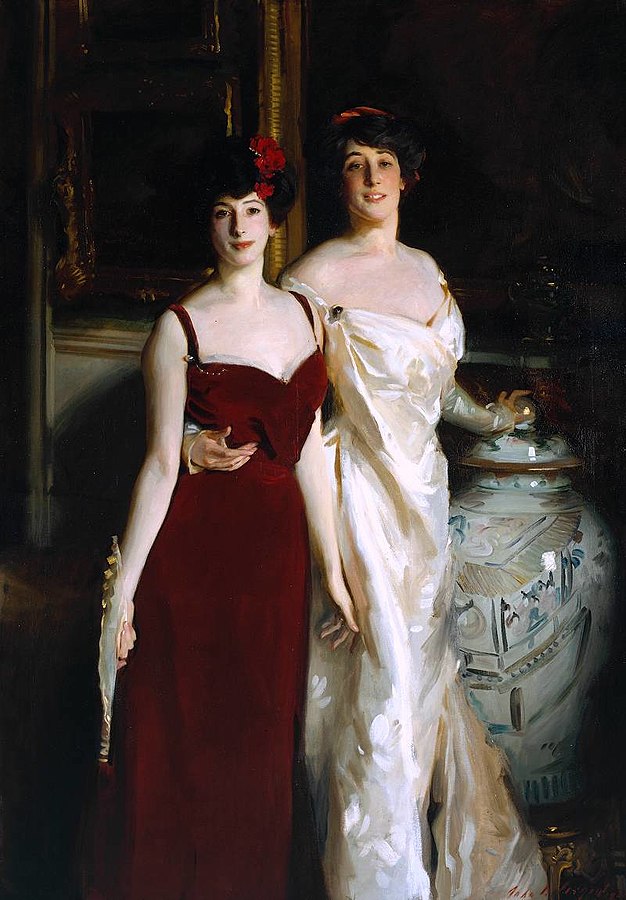
    The above is his 1901 portrait of Ena and Betty, Daughters of Asher and Mrs Wertheimer which hangs in the Tate Gallery in London, close to Westminster Abbey and the Houses of Parliament.

    Sargent befriended the family and  Asher Wertheimer, an art dealer, helped Sargent obtain commissions.

    I visited the Tate yesterday on a glorious sunny summer morning and as in my wont I wandered the gallery stopping at whim, at random when some painting or other grabbed my attention.

    I am a Johnny-Come-Lately to the visceral attractions of visual art, although my first visit to the gallery was in 1970, when I was at school round the corner in the precincts of Westminster Abbey.  I am ashamed to say I have been all too rare a visitor in the intervening period.  My wife is rather scornful of my late attraction to culture since she, unlike me, studied the history of western art at school.  Well as far as I am concerned, better late than never.

    My attitude to culture is that it is to be enjoyed and, if possible “understood”.  As with literature I don’t really need to know a great deal about the painter to appreciate what he is trying to tell me (or, perhaps more probably, his patron).  A few details of the artist’s life and his place in the society of his time can greatly enrich my experience but are not strictly necessary for me to enjoy and understand his work.

    In any event, I did learn a little about John Singer Sargent, an American expatriate in Europe, and in London in particular.

    The more personal details are that he appears to have been an avid and busy lover and while nobody seems to know for sure, some believe his lesser known erotic portraits of the male form suggest his taste may have veered in that direction.

    It is said by some that Sargent may even have used a male figure as an initial model for his stunning and controversial 1884 portrait of Mme Gautreau, American wife of a French banker in Paris.

    Whatever his personal life may have been he was a favourite of the important and wealthy in the late Victorian and Edwardian days: his clients included Roosevelt, Rockefeller, and Lady Randolph Churchill amongst other luminaries of his time.

    Anway while such details are of interest to me, my pleasure in art is of quite another sort. Sargent’s glorious portraits do something for me. Mme Gautreau was a beautiful woman and the Wertheimer daughters, while not so beautiful, were nonetheless wonderfully portrayed.  The female form, beautifully attired, is indeed a work of art, however it is portrayed and in whatever medium.

    The sheer voluptuous elegance of his woman, the richness of their costly gowns, the translucent skin. And the evocation of those now far off days. The “certainty” of that period; the days of Empire of world domination that brought such security and power to what in those days was rightly described as Great Britain.  The luxury liners of Cunard and White Star, the glamorous first class dining rooms on those magnificent transatlantic behemoths. The J Class yachts, the robber barons, the wicked and louche Edward VII.

    It is living history. I do not admire the concept of empire as my long suffering readers will certainly have gathered nor do I condone the arrogance it entailed. But I do envy the certainty of the time, which tragically was too end all too soon in the apocalypse of World War One.

    Sargent’s portraits bring alive a distant and in some ways attractive and enviable age for me. I revel in his technique, the beauty of his women and the grandeur of their surroundings.

    Sargent moves me.

  • Van Eyck – The Arnolfini Portrait

    Van Eyck – The Arnolfini Portrait

    Jan van Eyck painted what has become known as the Arnolfini Portrait in 1434.  The facts are well enough known.  As are the scholarly debates and interpretations surrounding this beautiful piece of art.

    I went to the National Gallery in Trafalgar Square today to try to understand why I like the painting so much.  I think I caught some glimpses.

    I was wondering on my way there whether my liking was more apparent than real; whether perhaps because the painting is so very well known I had simply assumed I liked it because it appears everyone else does.

    I first saw it face to face a few years back in another visit to the National Gallery and out of all the paintings I saw that day this one stuck firmly in my mind as a favourite.  Why?

    The sheer luminosity of the colours struck me particularly today, part of the artist’s technique I gather. The colours literally shone out at me 600 years after the painting’s creation.

    And then the richness and beauty and realism of the scene.  I could have been one of the figures reflected in the mirror above the Arnolfinis, so perfectly does this couple come alive.

    By richness I have in mind quality and beauty rather than monetary worth. While it is clear that the couple were well healed, I find money itself (particularly the love of it) a grotesque and vulgar distraction.

    Excess reminds me of the smiling face of beloved entreprenoooooors like the delightful Philip Green, whose pensioners fared so well in the collapse of British Home stores.  Or those cuddly Russian oligarchs and oil sheiks.  Gold Rolls Royces, zebra skin wall coverings, women with brittle hair, whitened teeth and embarrassing false breasts.

    Which is not to say that I can not get a warm glow from time to time out of what money can buy.

    The fur on the lined cloak is literally strokable when you stand in front of the portrait – even with my nose close to the painting it seemed more animal fur than oil (however politically incorrect that may now sound).  And the wife’s gown – difficult indeed to appreciate the texture on this web page re-production but to the naked eye, standing in that noble gallery, this feat of art is a wonder to behold. Every fold and crevice is so real and vibrant you can lean in and touch it. Figuratively speaking of course – I am sure I would have ended up in the local nick had I leant in much further.

    Just look at that brass chandelier. What a magnificent ornament.

    And yet there is more. To me the couple themselves are far from glamorous – they certainly do not seem to have been airbrushed in the time honoured fashion of today’s actresses and pop divas.  Mr Anolfini may be a rich merchant but he is certainly not a handsome one – it struck me today that he is more like Gollum from Lord of The Rings than I am comfortable with.  I had to take a step back at that point, half expecting him to put on the One Ring To Rule Them all.

    And the pregnant wife is no oil painting.  Well she is of course…but you know what I mean. Not a classic beauty by the standards of any age. The hubby’s headgear is not a shtreimel, surely?

    But cheap jokes aside, my love of the painting stands. Increased if anything by a greater familiarity with the detail after today’s close inspection.

    From the strange wooden  pixie-clogs to the apples, cherry blossom and beautifully lit furnishings, this painting transports me in time to a room in medieval Bruges  600 years ago.  A beautiful and exquisitely constructed time machine.

  • The Beauty of Performance

    The Beauty of Performance

    Beauty comes in so many forms and is so utterly transformative wherever it is encountered.   Most recently I have been struck by the serene beauty of the skillful elegance and nonchalant, seemingly effortless performance of a music scholar who plays the piano for a choir in which I sing.

    The pianist studied at King’s College, Cambridge, where he was organ scholar and graduated with a starred first class degree in Music. Previously he was a chorister at King’s and music scholar at Eton College.

    I sang in a choir as a young treble for some years but foolishly never studied music formally.  I gave up aged 14 when music seemed to an arrogant young kid to belong to a pseudo intellectual realm to which he did not belong .

    For the past eight years I have been trying to re-capture what skills I may once have possessed but in my case nothing has ever been effortless.

    I have spent endless hours in practice and study, learning a choral piece inside out until it is indelibly etched on my mind and performance becomes if not automatic, then at least to some extent fluid.

    Each week I am struck anew by the performance of our accompanist.  Sometimes when I arrive he will be playing some complex piece entirely from his imagination. His hands will move but his eyes remain fixed somewhere in the middle distance, pondering who knows what as his fingers automatically translate into sound whatever glorious harmonies are in his mind.

    In choral pieces there are usually introductions for the orchestra or piano before the voice parts start and usually the accompanying instrumental music will continue for a while when the voice parts have finished.

    And it is at the end that I most often notice the ethereal skill of our accompanist.  We have struggled, to the best of our ability, through the complex vocal bars of a section of Dvorak’s Stabat Mater.

    Our eyes turn to the young scholar who plays the remaining bars. With a twinkle on his face and scarcely looking at the score, he dazzles us with his skill.  With a gentle flourish the piece ends as he quietly plays the final chord and the sound slowly ebbs away.

  • A Secular Epiphany

    A Secular Epiphany

    A Beautiful Question

    Epiphany is usually thought of as the appearance or utterance of a deity to an earthbound mortal but it can equally be a secular phenomena, where one is suddenly struck by some extreme beauty, truth or revelation.

    The beautiful illumination above from Liber Scivias shows Hildegard of Bingen receiving a vision, dictating to her scribe and sketching on a wax tablet.  A classic religious revelation or epiphany.

    We modern Brits in 21st Century London don’t tend to get many religious epiphanies these days but secular epiphanies can inspire equal awe. The illustration below shows Archimede’s Eureka moment: a secular epiphany.  My morning was graced by such a moment; I know how he felt.

    Let me explain. I am engaged in research into the nature of consciousness and have been particularly taken by the approach of the Qualia Research Institute.

    Their hypothesis is that qualia (subjective, conscious experiences such as pleasure or anxiety) can be formalised.  That such experiences can be categorised, precisely described, mapped and explained. In particular they are looking at the pain/pleasure valence and believe that pleasure is caused by harmony or symmetry in the state of the brain. Pain is caused by the opposite: dissonance.  They intend to quantify qualia and believe qualia have mathematical isomorphisms.  It’s all part of our homeostatic control mechanism.

    They recommend Franc Wilczek’s book A Beautiful Question :

    A Nobel laureate and friend of Tegmark, Wilczek asks the question, “Does the world embody beautiful ideas?” and proceeds to explore how looking for beauty & symmetry in the laws of nature has been an extraordinarily successful strategy for physicists. Core takeaway: the Symmetry Theory of Valence is a reasonable extrapolation from the past trajectory of physics.

    I dutifully bought the book and was stunned by the lucidity of a chapter headed “Pythagoras II: Number and Harmony”.

    I have been engaged in classical choral music since childhood and have tried in vain to gain an academic intuition of harmony as well as an understanding of WHY music gives me such intense pleasure.

    Suddenly this morning all appeared to be revealed. It was a Eureka moment.

    The book explains the physical processes involved in the production, transmission and reception of harmonic sound and then ventures an explanation as to why such notes sound so good together.

    The brain receives a repetitive pattern which is predictable and easy to interpret: accurate prediction is essential for human survival.  Success in prediction of the repeating vibrations of the harmony has to be rewarded by the higher functions of the brain as pleasure so that the lower operative brain functions know they have got the task right.

    Discordance and dissonance is not repetitive and predictive and is thus discouraged with a feedback of pain or displeasure.  Its an evolutionary argument: the familiar selfish genes.

    And thus argues the Qualia Research Institute: pain is dissonance and disharmony in brain patterns; pleasure is harmony and symmetry in the brain.

    It’s a theory.  But the intuitive “rightness” struck a sweet chord in my mammalian brain. I was being rewarded for getting something right perhaps.

    So, a secular epiphany. An enjoyable and profound revelation, or thus it seemed.


  • The Book of Common Prayer

    The Book of Common Prayer

    The Book of Common Prayer is a much loved work of literature. Its language and phrases have permeated the English language for centuries.  It is nothing less than sublime.

    Originally published in 1549 in a version edited by Archbishop Thomas Cranmer, it was subsequently revised until the version of 1662 became the official version of the Church of England. It contains Miles Coverdale’s glorious translation of the Book of Psalms from the Great Bible of 1538.  Its intended use was to define and regulate daily worship in the Church of England and it is written in English, so as to be accessible to everyone and not just the clerics learned in Latin.

    It is now used by a small minority and has largely been replaced by alternative forms of prayer using simpler and more modern language.

    You do not have to be a Muslim to enjoy the beauty of Rumi‘s poetry or a Jew to enjoy Ecclesiastes. You do not have to be a Buddhist to bathe in the beauty of Zen or the Tibetan Book of the Dead.  You do not have to be a Christian to immerse yourself in the timeless reflections of the Book of Common Prayer.

    Sit in the choir stalls at Canterbury Cathedral and listen to evensong.  Wander through the English countryside and sit quietly in a Norman Church – open up to the beauty of mattins or evensong, read quietly to yourself, perhaps while listening to Byrd, de La Rue or Vittoria.

    It need not be about belief.  It is about reflection, quiet, meditation.  It is a re-affirmation of your weltanschauung.  It is to retreat (if only for a few moments) from the world of commerce and busyness and to contemplate for a while the vastness of the universe and its mysteries.  It is time well spent.