Category: Windows to the Numinous

  • William West, 1st Lord Delawarr

    William West, 1st Lord Delawarr

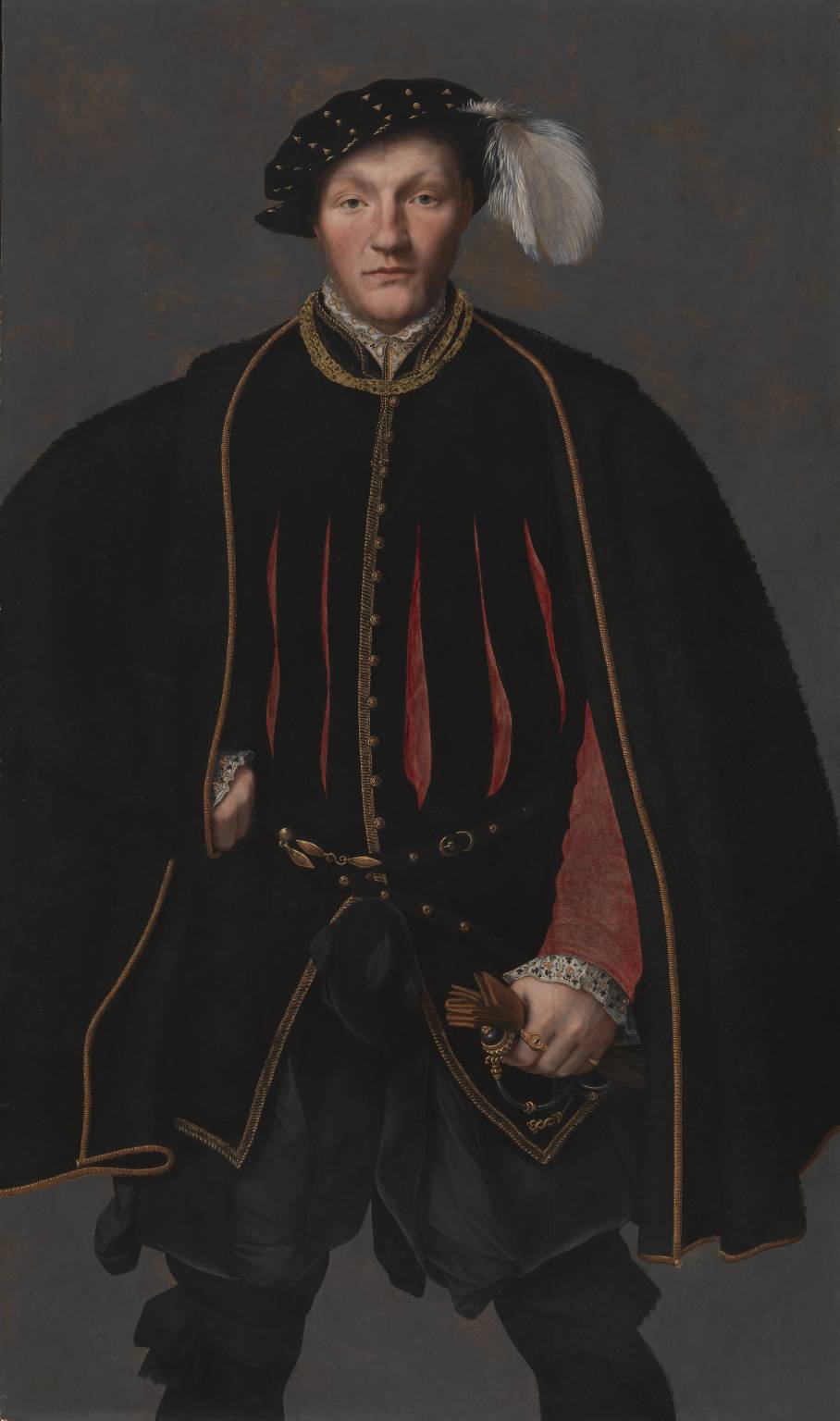
    The somewhat brutal face and the arrogant pose of William West, 1st Lord Delawarr, reassures us that human nature has not changed much over the centuries.

    This portrait hangs in the 1540 Gallery at Tate Britain on Millbank, London, near the Palace of Westminster. The aggressive pose is similar to that used by Hans Holbein in his portraits of the English tyrant Henry VIII and at one time this portrait was attributed to Holbein. These days, it is confessed that the artist is unknown and that the portrait was painted sometime later in the 16th Century.

    The sitter has not actually been confirmed. But it is amusing to think that it may indeed have been the thoroughly unpleasant William West, since this portrait indicates that the sitter was perhaps not an altogether pleasant character. Born c.1519, William West was  the nephew of the 9th Lord De La Warre, whom he tried to poison in order to gain his title and estates.

    Despite much exquisite beauty in the Tudor period, these were turbulent and brutal times.  Alongside the sublime music of Taverner, William Byrd and John Downland the period revelled in barbaric practices such as hanging, drawing and quartering.  The magnificence and lavishness of the architecture (Christ Church Oxford for instance) sits ill beside the abject poverty and misery of the masses.

    These days I try to be pretty methodical when I “do” art. I like to spend an hour or so in a single gallery and look at every painting in detail, read a little about each and then hone in for some more detailed research on those that particularly appeal to me. Any more than and my mind wanders.  The Tate Gallery’s website is a fabulous resource and thanks to my smartphone I can do a little research while I am in situ.  The technical details of the work involved in the attempt to date and verify artist and sitter are fascinating and well worth the effort to absorb.

    But primarily, as ever, what interests me is the psychology, the “meaning”, the “why”.  What does this painting tell me about human nature, about myself perhaps? Why do we humans behave as we do and what drives us?

    Much of the world today is no better than it was in Tudor England. Vicious savages entirely the equal of Henry VIII (or worse) rule much of the third world. Brutal dictators in Africa and other man made hellholes, rip off their people and squirrel away their winnings in Swiss Bank accounts. Rivals are murdered and whole populations “ethnically cleansed”.

    The Trumps of this world and the Corbyns are not altogether pleasant either..

    Animals are brutal. We are animals. William West was an animal.  Perhaps it is the fault of evolution. Perhaps we can not help ourselves but we have a duty to try.

     

  • What is the Purpose of Poetry?

    What is the Purpose of Poetry?

    Does poetry have a purpose? If so, then what?

    I noticed today that by far the majority of WordPresss bloggers who have been kind enough to like or follow my blog are poets. It set me thinking.

    Why on earth would a poet want to read anything I write? Then I realized that perhaps my goal and that of a poet are in fact the same. And that therefore there may not be so much difference between my prose and their poetry.

    My URL is “zenothestoic”. The title of my Blog is ” Weltanschauung ” – a Search for the Soul. According to Wikipedia:

    Weltanschauung is a concept fundamental to German philosophy and epistemology and refers to a wide world perception. Additionally, it refers to the framework of ideas and beliefs forming a global description through which an individual, group or culture watches and interprets the world and interacts with it.

    In a sense I have been writing “poetry” or at least writing prose but in a style which resembles somewhat the style of poetry.

    So if I have been writing poetry, to what end?

    Well I think the title of my Blog probably gives my game away. The purpose of my poetry (or prose, if you insist) is to help me understand the world and my place in it. Exactly the same purpose underlies my flirtatious dalliance with religion, art and music.

    And I suspect in essence poets (real poets) write poems for much the same reason. Including those who wrote the beautiful Book of Psalms.

    There is poetry even in science. When I read Richard Dawkin’s “Unweaving the Rainbow” I saw his sense of wonder and compared it, strangely, with that of a mystic or a poet.

    Because Dawkins believes he deals with science. And he does. But from science he gets much the same sense of wonder, much the same sense of pantheistic mystery as I might get from reading the Psalms aloud in a windswept and empty Norman church in the middle of the Shires.

    Science is wonder. Yes, science seeks rather more practical applications for its answers but it nonetheless receives a sense of awe from its subject matter – the universe, its origins and its “purpose”. Or its workings, in any event.

    So in a sense I see the same “use” and “purpose” in many different fields.

    In my case, poetry helps me to see and experience wonder. Even a war poem can help me to understand life, to broaden my horizons while confirming my view that life should not be about war. Or indeed hatred or any of our destructive emotions.

    My old Sweet etcetera is a case in point. What an absurdity, that war; any war. And foolish relatives at home taking pride in their son’s death and misery in the trenches.

    So for me the purpose of poetry is both to free and to focus my mind, if that makes any sense to you. A poem can make my mind soar like a mystic to dance in the sheer beauty of creation. But at the same time it can reaffirm the absurdity of most of what we humans wrongly consider important.

    Without poetry, art and music we would be dead souls, condemned to wander in the dark.

  • Crossing the Bar – Alfred Lord Tennyson

    Crossing the Bar – Alfred Lord Tennyson

    Sunset and evening star,
          And one clear call for me!
    And may there be no moaning of the bar,
          When I put out to sea,

       But such a tide as moving seems asleep,
          Too full for sound and foam,
    When that which drew from out the boundless deep
          Turns again home.

       Twilight and evening bell,
          And after that the dark!
    And may there be no sadness of farewell,
          When I embark;

       For tho’ from out our bourne of Time and Place
          The flood may bear me far,
    I hope to see my Pilot face to face
          When I have crost the bar.

    This is one of those rare poems which do not require great depth of thought or analysis to enjoy. No looking up of dull professors and their equally boring commentary. It is a piece of gentle beauty even you and I can understand.

    It is of course about the poet’s death. He wants calm at his death. He wants to cross the Styx, the Bar not in a storm, not with waves pounding on the metaphorical sandbar which separates life and death, but with quiet and peace.

    A deep, slow moving river is quiet and so with a deep, calm sea. “The boundless deep” should be a quiet place when we cross it, not full of “sound and foam”.

    Sunset, twilight and after that the dark. And yet Tennyson clearly expects to meet his Pilot, his god – he does not seem to be expecting darkness at all but some sort of afterlife. Hence there should be no sadness of farewell at his end.

    He was, it is said, a deeply depressed man, our Alfred. Full of melancholy and anxiety. Perhaps he hoped for better in death. It is a cause for wonder that a man possessed of such melancholy managed to create such beauty, such music in words.

    He was also it is said, deeply unconvinced by conventional religion. “There lives more faith in honest doubt, believe me, than in half the creeds.”

    A modern man, a man of science who does not seem to have been taken in by an anthropomorphic god. He wanted explanations of his world, he wanted the physicists and the chemists to tell him what it was all about. He didn’t want to take it on “faith”.

    His idea of the divine was pantheistic, modern. A follower not of Moses but Spinoza. His god most certainly existed but was abstract and impersonal. Not the sort of fellow who chucked a few stone tablets at you down Mount Sinai.

    God and Nature as two names for the same reality : that is certainly a god I can happily live with. Indeed if that is my Pilot, I would happily meet him.

    I first came across this poem when singing a setting by Parry, our home grown Edwardian genius. I can’t remember where we sang it – it may have been at a charity concert in Corpus Christe college Oxford.

    Whatever. I was, and remain, deeply affected both by the poem and the music.

  • Gerard Manley Hopkins – Heaven Haven

    Gerard Manley Hopkins – Heaven Haven

    I HAVE desired to go
    Where springs not fail,
    To fields where flies no sharp and sided hail
    And a few lilies blow.

    And I have asked to be
    Where no storms come,
    Where the green swell is in the havens dumb,
    And out of the swing of the sea.

    I wonder how many of us feel like this? I am not alone, surely?

    The sub-title is “A Nun Takes the Veil” and although, even in these gender neutral days, I would be hard pushed to do that, I have often envied the quiet of a monastic garden. Peace and plenty, a place where the water does not dry up. Stillness and calm, safety from the storms of the sea. Beauty: a field where a few lilies bloom.

    Yes, I would like all of that. A place with no hailstorms. A haven where the terrifying green swell of a rough sea holds no sway.

    One would guess that is what the poet yearned for as well, diagnosed as he has been, albeit posthumously and speculatively, with bi-polar disorder. Tragically, he never achieved heaven on earth, but then perhaps as a Jesuit priest, he did not expect to. Christians have ever been “jam tomorrow” people who, apparently, find contentment (or at least fulfillment?) in being as miserable as hell on earth since they are so certain that better is to come after their deaths.

    How damaging are such views, not so far removed from those of the Jihadist. How much more satisfying to make a heaven on earth and to achieve happiness in the here and now, rather than gamble on an uncertain and improbable future.

    I have reached a deeply satisfactory understanding, very recently, of the part that poetry can play in soothing the mind. It seems to have its part to play in making a better place of the here and now. It leads me on a dream, a pleasant and beautiful mind wander. Reading Heaven-Haven fills me with warmth; it puts me in such a place as Hopkins describes, where water does not fail and where lilies bloom.

    We live only partly in “reality” if at all. In a very real sense “reality” is what we make it. Think comforting and beautiful thoughts and in some sense those thoughts become your reality. Perhaps I am thinking of the extraordinary Dietrich Bonhoeffer who argued that Christians should act in the world rather than retreat from it, and who maintained calm and equanimity throughout his terrible treatment and eventual death at the hands of the Nazis.

    I strongly disagree with the necessity of sharing “in the sufferings of God at the hands of a godless world” but Bonhoeffer’s stoicism was remarkable.

    I am, alas, an escapist. I seek Heaven-Haven in the here and now and a poem like this somehow points the way, in a tantalizing and not quite properly defined fashion. In some sense I am deeply affected and moved by religious thought.

    And yet I do not believe we have to surrender ourselves to an unproven deity. I do not believe we have to resign ourselves to hell on earth,

    I do believe that this life, this here, this now could become what man has sought over the eons. I do believe, very strongly, that we can pull ourselves up by our own bootstraps. It will take a combination of philosophy and science. It is in our hands to solve pain and hunger and to replace it with joy and plenty, not for the few but for the many.

    Gerard Manly Hopkins soothes my often troubled mind. I want that field where lilies bloom and somehow, reading this poem, I can almost touch it.

    Image: Tate Gallery

    Music:Heaven Haven by Alexander Campkin, sung by the Fulham Camerata,

  • The Little Drummer Girl

    I read the book with much enjoyment many years ago, but this lavish BBC adaptation of  John Le Carré’s 1983 novel raises the bar to very high levels indeed.

    First the more banal but nonetheless important points of attraction. So far, this mini series is visually stunning, set on location in Athens, Germany, the Greek Islands and who knows where else; it is a joy to watch from that perspective alone. The lead actress is an attractive young thing and her character is played as a slightly cocky one.  So far I have enjoyed the acting as a whole, from the creepy and sinister Israeli spymaster Martin Kurtz, to the enigmatic sidekick Becker, who clearly has a very soft spot for the Little Drummer Girl which he must hold in check.

    But it is very, very dark, even more so than I remember. I don’t think I have ever read a book by Le Carré which has not left me feeling shaken and disturbed.

    This screenplay is such that I spent a very unsettled night after watching the first couple of episodes. Who are the good guys anyway? Who indeed are the bad guys? We are none too sure whether such black and white terms are suited to this novel or indeed its subject matter.

    From the first few episodes, the takeaway seem to be that the Middle East mess is the fault of the Brits who, in 1948, carved the modern state of Israel out of the Palestinian desert. So whose land was it anyway? Why should the Palestinians suddenly find themselves living in an Israeli state? Why shouldn’t the Jews, after the horrors of the Nazi gas chambers, get their own land? Who is maiming, killing and torturing who? And why?

    I don’t know. I don’t know the answers to any of these questions; the situation is as opaque as that of the Irish question, another British muck up. I wish they could all live in peace but they can’t. And we can’t seem to find any compromises or solutions.

    What is most noticeable about this drama is that we are never really sure where our loyalties lie. With the Israelis, persecuted for centuries by all and sundry? Some of the Israelis in this plot seem “nice guys” who seem to have the reasonable aim of preventing Jews getting blown up by terrorists.  Some of them seem total shits.

    And then the terrorists are portrayed. And, guess what? They are human too! Or are they freedom fighters? Because let’s face it Ben Gurion, Israel’s first Prime Minister, was once a terrorist too.

    Supposedly its all about spies but it’s far, far more than a spy novel. It’s about duplicity, split loyalties, the inability to separate “good” from “bad”.  Uncertainty, cruelty, absurdity and pointlessness.

    It’s a hunt for Palestinian terrorist Khalil.  The Little Drummer Girl, an English actress not wholly opposed to the Palestinian cause, is recruited by the dreadful Kurtz to infiltrate the network. There is murder and mayhem, committed by both sides and poor Little Drummer Girl suffers horribly somewhere in the middle.

    There is no right or wrong. Just shades of bestial behavior, murder and deception.  You will enjoy it, sure. But you won’t be left feeling very comfortable.

    Damned if I know how to sort the world out. Damned if Le Carré does either. If you can’t watch the film because it’s not out on Netflix or Amazon buy the book. But don’t expect to feel good.

  • My Old Sweet Etcetera – A Reading

    My Old Sweet Etcetera – A Reading

    For Eleanor

    This anti war poem, written by American poet EE Cummings and published in 1926, is such a perfect specimen of the genre.

    The speaker lies, perhaps dying, in the horrific, mud filled trenches of Northern France. The rest of his family plays the jingoistic game so favored at the time by those who went nowhere near those killing fields.

    His mother wishes him a death of glory, his father claims he would willingly have sacrificed himself on that futile, cruel cross.

    Barking mad old Aunt Lucy believes she knows just what her nephew is fighting for.

    And the sacrificed boy, one of the millions, lies in the filth dreaming of his girlfriend and her etcetera.

    I have sworn recently not to get angry anymore but reading such verse makes it a hard task to forswear criticism.

    General Melchetts all, and worse still the politicians, emperors and business people who let such futility occur in the name of patriotism, commerce and empire.  But enough. There is beauty and sadness here in equal measure. Enjoy the poem for what it is and pray for peace.

  • La Belle Dame Sans Merci – John Keats – a Reading

    La Belle Dame Sans Merci – John Keats – a Reading

    She sits wrapped in furs on an ancient Celtic floor, chanting her soft ballads and staring at smoke from a peat fire curling softly up and round and out of the roof. She has lived many lives and known many names; no doubt she will live many more. She is the Lady of the Green Kirtle, Queen of the Deep Realm, she is Lamia. She lures men to their death.

    The wind howls outside, along the sea loch and the birds cry their mournful song. She is wronged, mis-portrayed, misunderstood by generations. No Siren she but mere mortal, demonized by hapless storytellers who know no better.

    She is Eve, cast out of the Garden of Eden, she is the cause of all our suffering. No noble savages, we seek to blame womankind, when blind evolution alone has done us wrong.

    Our Circe, our witches, our magical world view are as present now as ever they were. They lull and caress us, inspire and guide us, if not literally then in the imagination of our hearts. To be human is to imagine. To imagine defines us, renews us.

    The poem tells a beautiful and ancient story, and what is our life but a story? Perhaps we live but a story after all.

    It is cold and dark and winter:

    “The sedge has withered from the lake, And no birds sing.”

    The knight is “haggard and so woe-begone.”

    The Belle Dame is

    “a faery’s child, Her hair was long, her foot was light,And her eyes were wild”.

    But her love, it seems, was nothing but

    ” A faery’s song”,sung “to pale kings and princes too, Pale warriors, death-pale were they all”.

    And in the end the Belle Dame was just a dream, like life itself.

    “And I awoke and found me here,

    On the cold hill’s side”

    Wrapped in the beauty of myth ancient and modern we create our own truth, we bring meaning to a universe some say is dark and cold and without purpose. Sometimes sad and sometimes not, our stories and our poems, our Green Ladies and our Belles Dames are reflections of our desires and anxieties.

    We are the stories we tell about ourselves. We are our myth in all its richness and beauty. In the world of our imagination there need be no ugliness, and without our imagination we would have no fire, no wheat to harvest, no wheel.

    Heaven and Hell are creatures of our own making. We have imagined them and it is in our power to create in our own lives a “heaven” or a “hell”. May more of us choose the former over the latter and “nirvana” can be here and now.

  • A reading: Sonnet 18, Shakespeare

    A reading: Sonnet 18, Shakespeare

    I have already written a few words on this, most famous of Shakespeare’s Sonnets and have just placed my own reading on Youtube. If you were to ask me why I bother, I would have to reply, simply, that it gives me great pleasure. While none may care to hear me, I have nevertheless read, and that, for me, is the only excuse I need.

    And yes, I chose to illustrate my reading with a beautiful woman, even though I know the poet wrote to a young man.

  • Shakespeare: Sonnet 18

    Shakespeare: Sonnet 18

    The first big error in my analysis is to head this post with a picture of a beautiful woman.

    As per Wikipedia:

    Gather Ye Rosebuds While Ye May is an oil painting on canvas created in 1909 by British Pre-Raphaelite artist, John William Waterhouse. It was the second of two paintings inspired by the 17th century poem “To the Virgins, to Make Much of Time” by Robert Herrick

    Yep, every-man’s favorite bard was referring to a boy, a youth.  Well I prefer to think of a woman when I read this poem, and it’s my blog anyway so I shall do as I please. And I love the corny and over-blown Pre-Raphaelites.

    I’m not at all sure that the poem will stand too much analysis – it is simple enough. It has 14 lines of iambic pentameter, three quatrains followed by a couplet. It has the following rhyme scheme: abab cdcd efef gg.

    The poem’s subject matter changes in the third quatrain: from a comparison of the youth and nature’s beauty, to the question of eternity, that favorite subject of poets (and indeed of many of us).

    And in the concluding couplet, the punchline: this poem grants the youth eternity. So long as there exist readers, the youth will live in verse.

    Probably the best known of William Shakespeare’s sonnets, it should, in my view, be taken simply at face value. For enjoyment. The thought itself is rather beautiful – that a youth (a part of nature) should be compared to the beauty of another part. We can see the summer’s day, all of us. And the buds of may. And the sun. All beautiful aspects of life on this planet which we have witnessed and enjoyed for ourselves.  And yet the youth’s beauty (in the eye of the poet at least) is apparently of a greater excellence yet.

    Poetic licence of course, mere advertiser’s puff but charming, engaging nonetheless.  Oddly enough for me the beauty only fully emerges in the reading, the physical recitation of these words.

    The rhythm lulls, it adds beauty and, it seems, meaning to the words. The combination is sensuous, it seems to soothe, to stroke.

    Research into the nature of consciousness suggests that the pleasure pain axis is a matter of rhythm and harmony (or the lack thereof), at heart a matter of mathematics which can be described by vibration. I seem to feel intuitively what the researchers mean when I read well constructed poetry.

  • YouTube Trailer

    YouTube Trailer

    Encouraged and enthralled by Kim Kardashian West (not sure where the West comes from) I was wondering whether to record a welcome video for my YouTube Channel.  Or is it called a “trailer”? Or does it matter? How very confusing.

    Young Kim has 1.33 million subscribers and her YouTube channel  seems to be about beauty, make up, white Rolls Royces, proud breasts, enormous bottoms and spending money on consumer goods.

    I currently have 9 subscribers, no white Rolls Royce, a distaste for reality TV and a strong dislike of consumer spending.  And my wife looks nothing like Kim, oddly enough.

    I think Kim must be some sort of American version of our own sweet Essex Girl, but bigger, sexier, more glamorous.

    Oh dear, rambling again.

    So why does a curmudgeonly old misanthrope bother with YouTube and the internet? I can only say that reading a poem out loud and recording it seems to have had an effect on me.

    You have to understand the poem to read it out loud. It makes you concentrate, it makes you appreciate exactly what the poet is trying to tell you.  And provided his message is something you want to hear, the experience is a wonderful one. Whether the listener would say the same is quite a different story.

    This blog is unashamed catharsis. I read and write and ramble and it all means something to me. Well, quite a lot actually. I think the same will be true of YouTube.

    I will not be recording Sylvia Plath. I will not be reading Virginia Wolf. I must stop banging on about the negative and concentrate instead on the wonders of life and universe, for there are many.

    I am sorry for our Sylvia and all like her but I think I must focus on less needy folk, less dire poems. Joy and wonder not misery and introspection.

    And I must give up on politics – I’m no social reformer, simply because I have no idea what we as a society should do. I haven’t a clue what could replace the capitalist model, no idea how to help the world’s poor, and even less intuition as to how the venal of this world might be persuaded to be less so.

    So my Channel – what are my intentions for it? My plans?

    Well, poetry, yes. My favorite bards, some of whom I have not revisited since university. John Donne and the metaphysical poets in particular. Some of Shakespeare’s sonnets.  The War Poets.

    And perhaps a book or two, or at least a reading here and there from some of my favorite texts. A Christmas Carol, Tolkien, CS Lewis. Copyright permitting.

    And exploration of the new, the unfamiliar.  To push my limits outwards, to expand my boundaries.

    And who am I doing all this for? Do I write to be read, do I speak to be heard?  Well, if you so choose, listen to me by all means. But perhaps this journey is primarily my own.

    Perhaps, like a tree in the forest, I may not exist unless I witness myself through word and thought, if not deed. Perhaps my outpourings are themselves a witness to my existence.

    I write, I speak, therefore I am.