Category: Windows to the Numinous

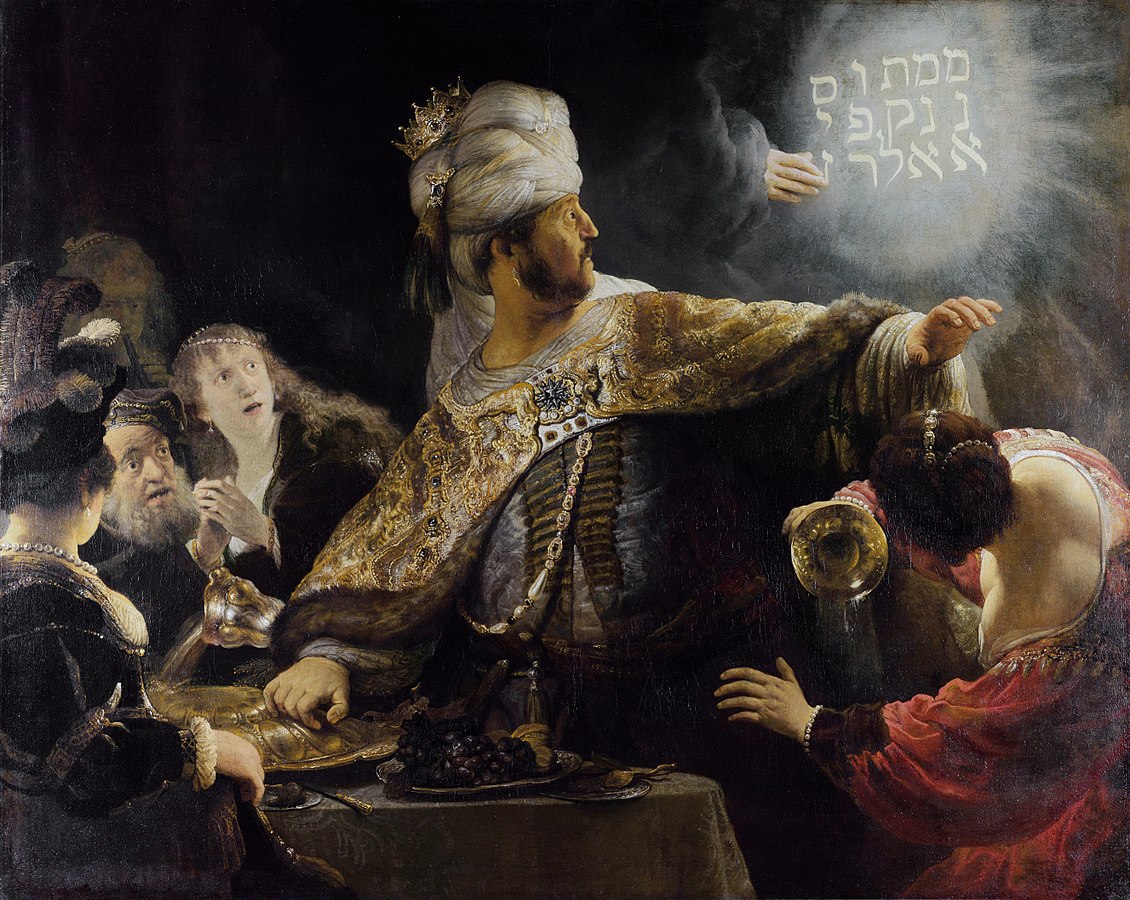
  • Rembrandt – Belshazzar’s feast

    Rembrandt – Belshazzar’s feast

    In an age of atheism and apathy, the literature, art and music of religion still holds vast sway over the imagination of us all.

    I defy you to find me, even in this dumbed down age, a single individual with even the most basic of cultural awareness who will not have heard the phrase:

    “In the same hour came forth fingers of a man’s hand, and wrote over against the candlestick upon the plaister of the wall of the king’s palace: and the king saw the part of the hand that wrote.”

    And here it is, writ large by none other than Rembrandt:

    How extraordinary that our very consciousness is so intricately threaded and woven through by these magnificent old fairy tales and the wonderful English of the King James version of the Bible.

    The writing is on the wall: you have been warned. Your behaviour in unacceptable, expect to pay for it. Things are about to change, and for the worse.

    Belshazzar’s dad Nebuchadnezzar had been naughty enough and now this deluded Chaldean king was up to the same tricks. Don’t mess with the god of the Israelites: he ought to have learnt his lesson.  The silly fellow had to go and blaspheme and quick as a shot his kingdom was handed over by the wrathful Yahweh to the  Medes and the Persians.

    ‘Shazzar had decided on a rave for his mates but made the cardinal error of using crockery ripped off from a raid on the Hebrew temple.

    Daniel (he who will later face the lions’ den) translates for good king ‘Shazzar:

    “God hath numbered thy kingdom, and finished it.  Thou art weighed in the balances, and art found wanting.”


  • Van Eyck – The Arnolfini Portrait

    Van Eyck – The Arnolfini Portrait

    Jan van Eyck painted what has become known as the Arnolfini Portrait in 1434.  The facts are well enough known.  As are the scholarly debates and interpretations surrounding this beautiful piece of art.

    I went to the National Gallery in Trafalgar Square today to try to understand why I like the painting so much.  I think I caught some glimpses.

    I was wondering on my way there whether my liking was more apparent than real; whether perhaps because the painting is so very well known I had simply assumed I liked it because it appears everyone else does.

    I first saw it face to face a few years back in another visit to the National Gallery and out of all the paintings I saw that day this one stuck firmly in my mind as a favourite.  Why?

    The sheer luminosity of the colours struck me particularly today, part of the artist’s technique I gather. The colours literally shone out at me 600 years after the painting’s creation.

    And then the richness and beauty and realism of the scene.  I could have been one of the figures reflected in the mirror above the Arnolfinis, so perfectly does this couple come alive.

    By richness I have in mind quality and beauty rather than monetary worth. While it is clear that the couple were well healed, I find money itself (particularly the love of it) a grotesque and vulgar distraction.

    Excess reminds me of the smiling face of beloved entreprenoooooors like the delightful Philip Green, whose pensioners fared so well in the collapse of British Home stores.  Or those cuddly Russian oligarchs and oil sheiks.  Gold Rolls Royces, zebra skin wall coverings, women with brittle hair, whitened teeth and embarrassing false breasts.

    Which is not to say that I can not get a warm glow from time to time out of what money can buy.

    The fur on the lined cloak is literally strokable when you stand in front of the portrait – even with my nose close to the painting it seemed more animal fur than oil (however politically incorrect that may now sound).  And the wife’s gown – difficult indeed to appreciate the texture on this web page re-production but to the naked eye, standing in that noble gallery, this feat of art is a wonder to behold. Every fold and crevice is so real and vibrant you can lean in and touch it. Figuratively speaking of course – I am sure I would have ended up in the local nick had I leant in much further.

    Just look at that brass chandelier. What a magnificent ornament.

    And yet there is more. To me the couple themselves are far from glamorous – they certainly do not seem to have been airbrushed in the time honoured fashion of today’s actresses and pop divas.  Mr Anolfini may be a rich merchant but he is certainly not a handsome one – it struck me today that he is more like Gollum from Lord of The Rings than I am comfortable with.  I had to take a step back at that point, half expecting him to put on the One Ring To Rule Them all.

    And the pregnant wife is no oil painting.  Well she is of course…but you know what I mean. Not a classic beauty by the standards of any age. The hubby’s headgear is not a shtreimel, surely?

    But cheap jokes aside, my love of the painting stands. Increased if anything by a greater familiarity with the detail after today’s close inspection.

    From the strange wooden  pixie-clogs to the apples, cherry blossom and beautifully lit furnishings, this painting transports me in time to a room in medieval Bruges  600 years ago.  A beautiful and exquisitely constructed time machine.
  • The Beauty of Performance

    The Beauty of Performance

    Beauty comes in so many forms and is so utterly transformative wherever it is encountered.   Most recently I have been struck by the serene beauty of the skillful elegance and nonchalant, seemingly effortless performance of a music scholar who plays the piano for a choir in which I sing.

    The pianist studied at King’s College, Cambridge, where he was organ scholar and graduated with a starred first class degree in Music. Previously he was a chorister at King’s and music scholar at Eton College.

    I sang in a choir as a young treble for some years but foolishly never studied music formally.  I gave up aged 14 when music seemed to an arrogant young kid to belong to a pseudo intellectual realm to which he did not belong .

    For the past eight years I have been trying to re-capture what skills I may once have possessed but in my case nothing has ever been effortless.

    I have spent endless hours in practice and study, learning a choral piece inside out until it is indelibly etched on my mind and performance becomes if not automatic, then at least to some extent fluid.

    Each week I am struck anew by the performance of our accompanist.  Sometimes when I arrive he will be playing some complex piece entirely from his imagination. His hands will move but his eyes remain fixed somewhere in the middle distance, pondering who knows what as his fingers automatically translate into sound whatever glorious harmonies are in his mind.

    In choral pieces there are usually introductions for the orchestra or piano before the voice parts start and usually the accompanying instrumental music will continue for a while when the voice parts have finished.

    And it is at the end that I most often notice the ethereal skill of our accompanist.  We have struggled, to the best of our ability, through the complex vocal bars of a section of Dvorak’s Stabat Mater.

    Our eyes turn to the young scholar who plays the remaining bars. With a twinkle on his face and scarcely looking at the score, he dazzles us with his skill.  With a gentle flourish the piece ends as he quietly plays the final chord and the sound slowly ebbs away.

  • Ozymandias, King of Kings

    Ozymandias, King of Kings

    Written by  Percy Bysshe Shelley in the early 19th Century, if there can be said to be polarity in Romanticism, then this poem plumbs the depths, rather than praising in the heights.  And yet there would be no yin without yang, no black without white.  No journey of the soul is complete without contrast.

    Hubris writ large, this work begs to be read by moguls and titans across time.  In a few simple and elegant lines, base ambition and materialism is exposed as futile vanity.  Our universe is governed by entropy and decay.

    And yet, tantalisingly, an eternity of sorts may be attained by “information” – knowledge and ideas transmitted through time. Arguably information needs a physical base, but the words of this poem have survived intact for 200 years and may last for many more as a popular meme in a living culture.

    Ideas and memes are not subject to physical decay; not so “two vast and trunkless legs of stone” which “stand in the desert”.  Not so the empire of  Ozymandias.

    Perhaps Ozymandias (or Rameses II as he was known in a different language) was the pharaoh of the Exodus.  Regardless, nothing much of him or his works has survived in material terms. His was not a 1,000 year reich.

    Does poem this inform our weltanschauung? Does it suggest a better way of life? Or at least one more meaningful.

    A search for meaning and knowledge may leave a more lasting legacy than the construction of an empire. The works of Isaac Newton or Albert Einstein may be of more lasting value than those of a business leader who constructs his empire much as a dung beetle rolls and buries his sustenance.

  • Hans Holbein – The Ambassadors

    Hans Holbein – The Ambassadors

    Painted by Hans Holbein the younger in Henry VIII’s England,  The Ambassadors tells us a great deal more than any mere portrait. It is a doorway into the mysteries of the Renaissance and the war torn religious strife of the Reformation. A rich and engaging portal into the mind of an age emerging into the modern world.

    (more…)