Category: Windows to the Numinous

  • Fading

    Fading

    I had the curious sensation of fading, being absorbed into the background, while walking along a country lane in glorious winter sunshine this afternoon.

    Perhaps letting go does that to you. Perhaps the mental discipline of letting all pass returns you in a very real sense to where you came from.

    It seems that once you have stopped clinging so very fervently to the things which once seemed to attract you, moth-like to the flame, your mind is freed.

    I can not say that the sensation this afternoon was not accompanied by a gentle melancholy, but the feeling was not an unpleasant one.

    To every thing there is a season,
    A time for every purpose under the heaven.

    Letting go does seem to become easier with usage. It strikes me there is a likeness in methodology to renouncing an addiction. It’s all or nothing.

    I admit to having always been binary, but this time it is irreversible and I’m happy with that. It’s like Alcoholics Anonymous really: the addiction you are giving up is the world of emotion. Or rather the world of destructive emotions. And once you have admitted to it, you are in a sense free.

    Happily you do not seem to have to tip out the baby with the bathwater – pleasure remains. Quiet and hidden.

    Wife, son and such remaining family as I have buzz around me and I am contented to feel them nearby. Letting them happily fizz and fuss in a companionable sort of way. Letting them get on with their lives, and they mine.

    There are so many things I should have done today and didn’t. Nor will I, in all probability. It seemed a day rather for contemplation than busyness.

    No global gladiator, I have renounced the power breakfast for replenishing the bird feeder and watching the robin play.  I have left cocktail networking to others and potter through the odd domestic task I was entrusted with, as my busy little wife fidgeted off back to London.  In a rather nice new BMW to which I had treated myself, but which has now been wholly absorbed by my friend. Well, I don’t like driving anyway; she is welcome.

    I am reminded of the Ode to Autumn, this lazy winter’s day:

    Season of mist and mellow fruitfulness,

    Close bosom friend of the maturing sun.

    Lest that sound too valedictory a comparison, I must state otherwise. I am content to sit careless on a granary floor. Or on a half-reap’d furrow sound asleep, Drowsed with the fume of poppies.

    But there is still plenty to be done and having renounced life as you once knew it, it may be easier to take more beneficial pursuit. To see what is around you and who, and to give it and them the attention which they deserve.

    To walk in the winter’s sun while there is still breath in your body and a pair of legs able to carry you. To spread perhaps a little of your own newly discovered “gospel”.  To make the world a place of slightly less fear and slightly greater beauty.

    Why speak of autumn when mid winter is upon us? Because winter is not yet in my bones and while I may, I will feast still upon the ripe rose-hips, the last of the summer’s leaves and the still warm sun.

    Winter is for another day.


  • In, and out of the Silence

    In, and out of the Silence

    Can or should you remain in a state or place of “silence” or must or ought you return to the world?

    My friend John has just written an interesting article on the “Allure of Sanctuary“.  He talks in wonderful terms of a place of safety.

    Sanctuary, John says, may constitute both a safe physical location but equally importantly “it may simply require achieving a peaceful and calm state of mind”.

    At the same time John envisages a return to the world:

    Something important to remember, though, is that we cannot forget, even when we are in that place, that it’s not supposed to be a total disconnect from the WHOLE world, because every moment as a living being takes place in THIS world. It is mainly up to us to figure out how much is too much, and to what degree our disengagement must achieve in order to be useful and productive.

    I replied to this as follows:

    I guess there are worlds and there are worlds. Some are a pleasure to return to: a choir practice the other night at the Norman church I am sitting in at this very moment for instance. Despite the bickering the other night, it is the sort of world I can benefit from and enjoy. Then there is the world of business or politics both of which I find alien and distasteful ~ those are not worlds I wish to re-enter if I can help it. I like people, I like chatting, singing with them, having a quiet lunch. But somehow when money is at stake, or indeed so many other things which people feel strongly about, the whole atmosphere changes. And at that point I have to run back to the silence. I think it is partly an aging thing – a weariness for a world of cut and thrust one has come to find valueless.

    I know where John is coming from. Physically speaking of course we can not disconnect from the world in its entirety. We are physical beings, we are fueled by food and water without which we can not survive.  We break and we wear: we may need penicillin or the mending of a broken bone.

    And yet mentally speaking, metaphorically speaking, there are worlds to which I do not intend to return.

    Another pen, friend Keith, gave me some valuable advice recently.  Again, he was no doubt speaking in allegorical terms for the most part but I suspect there was also a physical and practical element to his advice. His advice was to let go. Simply that. And I have taken it to heart, although I already knew its rightness.

    It may well be that I am in one of those periods of calm, when the entire world seems to make sense to me. When I feel sure at some deep level that ‘All shall be well, and all shall be well, and all manner of thing shall be well.’

    But for whatever reason and whether temporary or otherwise, I have made some very important mental shifts recently. Seismic shifts and long may they endure.

    Have I retired to a place of sanctuary and will I or should I re-enter the world at some stage?

    To those questions I answer “yes” and “no” respectively.

    But I sense that John is right when he talks of being “useful and productive”.   It is just that I do not believe I need to re-enter the “world” to achieve those objectives.  And I do not intend to.

    Over the past few weeks I seem to have discovered a subtly different way of being. It is not that I despise the world or anyone in it. It just that I do not want to be part of “commerce” or “politics”. I do not want to argue with people, I do not want to engage in conflict of any sort.

    The world I am willing to be part of is chatting to the old lady down the road who has just lost her husband. Talking to another elderly lady in the dusk on the outskirts of the village this evening. Just to engage in a detached and pleasant way with those I find around me.

    And I think that in a very real sense John that by writing, you are in the world. You are contributing something  “useful and productive”. I have certainly found your writings to be thus. And I am sure others will have done so too.


  • Unworked Wood

    Unworked Wood

    Let the world go by and you may hope to return to your origins, to the base reality from which you came and to which you will return.

    Let the world go by and you may find yourself at peace.

    I have sometimes imagined life as an oak tree, in some distant forest untouched by man.  Unworked wood.  If a tree has consciousness then it must be of a very peaceful sort, unruffled by the tedious concerns of the human world.

    My pen friend Keith has repeatedly advised me to let go. To let humanity and it’s 10,000 things trundle along without me.

    Somewhere, not so deep down, I have always known that this is necessary. For me at any rate.

    It seems advantageous somehow not to think badly of the world and that I think has been a part of the problem for me. On the one hand I look at the world and feel sadness for what happens and how our species is ruining it and themselves. But that is merely kicking against the pricks. As they say in Acts. And so I feel better in my soul when I simply view man’s busyness from afar and step aside.

    Certainly anger at the world is corrosive and part of letting go must be to drop any anger for the way things are. And any ambition to change that state. Nice as it would be, it is not going to happen. Not now, perhaps not ever and to fret about it is both useless and damaging.

    Let’s face it violence, poverty and disease are facts of life. Perhaps busy and dedicated people more interested in the world, more determined to be an active part of it, may save us from its evils eventually. I hope so. But I can not join their works.

    I think almost from the very earliest stages of my life I was uncomfortable with “the world”.  Not with the physical world and nature, with its soothing fractal beauty, but the world of busyness, business and human concerns.

    As a child I was all about art, drawing, woodwork. And science – which sadly I never followed beyond my early education. Oddly enough acting and singing formed an important part of my prep school years.  Not so odd perhaps if one views these as part of a general love of art and music, poetry and prose.  Actually I never followed any of these things again until much more recently.

    Looking back, I was always seeking something in these activities very far removed from the world I ended up in as an adult.

    I feel no need to let go of beauty. I feel no need to stop singing ethereal music. I feel no need to stop reading poetry, sacred or otherwise. I must take up woodwork again and I am passionate about my garden.

    The key to not letting even such beauty distract you and bog you down is to develop an unattached appreciation of it and participation in it.

    I refuse to let Purcell worry me and if I will never be anywhere close to the standard of the young bass who sings with us for encouragement, then so be it. That he sings with Genesis Sixteen is something to celebrate, not get busy up about.  Enjoy it without attachment.  Enjoy all things without attachment.

    That I get unspeakable joy from a Gothic cathedral is not something I feel any need to let go of or to stop enjoying. But quiet acceptance and an unattached enjoyment do me far more good than any academic study or deep involvement with the people who inhabit it.

    I feel no need to let go of art, and if I am inspired by Rembrandt’s Belshazzar’s feast or Vermeer then that is not something I need to drop. As long as such beauty is seen from a detached and un-obsessive point of view.

    If I want to take up woodwork again, then it will be for pure pleasure. A pleasant way of spending the odd hour. But I refuse to get attached to any one aspect of the life I am leading. Even my hobbies I can let go by and not attach too great an importance to them.

    I have perhaps overcome obsession by now. Or maybe more accurately I am learning to give it up. To let such joys come and go, to notice and enjoy things but not to become fixated or bound by them.

    Today was a day for letting go. I threw off the customary black lens and put on a kinder hue. I did nothing on the train journey from the dark satanic mills of 21st Century London down to our little cottage by the sea. I emptied my mind, closed my eyes. Stared out of the window from time to time and munched a sandwich. I lived, I existed and let go. There was one of those glorious moments of pure peace along the way. Although it was more than a moment and lasts still.

    As night follows day, so my mood will undoubtedly change, if not tomorrow then next week or month or year. Nothing stays the same, let alone something so fragile and ephemeral as mood. I will doubtless find myself once again wearing the black spectacles. Or perhaps not, who knows.

    But these moods too must be let pass. And they will. As will everything in this temporal world. As my friend in Canada said, enjoy this life while it lasts. It is too short to waste on worldly matters.

  • Travel Broadens the Mind

    Travel Broadens the Mind

    A day in Rye in East Sussex does not sound every-man’s idea of excitement but it is change which is important to the psyche, not distance traveled.

    Sameness can be a deadening influence in life, even if your days and the place you live happen to be pleasing.

    Its always a tough call these days to get up and go, even if the destination is only an hour or so away. But the very making of the effort is in itself a novelty and thus beneficial. New roads, new vistas. New pubs and churches and coffee shops.

    Not for me now, day long hikes in the mountains; or not very often anyway. But pleasure can just as easily be found on your own door step, without having to brave sniffer dogs and gender neutral concentration camp guards at what pass as airports.

    As my son would say “CBA”. For those unfamiliar with the language of modern English youth, the acronym translates as “Can’t Be Arsed”. CBA to travel that is.

    A chum invited me to go to the Caribbean recently, to the island of Bequia. Nice as it looked, the prospect became less inviting when I realized the length of the flight to Bermuda. Even less enticing was the additional short leg to Bequia. Probably much like travel in China 30 years ago, where your companions tended to be chickens and other livestock. I wonder if it is still like that on the short hop up to Canton? Or whatever they call the place these days.

    In any event, real travel is just too utterly uncivilized for me, now that I have become a grumpy old man, broadening though I am sure it still is.

    So I have become less adventurous and Rye seemed enough of a slog this cold and sunny winter’s day.

    The effort was worth it though. The fine English church was just that – fine and English, with stained glass by Burne-Jones and Benson. A good organist to boot it seems, though I could find no opinion on the choir.

    In the right mood these glorious old streets can soothe, elevate. What is it about the past that is so attractive to the imagination?

    Certainty I suspect. I would disagree with LP Hartly – it is the future not the past which is a foreign country. It is in the future where people do things differently; in those old cobbled streets they have done their bit and so far as we know, the past is immutable.

    Perhaps a comfort in antiquity is all part of the human quest for permanence in a universe where the only constant is change. The certainty is illusory of course, but part of the solace of visiting the ancient, is the pretense that it is not. The mental sleight of mind which allows us to deceive ourselves that all was and is right in this ancient town and that here safety is to be found. Refuge from the buzzing world of real people and all their fierce and urgent emotions.

    I try these days to let go. Let go of annoyance, anger, ambition even. And the trip was interesting in that respect also. The journey was, to be frank, frightful. As is usual with GPS, we were taken on an eccentric and curious route. Down narrow country lanes fit for donkeys but where, nonetheless, The Man in the White Porsche still presumes to strut his stuff. The Man in the White Van also. And the Travelling Salesman and the Mother in a Hurry.

    What I noticed, by and large, was anger, arrogance, impatience and aggression. All of which I let pass.

    It’s odd when you decide to let the world pass you by. Curiously therapeutic but hard to believe that that was once you. The impatient and mindless younger man, convinced that the road was his and everything that therein is.

    Is it part of enlightenment perhaps? The once important becomes absurdly irrelevant to you once you see through the veil of the blinkered lives that we have condemned ourselves to live.

    Hence all the greater my joy in meeting the Contented Craftsman – who by his own admission has only just realized that Queen Victoria is no longer on the throne.

  • The Contented Craftsman

    The Contented Craftsman

    Is there anything so wondrous as a man truly happy in his own skin and content with his life and his occupation?

    As Dr Beran Wolf wrote:

    “If you observe a really happy person, you will find them building a boat, writing a symphony, educating their son, growing double dahlias in their garden, or looking for dinosaur eggs in the Gobi desert. They will not be searching for happiness as if it were a collar button that has rolled under a radiator.”

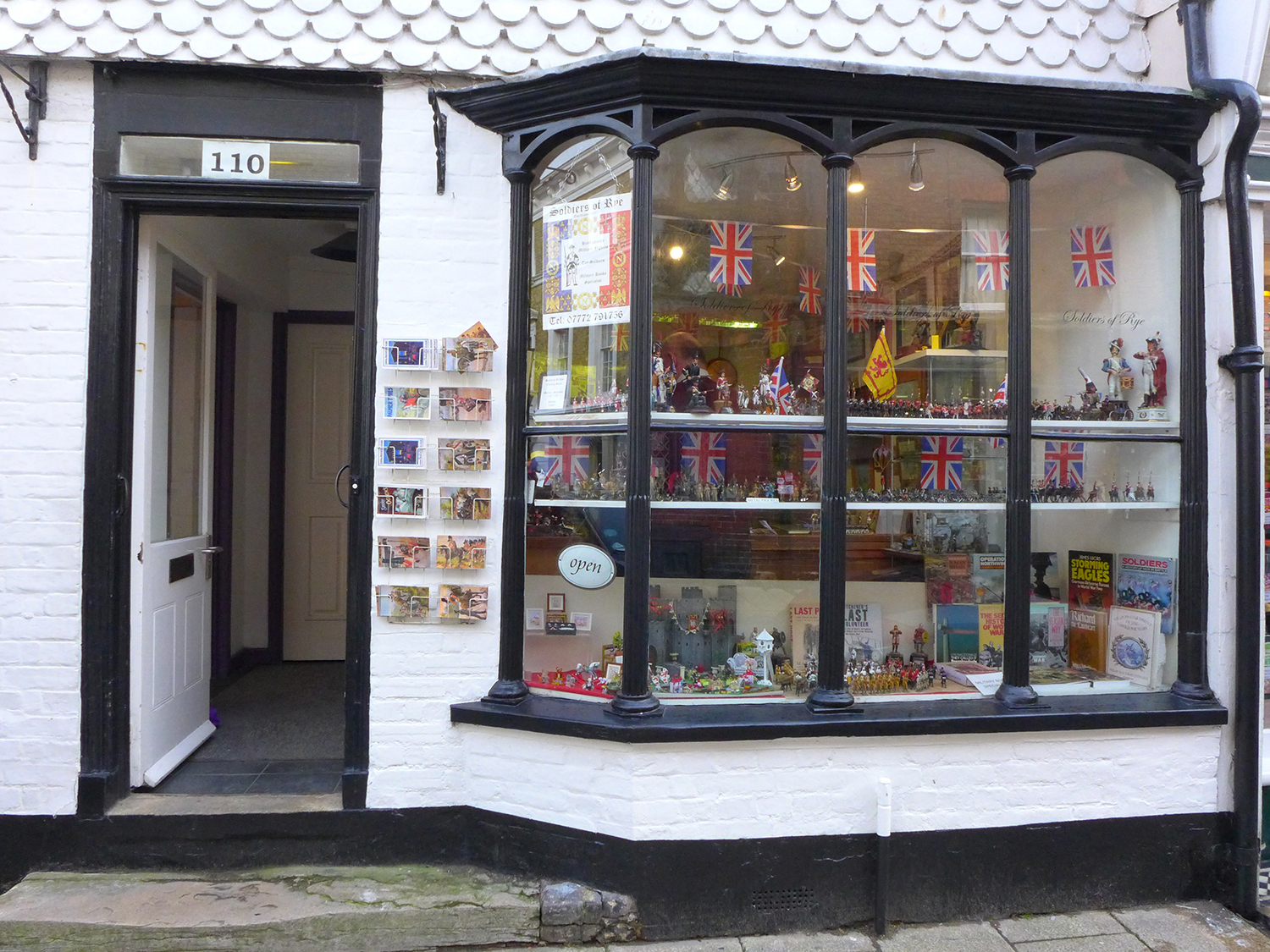
    Today was one of those days. A special day full of special moments but none so captivating as meeting Chris Viner at his shop Soldiers of Rye.

    Magical things do happen and as we walked through Rye and saw Chris sitting in his shop window painting toy soldiers, I  knew one of those moments had arrived.

    My wife tends to get fed up when I accost people and talk to them but it was she who immediately said I must go in and talk to Chris. It just had to be done.

    Chris has a Father Christmas twinkle in his eye; kindliness, boyish enthusiasm and quiet contentment are evident from the off.

    I knew I had to chat. He is the toy maker in Chitty Bang Bang, he is the Sandman, he belongs in a fairy tale.

    Did you know that lead soldiers were hollow?  If you make them out of solid lead, they are too heavy and collapse at the ankles. These days toy soldiers are made of a mixture of metals and so can be made solid.  Chris carves the master copy out of clay and then creates a mould so that, once he has replicated Winston Churchill, he can satisfy the insatiable demand for effigies of our great leader and orator for years to come.

    Gordon of Khartoum is a popular purchase and the Japanese can’t get enough of Sherlock Holmes and Dr Watson.

    What is there that is so satisfying and appealing about a man at his craft? How often have I wanted to be a binder of books in leather or to pursue the making of miniature furniture as I did as a child.

    Is it the manual element? It is certainly satisfying to create out of our own hands. The art, the creativity? Yes that too.

    Is there a hermeticism about it which appeals to me? I think that plays a large part in its attraction.

    There is something almost earthy, fundamental about the craft. It links us to the material out of which this rocky outcrop is made and to the produce which grows on it. Lead, wood, leather. Rich, aromatic, satisfying. Textured, physical, comforting.

    But Chris was also more than his craft. He had a wisdom and kindness which shone through.

    One of his sons had started in finance in the soulless City of London and hated it. Many a father would have been horrified that his son wanted out of a lucrative career, but Chris’ advice was that his son should leave immediately and follow his passion. This son’s real love was archaeology and so he went back to university and then went on to work as an archaeologist in Cambridge. The other also son found himself and his career misaligned and so Chris and his wife had him move back home to follow his love of painting. That son now has exhibitions all over the world.

    So you see, there are good things in the world and good people. Would that they continue to flourish and thrive.

  • The Railway Children

    The Railway Children

     There are few greater attractions than the country railway station.

    Full of promise, of excitement. Was it not from an English country railway station that the Pevensie children disappeared on one of their adventures into Narnia?

    I am sitting on one now. More is the pity that I am on my way to St Pancras and not the reverse, but the attraction is still there, even if I would prefer to be en route to Cair Paravel. Or deepest Wales.

    Airports are no fun nowadays. You could almost feel you were on the way to a gulag or a death camp. Over zealous petty officials surround you, armed with rubber gloves to probe places that should remain forever private. Little wonder that Hitler’s atrocities were committed on a day to day level by the little people. Small people emboldened and given a taste of power by means of their small minded uniforms and their charter to threaten and terrify.

    But the English country railway station: there you have an altogether more friendly beast. The old dear locked up in the staff room was most jolly, even if she was not available to sell me a ticket. And the ticket machine was broken; obs.

    Never mind I shall bluff my way through somehow, hoping to avoid railway police and the magistrates court. I bought and paid for a ticket of course (online) but petty officialdom will hold you liable no doubt for the failure of its own technology.

    Most people are charming. Lovely even if you approach them in the right way. And thus the conductor proved; understanding and helpful.

    Others take rather more careful handling. There is nothing more dangerous than the small time official with a chip and a modicum of power. God help you if you cross him. Or her.

    I had the misfortune of attending a speed awareness course recently and intentionally or otherwise was made to feel small, dirty and bad.

    I was an offender, a criminal given the chance to redeem himself by attending a few hours of ritual humiliation. I was warned of all the dire consequences which would follow any infraction of the draconian rules of the gruelling four hour course. Magistrates courts were mentioned regularly and we all gasped in terror at the prospect of finding ourselves up in front of Judge Jeffries. The infamous Hanging Judge. The course instructors of course were paragons of modern society and the finest drivers on the road. Although humour and criticism were not encouraged. We the prisoners, they the camp guards. Allowed to crack their truly awful jokes and god help those who didn’t titter.

    But I digress. That I loathe society will be self evident to any who have had the misfortune of reading my increasingly fevered ramblings.

    There is a point to my drivelling, I suppose.

    It all takes me back to the attraction of ritual, churches and make believe.

    While lacking a shred of belief I nonetheless get great comfort from the arcane and ancient rituals of the Anglican church. It and they transport me to a better place. I can put aside my cynicism for an hour and bathe in music and smells and bells which transport me from mundanity to an altogether more attrative realm.

    And so with half an hour spent on a country railway station. Where is the harm in revelling in the mild and childish excitement of a short and pleasant journey?

    Where is the harm indeed in putting yourself in the shoes of the Pevensie kids and travelling in your imagination into Archenland, or to the Lantern in the snowy woods to meet the White Witch Jadis.

    Stories are good for us. And in a sense they are true. Or can be made to be true. So you don’t believe in the Christian God? Or even the Buddha. Made up stories to soothe the existential howling, the black hole at the heart of our psyche. But imagine the benefit of behaving as if your favourite faery story were true.

    How much better might we behave, how much better might we feel, if we maintained the fiction that Father Christmas were true and that Aslan’s land was just the other side of the Wardrobe.

    Am I talking of Pascal’s Wager? No, not at all. I live in the 21st Century. But I try to take his advice not because I believe in heaven and hell but because trying to be reasonably pleasant (as far as my perennial black moods and cynicism allow) makes me feel better.

    And I read beautiful faery stories and attend beautiful rituals because, in a sense, it does actually alter my reality. It makes a better world for me and, I hope, for those I might come into contact with.

    And there you have the importance of the humble country railway station. Give it a go. It might transport you to some surprising places.

  • Margate Minge

    Margate Minge

    The Margate of my youth was a poorer place without Ms Emin and her revealing artwork (an example of which can be seen above) but I am nonetheless delighted to say the working class seaside atmosphere remains, despite the arrival of Bohemia and East London.

    My son and I had a thoughtful morning at the Turner Gallery to view an exhibition “Seaside: Photographed“.

    While I can not claim Cleopatra’s immunity to age, the sloughing off of most commercial ties has led me to a new vitality. I find myself increasingly moved by art.

    This was art with deep personal relevance.  I had a grandmother in the seaside town of Ramsgate, whose ancient and musty dwelling was full of old black and white photographs of her siblings and stern forbears.  Women in severe black dresses of the Victorian age, men in mutton chop whiskers and heavy suits.  She lived but a few yards from the harbor and seafront where great glories were to be found. Donkeys on the beach on which my sister and I had our pictures taken, a smelly old harbor with fish stalls and tarred wooden cobbles, cockles and whelks, egg and chip cafes, the “Merrie England” funfair.

    Our summer home was in Birchington, a rather posher enclave in those days, but Margate was a mere 4 miles away and supper was often had in the long gone seafront cafe “Longhis”.  So many Italians in those days, some of whom survive. Morelli, Pelosis, Marchesi: they all ran ice cream parlors and old fashioned, delightful seaside restaurants around the Thanet coast.

    One day when we sat in Longhis we were treated to a vicious battle on the sands. The Mods vs the Rockers. One of said gangs even brandished a shotgun outside the window where we ate dinner. The roar of motorcycles, the sinister swish of chains wielded in battle. The blue uniformed police trying to control the tide of vicious rivalry.

    But there were calmer days. Old couples sat in deckchairs on the beach, fully clothed in town outfits, though sometimes with knotted handkerchiefs on the head to ward off the summer sun.  Kids splashed in the sea or the boating pool, young women revealed a dash of  cleavage.

    My great grandmother used to ship her 500 girls down from her garment factory in Walthamstow for their annual summer treat. She had a splendid old summer house herself just around the coast.

    And so the exhibition was a big treat. A nostalgia trip but also a pleasant reminder that it is all still going on. The young lovers, the drug crazed raves, the sedate old couples.

    There is and was poverty and grime in these old seaside towns – Thomas Cook and his ilk took away their glory days. There are boarded up shops on the seafront, the amusement arcades suffer from internet gambling. And all of it suffers from the horrible English weather.

    But it survives. Blackpool is still there. Graham Greene could still write Brighton Rock. The funfairs struggle on.

    Lap it up, enjoy it. Long may Margate survive, with or without Minge and trendy artists.

  • Hobbiton-on-Sea

    Hobbiton-on-Sea

    One of the advantages of living in Middle Earth is observing the locals at work and play.

    I was wandering around looking for a golden ring I had lost and thought to drift into their local place of worship. Do they worship Ents? Tom Bombadil? Gandalf the Grey? I am never sure but no matter, their music seems good.

    Today I was lucky enough to barge in on a neophyte, female, Hobbit organ student strutting her stuff. Unusually for a Hobbit she was wearing shoes, but I understand this is just so she can reach the pedals.

    This tubby little soul is a close relative of Sam Gamgee and a keen member of the local gardening society. She has only just moved to the area (an immigrant from Bree) but is already busy baking cakes, growing vegetables, chatting to all and sundry and generally bumbling around.

    Therein perhaps lies the clue to a happy life. Engagement and simple pleasures. Playing the organ at the village church, chatting to the ladies arranging flowers for the wedding later in the day, mowing the lawn, cooking in the kitchen.

    Those of us who have led busier lives, wielding our picks and shovels at the coalface of finance, might learn from the Hobbits.

  • Vierne: Messe Solennelle

    Vierne: Messe Solennelle

    Rarely have I felt such intensity as when singing Vierne’s Messe Solennelle with Fulham Camerata last Saturday.

    It was one of those peak experiences so frequently read about and so mysterious as to be almost impossible to describe.

    Our conductor himself (Harry Castle) is intense and intensely expressive.  It was fascinating to watch his face as he conducted the Kyrie, a heavy, brooding magnificent setting of those hallowed words preceded by equally heavy and expressive organ music.

    The performance was greatly lifted by drafting in singers from Genesis Sixteen as well as our own choral scholars who are kind enough to put up with the rest of us. And we had a wonderful organist.

    Harry’s face during the Kyrie was a joy to behold. After weeks of trying to persuade a recalcitrant and belligerent bunch to actually look at him, on this occasion I believe we all did so. And it really counted. Harry was clearly enjoying at least this part of the performance as much as I did.  I’m sure others must have noticed the flow, the sheer magic of this opening movement where for one of those all too rare occasions, we seemed to have got the picture. It was like riding a wave, an experience I will not forget.

    Life does not get much better than this.

  • An Allegory of Man 1596

    An Allegory of Man 1596

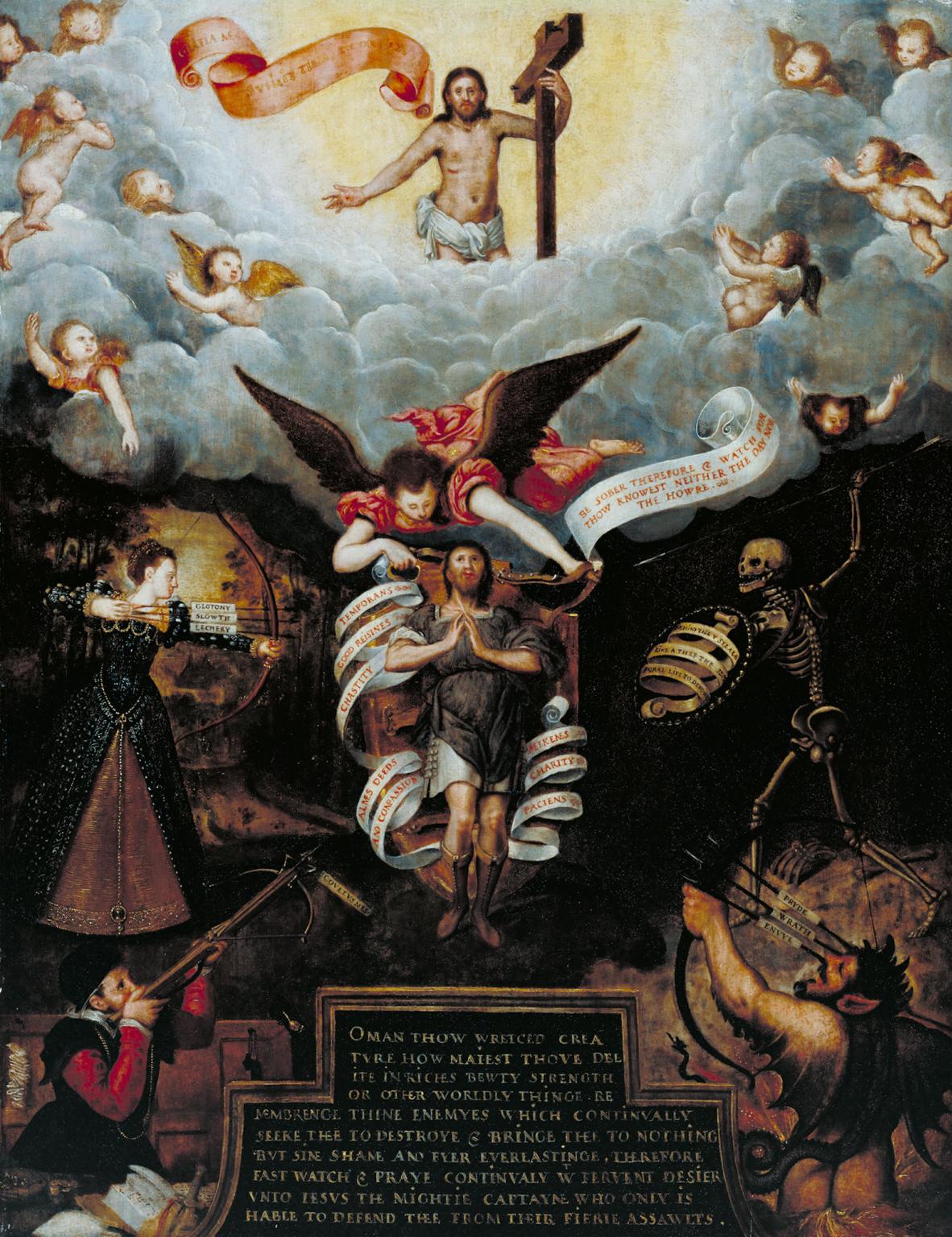
    The painting warns the viewer of the soul’s vulnerability to the vanities of the world.

    It strikes me as a sort of 16th Century morality comic book.  It’s a bit like a Tudor version of The Beano, where Dennis The Menace and Gnasher are tempting the saintly and wet  Lord Snooty with all sorts of naughty stuff.

    Mostly I find Christian art difficult to appreciate. All those grisly bodies full of arrows, the dripping bloody men on the cross, the insipid looking adorers standing at the feet of god. I don’t care how skillful the artist may have been; Titian, Rembrandt, Reubens all had their good points but the heavy religious plug is not for me.

    There are exceptions and oddly I find art related to the Old Testament a lot easier to tolerate. Such wonderful, grim and bloody stories painted in oil on canvas. Belshazzar’s Feast being a great example.  It doesn’t come much spookier than the “Writing on the Wall”. What a bounder he was; not surprising someone ticked  him off and wrote threats all over his wall.

    But the Allegory of Man is in a wholly different category. If you discount the ridiculously anthropomorphic god hovering above the tempted mortal and consider him more metaphor than divinity, then I believe the picture can speak to us. The horrid devils and skeletons and assorted beasties are trying to tempt the poor mortal to commit terrible sins. Covetousness, sloth, greed, lechery and more –  all the human failings. And then of course the painting lists the Christian virtues in more little bubbles in this lovely comic strip.

    ‘BE SOBER THEREFORE & WATCH FOR ¦ THOW KNOWEST NEITHER THE DAY NOR ¦ THE HOWRE.’

    Love it and I’m not making fun. All joking aside, there is something profound and magisterial about these words. Sometimes when I’m up in the mountains far from light pollution, or down at our little cottage on the Kent coast, I go out into the garden and lay marveling at the sheer immensity of what is out there.  And the sheer insignificance of our tiny world and our silly stupid cruelties and petty concerns. So yes, I do appreciate this picture.  I do wholeheartedly subscribe to what it is trying to tell me.

    It hangs in the Tate Gallery in London if you want to see it. The painter is not known, nor the “purpose” of the painting, Nor where it originally hung.

    I don’t need a god to tell me what to do. I can decide right and wrong for myself. But I do appreciate the message. It is meet and right even if it is a bit preachy.