Category: The Imaginal Realm

  • Make Believe

    Make Believe

    While there may be no god and no objective morality, we may act as if there were. Some of us find that we must.

    Do I deny reality if I dream of a better world? Or, by contrast, do I create a better reality by dreaming of one. We are creators. However we arose, and whatever horrible sump we emerged from, we are a miracle. No less. However brutal and vile our past, our future can be different. If that is our desire. If we dream such a beautiful place into existence. We have that power.

    My job is to dream and to write about my dreams. In my meditation, I may not solve the mystery of dark energy, nor plumb the singularity at the center of a black hole. And yet somehow I often feel a quiet comfort and certainty about reality. A conviction that perfection exists and is within our reach. That eternal peace, happiness and joy are somewhere not so very distant.

    Do I dream of a technological singularity? A world where the infinite resources of a boundless universe create plenty for all. Where we merge our minds with those greater by far than our own. A world where the miraculous is commonplace and yet we never tire of the excitement and awe of the infinite.

    Yes, I believe that I do so dream, and that I am right so to dream.

    There are those who will say that such a supposed utopia will be dominated by the rapacious and villainous, but our dreams may make it otherwise. We have minds and we will create even better ones. We need not retread our brutal evolutionary path if we decide that it should not be so.

    I like to drift in a twilight zone where I see dryads and talking naiads. Where a god, or something very like one, calls and tells me all is beauty and ugliness can be banished. Where children visit magical lands. Where moral absolutes are real and where good always triumphs over bad. Where cruelty is ended and a warm sun always shines. Where tyrants are toppled and hunger and disease are ended.

    Will you tell me that I am wrong to dream such a dream? My mind is my reality and I choose, increasingly, to live in such a place. Where I hear the cry of a red kite circling above on the fresh breeze, and see a land unsullied by crude tarmac and the internal combustion engine. Where I hear plainsong rising from an ancient abbey by the sea and feel the peace of the monk’s herb garden as they pad around in their simple garb.

    Perhaps in some distant future we will be able to re-create such places. Places which retain the beauties of the past but with the comforts of an infinitely advanced future. Where medicines and the comforts of modern living do not have to entail tower blocks and diesel fumes. Tyrants and torturers. Crooked politics and self interested business.

    And if I were young would I join the search for the infinite mind? Where some see terror in artificial intelligence, I see the prospect of ecstasy and the eternal. If there is no god, why not become one. It does not seem so far fetched.

    Alas no. Were I twenty years old I would probably become a contemplative. I would earn my daily bread as a postman in the Scottish islands perhaps, but set my mind free to wander. Or roam as a warden in some remote reserve, with only nature and simplicity as my companions. Or perhaps just live in a simple caravan somewhere remote and live on thin air and the cry of gulls over the sea.

    Or do I belie a streak of ambition? Were I young again would I make amends for the follies of my past and search the far side of Big Bang. Or, more likely, look for the means to allow man to live in gradients of bliss. Yes, I think the latter.

    Too late alas. The time to do is long past. I will content myself with my dreams and hope in some small way that my thoughts may find purchase in other minds and contribute to the search for omega.

  • I’m off to Narnia

    I’m off to Narnia

    When it comes to parallel universes, it does not get much better than Narnia. Where better to escape the troubles of a world which at times feel overwhelming.

    The desire to transcend to a realm of peace, goodness and beauty has been paramount in our minds since we first acquired the double-edged sword of consciousness. Who does not seek an escape from pain, uncertainty and eventual death?

    For me, Narnia always has been and always will be a place where I feel at home, a place I feel wholly and completely at peace.  Those enchanting tales fill me with joy and as with all the best stories, when I read them, I almost feel I am there.

    There is no travel agency for those who want to make the trip and besides, you need an invitation. For those lucky enough to be summoned, the journey is strange, and the means of travel varied and magical.

    The first visitors witnessed the very creation of that world, genesis itself. And this first journey to Narnia was one of the most memorable.

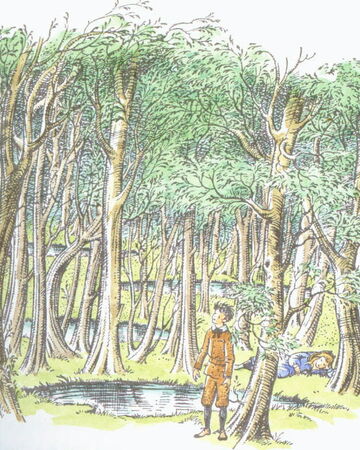
    In the Chronicles of Narnia, we learn that time and space are malleable, infinite, unfixed. All is possible, everything exists somewhere in a multiverse, a place of infinite possibility. These first visitors were children form Edwardian London and their portal was a wood between the worlds. A lush, sleepy sylvan setting, where each of the woodland pools led to a different world, a different universe. That wood itself was very special and somewhere you feel you wouldn’t mind resting awhile.

    The children (Polly and Digory) had the misfortune to awaken evil in one of the worlds they visited and introduced it into Narnia at the very dawn of time. They brought Queen Jadis form the land of Charn, where she had used the Deplorable Word to destroy her own universe and now looked for another realm to spread her wickedness.

    Narnia is created by the Word of Aslan. The logos. That world is sung into existence and as the music continues, black waters are calmed, and dawn arrives. The song conjures all into being as trees and rivers, hills and mountains and the talking creatures themselves are fashioned by the beauty of that voice, called into existence. From nothing came everything. From empty blackness the Word called matter and energy to birth yet another world into the infinity of the multiverse.

    It was all there in this new land. Evil, temptation, joy and sadness. Good and bad. But it was a special place, one where you somehow knew the bad was a mere test and that good things would surely arrive, if only you had the right intentions and avoided temptation.

    It was a land in which there was guidance, a clear code of behaviour. A land where somehow one has the feeling that the right path is obvious, and not so very difficult to follow.  Where it is simple to make the right choices and one is glad to do so.

    For some lucky children in The Lion the Witch and the Wardrobe, the portal is a magical wardrobe built from a tree whose seed was brought from that fabled land by an earlier generation. Staying with a kindly old professor deep in rural England, the children brush past fur coats and emerge in a land of snow and ice where the spirits of trees and rivers roam the land. And where talking animals greatly outnumber humans.

    I can still feel the sense of wonder when my primary school teacher read the book to us in class back in the early 1960s. I was hooked at the first sitting and am still entranced by Lucy and Mr Tumnus, by Aslan and the Beavers. I still shudder at the White Witch, who condemned the beautiful land of Narnia to eternal winter.

    A couple of later visitors jumped through a picture of a Narnian sailing ship, hanging on a bedroom wall, and found themselves swimming in a foreign sea nearby to the Dawn Treader, the royal Yacht of King Caspian of Narnia. Those lucky children joined on a quest to find the seven lost Lords of Narnia. It is here that you will meet Reepicheep, the valiant talking mouse who is in search of Aslan’s land.

    In one adventure, the search for the Silver Chair, two children escaped their miserable school through a gateway in the wall and found themselves on a high clifftop in the land of Narnia’s creator. From whence they were gently blown towards Narnia itself, far out over the seas. Their adventure with Puddleglum the Marshwiggle, in search of lost Prince Rillian, is perhaps the most captivating of all the Narnian Chronicles. The giants of Harfang want to eat the children as part of their Autumns Feast, while the Lady of the Green Kirtle wants to enslave them in her claustrophobic underground kingdom, where she holds the Narnian Prince under an evil enchantment.

    Death itself might call you to this land of milk and honey, as it did to the children who were transported from the scene of a train crash.  These children joined others in the Last Battle, the Narnian day of judgement, where the chosen ran on and ever on joyfully into ever higher heavens, and the undeserving met their end in the destruction of Narnia at the end of its days.

    Is Narnia a land where all is good, and evil has ceased to exist? Not quite, for Narnia is a testing ground for those who seek an even better place.

    But what evil there is in this far away world is not of the visceral, threatening sort we find in our own universe. Somehow, even the wickedest of White Witches is manageable. Somehow, we know that the serpents and giants, the tyrants and the bad dreams are manageable here and can be conquered by a little faith and some determination to do the right thing.

    In Narnia we can see the whole span of a universe’s history from creation to eventual destruction, but with the comforting knowledge that all shall be well, and all manner of things shall be well.

    Narnia is a place where only good can triumph and where evil may last a while but is never too terrifying. It is a country with a protector, an omniscient and omnipotent creator who will make sure that all will go well in the end. And when the time comes for that world to end, he will open the doors to better and greater paradises.

    It is true that you must make the grade in Narnia. At the end of days, the great Lion stands by a gateway and those who have lead lives of evil are sent off to a realm of darkness and destruction. Only those who have behaved well are ushered through to light and Eden.

    But it is difficult to be a monster in Narnia. It is a land which seems to make the choice to act well so obvious and easy. A realm where the division between good and evil is so clear and the right path so easy to tread.

    It is a world where doing right and making noble decisions seem to be the default option; where evil and taking the wrong path seem so obvious and so easy to avoid.

    There is so much beauty and goodness in this charmed land that a brief (even if imaginary) visit has changed the lives of many who have been lucky enough to be called there.

    Narnia is a country I have visited so very often in my mind and a place I suspect I will visit again and again as the years roll by.

    I can imagine a wide range of opinions on hearing my words. Some will be uncomfortable with the religious themes of which I remained blissfully unaware in childhood. Some will be irritated by the magical thinking, the apparent belief that such places can or do exist.

    But the imagination is a surprising tool. Consciousness is a great and powerful creator. In a very real sense, we are what we think, and we think our world into being. Our brains are indeed governed by the physical laws of the universe in which we happen to live, but our imaginations are not.  We have emerged from mere matter but our whole is so much more than our parts.

    Could we but see it, Narnia is not an inaccessible and imaginary world open by invitation only. We may not have Dryads and Nyads walking the earth, we may not be able to converse with talking Fauns and Beavers but we are in possession nonetheless of a miraculous universe.

    We are learning each day how to re-arrange matter in previously unthought of combinations to make better materials for our use. Medicine and food production continue to improve. Disease could one day be a thing of the past. Mental and physical disability will be overcome.  Death itself may be vanquished.

    All we need to do is to make our world one where, like in Narnia, the right path is so easy to follow. And where evil is as easily vanquished.
  • Messiah – Netflix

    Messiah – Netflix

    Profound and beautiful would be my best shot at describing this wonderful new series Messiah from the creative genius that is Netflix.

    Needless to say I do not give a toss about the general critical reception and care even less for petty debates as to whether the series is blasphemous or takes liberties with the “scriptures” Hebrew, Christian or Muslim.

    I am no believer in gods or saviors of any flavor, but clearly I must have a hankering after the divine to enjoy this fictional portrayal of a supernatural being who declares that history has ended.

    My favorite scene? His meeting with the US President, himself a man of deeply religious conviction, who is moved by the Messiah’s plea to withdraw all US troops from abroad.

    Yes, peace. Call it naive, Utopian, unrealistic but it is some such shattering event for which I have long yearned.

    Peace, love, goodness a dropping of hatred, bigotry and greed. What is not to like about such a philosophy? Is he the son or god or isn’t he? Is he possessed of miraculous powers or a mere charlatan, who has learnt the power of deception and conjury from his wicked uncle? Did he really walk on water in the capital city of Mammon and did he resurrect a bunch of latter day Lazarus’s from the dead?

    Well this is not reality so the answers to those questions have little relevance outside of the curiosity to see what this tale will reveal.

    But is there not a longing in many of us (most perhaps?) to abandon this mundane plane of existence, to upsticks, to thrown down the dull tools of survival and follow some greater calling?

    Would I want some anthropomorphic god dropping down from the skies? Probably not but the idea of a new beginning, a new world, a better society, a dramatically different existence – yes, that is something I would welcome.

    Fiction it may be, but the desire for transcendence and meaning is something for which so many yearn.

    If the Messiah makes us question our lives, our behavior, our beliefs, then all power to its creators.

  • Game of Thrones 8

    Game of Thrones 8

    If you think it’s all about sex, dragons and slaughter you might just be wrong.  It’s also about apocalypse and that I find rather fascinating.

    I watched the whole of Series 8 in a few short days and remained gripped throughout. And not just because of a pretty girl and her pet dragons.

    It is bloody, gory and pointless slaughter all the way but perhaps that is the whole point. Perhaps that is what life, human and otherwise, has always been and perhaps that is why apocalypse is rather attractive.

    Attractive because it means it’s all over. The world has come to an end, everyone is dead or dying. And in a very strong sense that can come through as an enormous and cathartic release. The struggle is over. It is all finished, no one left to kill . The meteor which put paid to the dinosaurs has struck again and we are all wiped out.

    No more bills, tax collectors or trips to the Co-op. No more crushing dullness. Does the phoenix rise from the ashes? Do we want it to? And if it does will in usher in more of the same or some brave new world? Sadly, as likely as not, the former.  More violence, greed and struggle for existence.  More bills, more tax men and more entreprenooooors thrusting useless junk down consumerist throats.

    But that is why I find apocalypse attractive – at least in celluloid. Or is it now digitoid? It always seems a huge relief when the monsters take over, the aliens land. The immense, turgid, dull routine is swept away and as a member of a group of bedraggled survivors I can trudge off to some mountain hideaway and huddle up in a cave never to visit the Co-op again.  Never to have to see or see some fool politician’s face or that of Philip Green who did so well for BHS’s pensioners.

    Never to hear any bad news because there is no internet and no newspaper. And probably no news anyway.

    But of course the “Noble Savage” is merely a dream. There never was a time when the hunter gatherers went about their vegan way, nibbling nuts and glugging palm oil.  In peace and harmony.

    But watching those dragons breathing fiery death, just for a moment, you think it all might be different next time.


  • The Mysticism of Blade Runner

    The Mysticism of Blade Runner

    ““I’ve seen things you people wouldn’t believe. Attack ships on fire off the shoulder of Orion. I watched C-beams glitter in the darkness at Tannhäuser Gate. All those moments will be lost in time like tears in rain. Time to die.”

    Does it sound curious to link a vastly popular work of science fiction to the concept of mysticism?

    Roy the terrifying robot saves Deckard’s life and before he dies the robot utters those magical, moving words.  A robot has “seen the face of god”.  The film shakes our very perception of life and consciousness. Mankind has created sentient beings, and yet chases them to death like rabid dogs when they strike out for freedom from servitude.

    Science and mysticism are intrinsically linked.   They are two sides of the same coin. The mystic seeks to see the face of god by direct and intensely private personal experience. The scientist, if he did but know it, seeks the face of god through experiment, induction, rational thought.

    Both the scientist and the mystic seek the same end. Knowledge, gnosis, to know.  Truth, meaning. To escape from the goldfish bowl of our small existence and to witness the multiverse, unlimited by our own meagre senses of sight and hearing. To see what is out there, to witness it, to understand it.  To meld with it.

    Above all, to feel it.

    I have no doubt there are many scientists who would see themselves as rational, clinical beings. Dabblers in numbers and physical exotica, which can only be explored through higher maths.

    And yet at heart I suspect they know that they too are seekers and not so far removed from the mystics.

    We are trapped on a spaceship called earth, rotating around an insignificant sun in a sea of infinity.  We do not know what we are.  We do not understand why or how we are conscious.

    Is it any wonder that we have created myth and religion down the millenia to seek comfort and meaning? Is it any wonder that as a  rational scientist or an arty writer, we both seek to “see the face of god”?

  • Has Iain M. Banks Sublimed?

    Has Iain M. Banks Sublimed?

    Subliming according to Wikipedia is a process that allows a civilization to transfer the consciousness of its individual members (biological and/or artificial) from the material universe that we experience to another plane of existence.

    The bald facts are that Iain Banks was a Scottish socialist and atheist and (in my opinion at least) one of the finest writers and thinkers of our age.  Would he be horrified to see his concept of “sublimation” extended to the almost universal desire throughout human history for the divine? Yes, I think he probably would but he must have been aware of the parallels.  I can do no better than observe: “the sublimed species seem to utilise immense power over the material universe, to the point where sublimed species can be thought of as close to godlike”.

    The Culture is undoubtedly a Utopia but a far from dystopian one. It is a universe where beneficent “Minds” embodied in vast travelling spaceships can and do almost everything. They are undoubtedly godlike.  They look after the universe and try to improve the lot of those they encounter. They are good. They are wise. They are bold and well nigh invincible.  They are everything we ourselves would like to aspire to.

    And in this age of almost overwhelming technological optimism we may hope to become “Minds” ourselves in the (supposedly) coming singularity.

    Yet beyond the Minds there was another universe, another plane – a non physical one. The Minds were still bound to metal; in Descartian terms they were minds but also bodies. Do some of us still think in these terms? Do some still believe that we are more than the sum of our parts and can thus aspire to a post physical world?

    I hope so.

  • The Magician’s Nephew

    The Magician’s Nephew

    This is not the place to talk about the author CS Lewis, his time as a revered scholar of English at both Oxford and Cambridge or his friendship with JRR Tolkien and their evenings at the Eagle and Child in Oxford.  It is not a place to talk about Christianity or the Screwtape Letters.

    The Chronicles of Narnia need no extraneous detail, no introduction. They need to be revelled in for the beauty of the eternal tales of good and evil and for the language in which they are written.   They need to be delighted in for the loveliness of Pauline Bayne’s illustrations.

    In the Magician’s Nephew, Polly Plummer and Digory Kirke are hijacked by evil Uncle Andrew Kettering and unwillingly sent on an adventure into parallel worlds via the lovely wood between the worlds – a sort of Clapham Junction for magical travel.

    By mischance in the desolation of Charn, they wake evil empress Jadis and unwittingly take her back to Edwardian London, where she terrorises Uncle Andrew and rides a hansom cab for her imperial carriage. A veritable Boudica.

    The children remove Jadis with the help of Uncle Andrew’s magic rings and back through the wood between the worlds they end up in a black, darkened and unformed universe.

    Magical and majestic Aslan sings the new world into existence with talking animals as well as spirits – the Dryads and Naiads and gods of springs and woods.  The cabbie and his wife from Edwardian London become the benevolent King and Queen.

    After a visit to a green hill far away on the cabbie’s horse Pledge (now given wings by Aslan) Digory makes up for his mistakes by seeking a magic apple to ward off Queen Jadis from this newly created paradise.

    As a small child you are unlikely to ponder the parallels with Christian mythology, let alone worry about it.  These are simple, glorious, colourful tales where good always triumphs over evil and comfort is alway eventually attained, even peace.

    If as a child you are mesmerised by these books you will never forget them and will return year after year to re-read them as an adult, finding the same pleasure they gave you as a child.