Category: The Imaginal Realm

  • Dune!

    Dune!

    Another day another messiah. Another day another superhero. Superheroes are a consistent feature of the human imagination, human need, human longing.

    Back in the second century AD the inflated claims of Christianity, as we know it today from the canonical version of the Bible, had not become established.

    Jesus as a superhero was by no means fixed in character or powers in those days.

    In the Infancy Gospel of Thomas, a child disperses water that Jesus has collected. Jesus kills this child. At age one he curses another boy, which causes the child’s body to wither into a corpse.

    In other “gnostic gospels”, Jesus has somebody else crucified in his stead, impregnates the “virgin” Mary, and sells his own twin into slavery.

    Two thousand years ago, man had not invented science fiction. At that date man thought space was a physical canopy above the earth, and so early Superhero authors had to set their tall stories on the earth, since the earth was all they knew.

    Why do you like Dune, why did Herbert concoct the story, why were the books and films so successful?

    The subconscious is a strange thing – perhaps you too have a desire for “super-heroism” to be true. Even if not, many of us clearly find something about Dune amuses us, attracts us, interests us. 

    And so now to “truth”. Eventually, the early Christian Church bigots kicked out all the inconvenient gospels and said the only true version of their super-hero Jesus “Christ” was contained in what we now call the Bible. In that version JC is a real good guy and certainly did not impregnate his own mother or kill others out of sheer spite or anger.

    Do superheroes “really” exist? The Church believes so. Others may take a more balanced view: no, I do not believe that JC or any other superhero exists or ever has existed.

    But our longing for something beyond the physical world we can prod and measure does have some justification in reality. In the sense I have so often spoken about. That the world is far more mysterious than we pygmies can yet imagine and that while there may be no “god” as such, perhaps we have the power to become “godlike”. There certainly seems to be godlike power out there somewhere. To me at least.

    That has always been my take on the matter.

    And Dune? What is it? On one level it is simply a fun story, an amusement. On another level it takes on a very much more significant shape which can sometimes have very severe consequences. ”Good” ideas, like communism have a plethora of Superheroes but usually have horrendous consequences. The communist Superheroes far outdid the Nazis in terms of mass slaughter. The desire for a Superhero was of course also cruelly exploited by the Nazis who seemed to offer a paradise, a way out for a Germany impoverished by Versailles, Weimar and hyper inflation. Hitler and his cronies were worshipped before it all went disastrously wrong.

    Christians twisted a good folk tale into what has often been an instrument of hideous cruelty and murder, and so have other religions which shall remain nameless. Lest I receive a bomb through my letter box or have my head cut off by an insane extremist. Lest I receive a police visit for hatred or prejudice of some sort or another against what is fast becoming an unassailable orthodoxy.

    So Dune and stories like it point out tantalising images of possible, imaginary utopias. Which we have always sought.

    If I wax lyrical as usual, you will understand that this is a topic of great interest to me. Since I believe the issues go far far wider than one story, one book, one attempt to explain our world and to explore possibly better places or incarnations.

  • The Wardrobe

    The Wardrobe

    I have passed through the Doors of The Wardrobe and I do not intend to return.

    I have joined William Blake and the countless others throughout history who entered another reality, and determined to live there.

    I was first captivated by Narnia aged 7 and my love of Aslan’s land has never wavered.

    If ever there was a vision of perfection, then CS Lewis captured it. He wrote the bible, painted the definitive allegory of Elysium.

    I should have stayed in Narnia from childhood, but like Eustace perhaps, a few lessons had to be learned first.

    It is a pity that those lessons, so clearly laid out for me aged 7, took 60 years to absorb, but that is so often the way in life. I have ended up right back where I started, where so many journeys end up.

    That is the way of the universe. Everything cyclical, our lives included.

    My way has become increasingly clear to me. My weltanschauung almost complete. I had not realised it would be the task of a lifetime, but so it transpired. From dust to dust, ashes to ashes but in between the beginning and the end we have a puzzle to solve. A job to do. A realisation to craft and hone until we are satisfied with the result.

    Most of us are like the dwarfs sitting in the donkey’s stable at the end of time. They refuse to believe, they sit in darkness and filth and cannot see the reality which surrounds them. They are like so many of us who cannot see that our needs are few and who continue the brutal competition for more and “better”.

    I have no need to preach, no desire to pretend goodness or badness. I am and I see what I am. I am alive and I see what life is.

    Revelation, I suppose, differs according to the receiver. I have received revelation, but from within. Some of course would claim they had found god, or he them. As did Lewis.

    I make no such claim.

    I have found something related but suspect that it is innate in all of us. In a sense we are god, or could become him or it. If we could but see our way out of the stink of the stable, if we could but see that the Last Battle is one we must conduct against ourselves.

    I have almost lost track of why or when my desire to enter the Wardrobe began, but I suspect it was way back then, when I first learned of it. Something was deeply right with Digory Kirke. He had stood at the beginning of the world and heard it sung into existence.

    Like Susan Pevensie, I grew up and that is when the trouble began. I became an adult and put away childish things. I should have kept the toys out of the cupboard and never put them away.

    So in a sense I have reverted to childhood, not through the frailty of advanced age, but by having discovered once again the truth to be found on the other side of that wardrobe door. Tucked away as it is in a beautiful country house in the gentle English countryside.

    To enter those doors is to rediscover lost innocence. To cast aside what so many seem to think they want and to revert to a life of simplicity and quiet thought.

    To renounce conflict and desire and to realise just how little is needed.

    Some mornings (and mornings seem to be best) I have quite literally entered another dimension. Not physically, but in mind. And after enough of such mornings, I have found my psyche ever more prone to remain on the other side of the Wardrobe Door.

    In a very literal sense my very reality has become different.

    I make no extravagant claims. I do not have magic powers nor the ability to affect external physical reality. And yet, after a lifetime of severe internal suffering, I have discovered that in a sense I am a creator.

    We are what we think, we will our own fate. And so I think of Narnia, I walk through that door.

    One wet afternoon, I disappear up to a lost bedroom at the back of an old and magical house, to escape the housekeeper who is conducting a guided tour of this fine and ancient dwelling.

    I hear voices approaching, even at this remote end of the house, and so I slip into the wardrobe. My face brushes against unfashionable mink as I make my way to the back to hide.

    I feel an icy coldness and put on one of the coats. Soon, to my surprise, I feel crisp white snow underfoot and see an old fashioned Edwardian lamppost shining in the middle of a remote snow clad forest.

    I have arrived at a place I should never have left.

    When I awake from my reverie, I find I am still in that quiet forest. In days gone by I might have shaken off the mood, the images. Re-entered the adult world of Susan Pevensie. Strayed from my natural inclinations and wandered back into a different and altogether less pleasant place, where all that matters is survival and brute competition.

    No longer.

    And yet, as in the fable, so in life. There is always “further up, and further in”. Reality is a series of concentric circles, a Russian Doll, an onion.

    Each inner circle is of greater circumference than it’s predecessor. Each doll bigger than that which encased it, each layer of the onion bigger than the last.

    The journey can never end – the progression goes ever on.

    Each day brings new revelations, new joys. And sadness, while still there, takes a back seat.

    And all of this comes for free – you do not have to pay for it or sit under the feet of another. A path will emerge for those who seek it in earnest. The buying and selling of spiritual treasure has always been a sign of trumpery, and so it remains.

    A long an arduous path but in the end we all get there.

  • The Door

    The Door

    Talk continued in the Chapter House, as rosy fingered dawn peered in through the leaded windows surrounding those at the conference table.

    “We will help” said Eustace. “So we will” said Polly, although neither had any real vision as to what their adventures would encompass, or how they could help where these all powerful creatures had so far failed.

    “Thank you” said Rosalie and Aliénor in unison. “We must set off immediately” said Aliénor, the younger of the two sisters, although the Mage had by now laid out a generous breakfast after a long night of talking, and no-one really intended to move while such splendor filled the tables. Almond croissant, pain raisin abounded and finely chased silver coffee pots gave off the most delicious aroma. Hot chocolate was offered too, in steaming earthenware jugs and every variety of fruit juice was to be found in crystal flasks. Muesli and thick creamy yoghurt, honey and jam, toast and marmalade and a host of other delicacies were placed before the guests, and conversation took a more jovial turn after the long council of war which had lasted the whole night.

    It was generally agreed that the trouble in the Northern Lands seemed to emanate from the Great Wall of Time, built forgotten eons ago some distance north of Dunholm, to keep out some long forgotten evil. And yet the Wall still served a purpose and somehow evil had not until very recently plagued the realm again.

    Details of the Wall’s construction were long lost and yet it had possessed the power to stabilize the whole country, even if it no longer formed a strictly physical barrier between the cold and mysterious north and the warmer climes of the south.

    It held (or had held) some deep magic and while it had stood intact for all those thousands of years, peace had held. But lately the Wall had started to crumble, to disintegrate from within. Whatever cunning magic had woven its structure, its power was failing and dark things were seen to cross the land once again.

    Ogres, trolls and goblins were seen on the wild moorlands of the far north and wolves once again plagued farms and villages, taking livestock and occasionally children to devour at leisure.

    Tall Riders in Black had been seen, men of menace and mystery seated on mighty amour clad horses and shrouded in deeply hooded cloaks. Had they a leader these men, and what did they plan, where had they come from? They stormed the land sewing dissension amongst the kingdoms, stirring intrigue and jealousy, setting king against king, son against father, mother against daughter. A madness had gripped the towns and villages and where peace and trust had once prevailed, bitter quarrels now grew for no apparent reason. Power and greed seemed to grip the realm. Where once the watchword had been co-operation for the common good, the norm had now become competition – ruthless at that.

    Pitched battles were fought (such as the one Polly and Eustace witnessed courtesy of the Book of Ways). Sword and mace had replaced hoe and plough in the Northern Lands and Polly and Eustace had bravely offered to find out why.

    Rosalie and Aliénor made good hosts and passed round cakes and good things, pouring fragrant coffee and cream topped chocolate as they mingled with the gathering. They were famed at home for their cuisine and keen both on making and eating fine pastries, all the time remaining wafer thin. They ran a café and bookshop down an ancient cobbled alley in Dunhelm – called, appropriately enough, “Books and Cakes”. Both held tenured positions at the ancient University of Dunhelm. Rosalie as a lecturer and deeply respected expert on ancient Norse language, literature and religion. Aliénor headed the faculties of magic and metaphysical philosophy.

    The Mage was very jolly now and chatted amiably to each and every one of the assembly in turn. He rather reminded Polly of Father Christmas in his glorious green robes and fur trimmed hood. Perhaps he was.

    “You have taken on a mighty task and your valor will long be spoken of! Troubadours will sing of your bravery, lutists will pick sad minor chords mirroring the darkness you encounter. Beautiful cadences and triumphant notes will hail your great victories. Your generosity will never be forgotten” boomed the Mage between mouthfuls of sugar-iced current bun and slurps of frothy chocolate.

    “This is as much about you as about evil and magic in distant lands. It is a test, if you like, certainly of your resolve. What do you believe in, what do you care about? How should we behave towards each other, how should we lead our lives? My belief is that there is some deeper magic hidden somewhere, that even I have not yet discovered. Perhaps you will find it where I have so far looked in vain. All “makes sense”, of that I am sure. There is purpose and meaning in life, and goodness and decency are at the heart of all. You will return much changed and may even awaken to some ultimate reality.”

    “I hope we won’t disappoint you” said Eustace. “Somehow, I think I was waiting. Your call was not so unexpected. Difficult to explain really, I can’t put my feelings properly into words”.

    “Yes, I too felt an inkling of something strange these past few months ” added Polly. “Both of us smelled change and adventure in the air. I need to know, I can only put it that way. I seek and I have always sought. Why – I want to know why. And how and where and when and all manner of other questions, hidden from we mortals since the beginning of time.”

    “I understand your intuition well” returned the Mage “and that is why you were chosen, both of you. You have good in your hearts and a deep thirst to know. You will learn, you will grow, you will flourish even if at the end, this task remains beyond you. Even should you perish in the attempt, good will come from your bravery and resolve. For there is no true death in the Many Worlds, your spirits, your essence will be honed and tuned, hammered and tempered, refined and renewed. But above all it will survive. Listen to the wind, to the silence for clues. Hear the speech of the raging seas, the call of the birds, the whispering of the animals, talking and otherwise. Clues will abound, some hidden in plain sight, some dressed in more serpentine garb.

    You will find help along the way, wise guides to offer sustenance and succor, comfort during the hard times you will face. Listen for the voice of the universe, hear the quiet from the very center of all. It is there, somewhere, that I feel in my very bones. Who knows, it may find you or you it.

    Imagine! The two of you taken from your quiet village in rural England to heal a foreign world and to find all manner of wonders as you journey. The meaning of all perhaps, the philosopher’s stone, the very center of existence which thus far has eluded even we Elders.”

    “Enough Mage!” exclaimed Rosalie “Stop frightening them! Aliénor and I will do all we can to help. Polly and Eustace should meet us at “Cakes and Books” and we will make a concrete plan for their trip to the Wall. That is where they should start out from.”

    “How do we get there Rosalie?” asked Polly. “Oh, its simple enough” Aliénor offered. “Open any door you see around you in the wall of the Chancel and step through it with the firm intention of ending up in Dunholm. That usually does it, although I have occasionally been a little absent minded and ended up in some quite different world and had a devil of a job trying to find my way back. But you should be fine if you concentrate – picture us in your head as you step through the door. Imagine a quaint little city on a rocky hill in a cold northern land, surrounded by a dark and swiftly flowing river. Hold in your mind our warm little café in its cobbled alley, see the brightly colored sign swing above the door in the howling wind – “Books and Cakes” its says, quite unmistakable. That should get you there. I’m afraid we can’t travel together through a door, it doesn’t really work that way and heaven knows what would happen if we tried.”

    “Oh, well we do know what would happen Aliénor , because last time we tried to lead a tour group back for a lecture series in Dunhelm, we shepherded all of them through the same door together. If you remember, half of them ended up in an unnamed desert world on the far side of an undiscovered galaxy in some bizarrely parallel universe. Even the Mage had trouble helping us to find them and get them safely to “Cakes and Books” where their afternoon tea grew cold.”

    “Ah! Sister, I had forgotten that little mishap” said Rosalie. “It’s safe enough for the two of you to enter the same door but a crowd and all their conflicting thoughts seems to confuse the system, so Aliénor and I will be cautious and travel separately. Safe passage for two is offered but any more seems to cause a bit of a problem, so best not put it to the test.”

    Aliénor and Rosalie said their goodbyes to the assembly of elders with many hugs and kisses and pocketed a few almond croissant for their tea back in Dunhelm. Just in case the Café had run out or the girls who helped them run it had closed up early for the day. They held hands with Polly and Eustace fondly for a few moments and expressed their gratitude for what the two of them had agreed to take on.

    “Fare well, Gothic Elves” said the Mage as he lead them over to one of the Chapter House doors. Flavio gave the sisters a hug and a fond farewell as did Pluribus and a host of other elders. A winged horse, a centaur, and a large hedgehog came to add their goodbyes, along with a couple of owls which looked just as wise as owls are supposed to. “Good luck sisters” they cried, or hooted. “Be sure to return in time for the Midsummer’s Night Feast!”

    And with that, the twinkling Gothic Elves darted through the open the door the Mage had escorted them to, and disappeared into swirling snow. Dunhelm Cathedral was just visible through the murk (gently lit by gas street lanterns) and The Mage closed the door hastily to shut out the cold and damp that was such a feature of that little northern city.

    “Your turn my children” said the Mage in a kindly voice as he pointed them in the direction of a door in the Chapter House wall. “Any door will do. So long as you set your intentions on where you want to go, the portal will do the rest. Return soon but call me if you have need. The sisters will look after you well, but you have only to turn your mind to me in dark times and I too will come to your side.”

    Polly and Eustace bade an emotional adieu to the Mage and their newfound friends among the elders. Pluribus and Flavio stood by and smiled in encouragement, honored by the bravery and resolve of this young couple with so little knowledge of the real world.

    “You too must return for the feast on Midsummer’s Night. As our honored guests” said Flavio. “If you are not here, we will take it as an ill omen and send out such help as we are able to muster to secure your rescue. Not, I am sure, that you will need it. But know that we are all here for you should the necessity arise.”

    And with that, Polly and Eustace held hands and disappeared through the door held open for them by the Mage. To say that they were nervous would be something of an understatement, but as they stepped through the strange portal, they tried to keep an image of ancient Dunhelm in their minds. And they imagined the warm interior of the sisters’ café which awaited them on their arrival.

    That all was not going entirely to plan was obvious to the Mage as he peered through the door after the couple, before quietly closing it at their backs. He had expected to see the familiar Cathedral in all its winter gloom, but was surprised instead to see a tunnel of bright light which disappeared into an infinite distance. At this stage the Mage was not too concerned. Such errors happened from time to time and the odd glitch in their esoteric mode of transport between the worlds usually bode no ill. Often as not the door would sort out the mess before the travelers were even aware of it and managed somehow (usually!) to deposit them at their intended destination. Anyhow, the tunnel of light looked far from ominous and the Mage would soon enough call the Elves and check on their guests’ safe arrival.

    Polly and Eustace felt no discomfort or fear but were nonetheless surprised to find themselves floating in light, with no solid ground beneath their feet.

    Neither had any sense of “self” or place or time. They knew that they “were” but they did not know what they were. They were conscious but absorbed in a whole, not separate individuals anymore. They were neither Polly, nor Eustace, nor apparently part of any physical universe.

    The sensation was wonderful. Freedom, complete freedom and an overwhelming sense of peace and understanding. They knew that they were “home” even if they knew not where that might be.

    By and by, after what seemed like an eternity, a voice spoke. Gently. Male, mature, magnificent but at the same time kind and comforting. It seemed to come from all around in the kaleidoscope of warm light in which they were bathed. No up, no down. No left nor right. Just isness, being.

    “I am Omega”, said the voice “I have been expecting you. I waylaid you at the Chapter House Door. And here you are, at the center of eternity, the end point of all. You must be confused but do not be afraid. You are out of the physical realm here, all is pure thought. Think and it shall come into being. Put yourselves into some setting you are more comfortable with and you will slowly come back into yourselves”.

    “An island” muttered Polly dreamily, ” A beautiful island in an emerald sea with the most wonderful country house and gardens at its center. And hedges and topiary and gardeners and mowed lawns. And butlers and chauffeurs and all manner of old fashioned staff, smiling and kindly just like my old childhood nanny.”

    “And a white painted wrought iron table with lemonade” muttered Eustace groggily “by a white canvas pavilion, on a sloping lawn just in front of the house. Leading down to a sandy beach. A Tudor house, big and irregular of mellow red brick. And a maze, a big beautiful maze. A glorious warm day full of sunshine and birds and small puffy clouds. And rabbits everywhere nibbling at the grass.”

    Pop. Both felt a gentle movement and then there they were in just such a place as they had imagined, sitting in warm spring sunshine by a tent at a table with a jug of fresh lemonade and three cut glasses. And cucumber sandwiches. And buttered scones and cream and jam. Looking out over the most wonderful country house either of them had ever seen.

    There was a gentle whirring and the two saw an old gardener pushing a mower over the lawns, who waved in greeting. Assistants in traditional overalls and dungarees were calmly snipping at the hedges with old fashioned hand sheers and others gently hoed weeds from the flower beds, or picked roses and wild flowers and laid them in wicker baskets to take indoors to decorate the tables. An open Bentley from the 1930s stood on the graveled drive of the lovely old house, polished by a young man in racing goggles. A smart gentleman in striped trousers and a morning coat waited at the front door with a welcoming smile.

    Another gentle popping sound. Omega appeared alongside the young couple and sat down at the table. He sipped at a glass of lemonade and smiled. “Sorry to startle you but I wanted to have a little talk before you go on your adventure” he said.

    The previously disembodied voice of Omega now had physical form and the young couple were delighted to see that he had taken the guise of an elderly professor with gold rimmed spectacles, neatly cut thinning white hair and a shabby old tweed jacket. Complemented by a frayed pair of golden corduroy trousers.

    Omega smiled in his kindly way. He was so like the Mage the two could almost believe they were back in that clearing in the woods, with the old church and the Chapter House.

    “You see, there’s a bit more about all this you need to know” he started, smiling brightly and raising his glass to his lips. “We all end up here eventually but it can be a bit of a long haul for some of us. I’m sorry to say the physical universe was a bit of a mistake – it all just happened, leaked out. You know, big bangs and expansions and black holes and all that sort of stuff. Someone at this end got a bit over imaginative in his thinking and physics just popped up. Moof! Its all been a bit of a nuisance to be honest.”

    “So who are you?” And how did you get here?” perked up Polly “If you don’t think I sound too rude in asking.”

    “Oh, not at all, not at all” said the old professor. “In a sense we are all one, you, me, the evil at the center of the Northern Lands. We are all spirits, mind, consciousness if you will. All together, unified and yet separate. Its evolution really – but of the non physical kind. The material universe split off by accident and some minds got trapped over there and then it all started going wrong I’m afraid. They forgot where they came from eventually and got swallowed up in all the physical worlds seem to offer. Gradually they forgot this place and me and all the countless billions who live here in an eternity of peace and harmony.”

    “They lost their minds and were re-born in primeval slime on countless worlds and planets throughout a whole host of multiverses. And then material evolution took over – endless branching and weaving and sewing and sticking and gluing. Gradually consciousness started to re-emerge, but sadly by then most had forgotten their peaceful origins or where they had come from. They didn’t need to strive and struggle and fight and kill but by that time they had grown all sorts of nasty stuff like teeth and claws and digestive systems. Some grew into wise old oak trees of course and some into flowers and shrubs and all sorts of flora. Those were the nice guys. The animal kingdom was a different kettle of fish. So to speak!

    It was the Garden of Eden to begin with but sadly only a few ever saw that. A few wise men and women woke to their true natures and tried to warn the rest of the exiles. A young carpenter on one rocky little planet started preaching decency and kindness and talked of a better place. The ruling evil empire strung him up and killed him in the brutal fashion of the times. Nice young fellow – and he ended up back here of course where he belongs. So no real harm done. Trouble is, his followers made a right mess of it. Took a simple story of a good man’s awakening to the true reality of his roots, and cluttered it with all sorts of mumbo jumbo, tomfoolery and funny outfits. Then the evil empires got hold of the story and we were back to the usual savagery – wars, conflict, torture and money. People selling (fake) shavings of the tree the young man was strung up on, flogging bits of old bone they claimed were his earthly remains and so on. He was most upset but of course nothing he could do about it once he was back here.

    Oh and lots of other good people woke to the truth down there but none of it did a great deal of good. One nice old fellow with a bald head in a loincloth sat under a tree until the penny dropped and eventually of course he found himself back here where he belonged. His lot were rather better behaved after he went but sadly they never got far either – same old stuff went on and on. People killing for greed, unable to see there was plenty for all if only they could share. Sigh.

    Anyway, The Mage and his lot are truly good people doing an excellent job. They are a mere hair’s breadth from finding their way back here. I must go and visit them shortly to give them a few pointers.”

    “So how do we fit into all this?” said Eustace “and what is required of us?”

    “Yes, how can we help” said Polly, looking a little puzzled in the face of the all powerful Omega.

    “Well it’s like this really” said Omega thoughtfully, “it has to come from them, or they will never “wake”. The lost souls in the physical worlds. Never find their way back to peace and plenty. Harmony and the eternal. Go and find the source of evil in the Northern lands and reason with him or it, or her or them. Get them to see how foolish and unpleasant it is to stir up war and pit kin against kin. You’ll have to force their hand of course and that’s part of the reason I brought you here. Physical things really do count back down there – everything in the Northern Lands was nicely held in place by a crystal brick at the center of the Great Wall of Time but its gone missing. I won’t bore you with the technical details but it sort of held things in check down there. Held back some of the nastier impulses of the local thugs and made life a bit more tolerable for the locals. The sort of thing that’s very helpful in curbing the worst excesses of evolutionary bestiality. Anyway it emitted beneficial fields and held the balance nicely for a few hundreds of thousands of years. If you can find it and put it back into place, the locals can get on with their lives again, and hopefully some will even wake and find their way home. Eventually.”

    “Enough business!” said Omega, “Come and walk with me a while. See a bit of the place you have created while you are here.” And with that they headed down to the golden sands of a long, long beach and strolled along calling out to the birds and playing ducks and drakes with rounded flat stones.

    They waved a merry greeting to a dryad or two (or that’s how they cared to clothe themselves) and a strange gentleman in the garb of a sea god. The inspiration for the earthly Neptune perhaps. Jolly and pleasant people and all chatted in a kindly and interested fashion to their amazed and stunned visitors.

    Eustace began to feel a little troubled suddenly. He felt small and vulnerable in the face of the enormous task he had been entrusted with and his fear began to show. Imperceptibly the wind began to rise and clouds darkened and covered the clear blue sky as they walked. Suddenly, the waves rose alarmingly and to his horror, Eustace saw a tall black wall of water a mile or so offshore, moving towards them at an ever increasing pace, with wild foam blown by the now howling gale. The wave looked to be several hundred feet high and birds wildly scattered down its menacing curve and huge sea creatures were bourn before it, tossed helplessly by its enormous power . Eustace felt the ground quake beneath his feet and heard a terrible roar as the wall of death approached the pretty little island, which would surely be swamped and destroyed. He shouted at the others and ran as fast as he was able up the sandy shore and back towards the house which stood at a somewhat greater height above sea level. 100 feet perhaps, but little enough protection against the terrifying tsunami approaching.

    Strangely, the others took no notice but continued along the beach, laughing and chatting as if nothing was wrong with the world and the sun still shone. They didn’t seem to have seen the approaching danger, hadn’t noticed the abrupt change in the weather.

    The truth was that Polly felt no fear and so projected none around her. As Eustace ran she turned and called him but his panic was too great for him to hear. She turned to Omega and saw the old professor was unabashed and still had a beatific smile on his face.

    “The mind” he said. “All here is mind, made by mind and unmade by mind. There is no fear once you get used to it but you have to learn to curb your imagination a bit or you might get carried away by your own dreams and that wouldn’t do at all, now would it.”

    He appeared at Eustace’s side and gently touched his arm, speaking soft and comforting words. The terror on Eustace’s face slowly faded and the tsunami faded with it. The sun reappeared and the birds tweeted. Calm was restored to the little island and the beautiful old house stood firm. Eustace felt a little abashed at the fuss he had caused but the old professor just nodded gently.

    “Takes a bit of getting used to, doesn’t it? Dream it up and there it is. But it is a dream, a fantasy if you like. You can create a beautiful island in an emerald sea and then again a terrible storm and fearsome creatures. But the fear goes and so do the monsters. All here is safety and goodness and the phantom storm would have done you no real harm – it would have passed over like the dream it was. Back to the house for rest and dinner I think, for tomorrow you must resume your journey and rejoin the Gothic Elves at their little café in Dunhelm. People to meet and quests to embark on!”

    With that the little group found themselves back at the front door of the beautiful old house and the butler was handing out thick towels and robes and sweetly scented bath soaps. It may have been in the mind but it was very welcome for all that. Especially for Edmund who really had suffered a terrible shock.

    Baths were drawn and had, a little nap was taken and then a splendid dinner was laid on in the lovely old library. A fine suit of amour stood in one corner and every wall was covered in rare leather bound books, telling tales of derring do in the many world. And spell books, they were everywhere, although they were not called such in this august context. Suggestion books perhaps, recipes to conjure up what you desired and what would give this unworldly realm ever more beauty and joy.

    Polly and Eustace laughed and joked and feasted with the professor and his guests. The young carpenter was there, and a very merry soul he was. The beastliness of a couple of millennia ago was quite forgotten and he and Omega wondered whether a rematch was due – a second chance to see the warring tribes of earth kiss and make up. Hmm, a little too soon perhaps. Not enough lessons had been learnt from the last visit, which had turned out to be largely a waste of time.

    “Never mind” said the young man, “they will learn. Evolution will slowly have its way.” The elderly gentleman in a loin cloth to the right of Eustace agreed. “All in good time” he said “and others seem to be slowly leading the way down there”.

    And so to bed, after a day of wonder and excitement. A day of revelation and awakening for this innocent young couple from a sleepy village somewhere in rural England.

    Polly and Eustace walked sleepily up the grand staircase and found their way to a luxurious bedroom with rich drapes at the windows and a huge and comfortable four poster bed.

    “It can’t ever have been this comfortable in Elizabethan England” Polly giggled and turned over sleepily while Eustace switched out the light on a long and eventful day.

  • The Chapter House

    The Chapter House

    Some weeks after their adventures with the Book of Ways, Polly and Eustace sat enjoying a breakfast of boiled eggs and generously buttered toast in their little sitting room, which looked out over the front garden and down the lane to the stream. An insistent tapping began somewhere in the garden, which at first they put down to a woodpecker, although the noise was a little louder than even the heartiest of the local birds normally produced.

    Winter had set in and outside the day was overcast, with light drizzle. The temperature had dropped and so had most of the leaves but it was a season which nonetheless had its own pleasures. Kicking through the now composting leaves along the woodland paths, putting on warm jerseys and carrying homemade soup in their rucksacks for picnics along the way. And large cups of hot chocolate by a crackling open fire in their little sitting home when they returned. Red faced and well exercised, they would settle down for an evening of reading, or even just quiet contemplation, staring into the hypnotic flames in the grate.

    The cottage had a newly thatched roof, set to last some 30 years, and three small but comfortable bedrooms upstairs. A tiny water closet housed a deep hip bath, which added to the eccentric charm of the place. Their home was everything this contented couple could wish for – not so big that it was a struggle to maintain, nor so small that it was uncomfortable to live in. Life was untroubled: a small but successful business which combined skilled craftsmanship with intellectual satisfaction, beautiful if sometimes mysterious countryside, and few cares to disturb their peace of mind.

    There was no big town near by, no busy road. No light pollution to blot out the dance of the stars overhead or the magnificent wash of light from the Milky Way. The village seemed set in a lost world of idyllic bliss, an Arcadia, an Eden almost. “Et in Arcadia ego” it was said, and some held that there was a serpent in every Eden. And yet recently Eustace had begun to wonder whether death itself was a myth, and evil an option rather than a mandatory requirement of life on earth. He had been much affected by his recent adventures and both he and Polly began to realize that reality was altogether stranger and perhaps more benevolent than either of them had ever imagined.

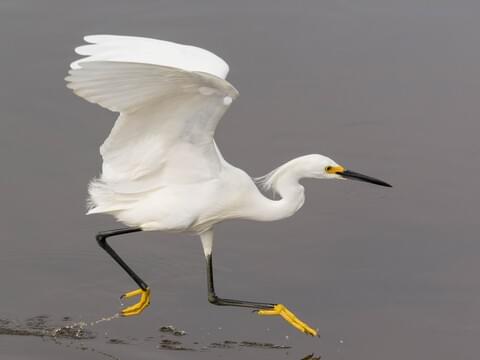
    The determined tapping continued, now on the diamond paned leaded glass of the sitting room window. Opening the front door onto the garden, Eustace was surprised to see that a large snowy egret was the culprit. Perhaps the very same bird from that green hill in an enchanted valley which now seemed but a distant memory. Its long brown conical beak was still tapping at the window. When it saw Eustace had at last answered its call, it fluttered over to the front door.

    “About time, if I may say so” said the bird, flapping its large yellow-green feet on the front path and shaking the beaded rain from its elegant, snow white wings. “I am Pluribus and I have travelled long and far. I would greatly appreciate a moment or two of your time by a warm fire with a bowl of hot milk.”

    Pluribus settled himself happily down on the floor, close enough to the fireplace to warm its chilled body but not so close as to endanger its beautiful white plumage. When he had finished lapping the warm milk, he pecked contentedly on an oatcake Polly had found him in the kitchen, and no longer seemed in such a hurry. Perhaps after all, he had just been impatient to come in from the cold.

    Eustace and Polly sat patiently and eventually Pluribus sighed contentedly, and raised his head towards the couple. “We saw you at the gates at the top of the green hill” said Polly, “but we were whisked away before we had a chance to come and say hello”. “Ah, well then, Mages and their toys work in mysterious ways. Perhaps the Book had shown you enough for one day, or perhaps it thought you were late for choir practice. But it’s time we talked. I bring you a message and come with a request. You are both summoned, if you will, to the Council of Elders at the Chapter House. In the far corner of reality I come from, it’s a sort of parliament. A meeting place where we guardians of the timeless dimensions chew the fat and wonder how we can best encourage those still wandering the lower paths.”

    “I’m not at all sure I understand” admitted Eustace. “We live a quiet life here in our own little world and I can’t imagine how we could help out in matters so far beyond our limited experience”.

    “It’s like this” said Pluribus. “We guardians like to prompt and guide, to suggest. To use force can only ever be a last resort, and sometimes we need a little help from you mortals, if I can put it that way.”

    Polly and Eustace looked none the wiser. “Where or what or who are you all? ” asked Polly, “The Mage, the book, the Green Hill. It all seems so mysterious. One moment we are living our quiet lives here in our hidden valley, and the next we are whisked away to see lands and people and things we never dreamt existed.”

    “Now you are asking!” said Pluribus “What questions you have and all the right ones, if I may say so. But others at the Council may give you the answers you seek. Now we must hurry – it doesn’t do to keep The Mage waiting and the Council is assembling as we speak. I suggest you go and pack your things, you never know how long one of these adventures is going to last or quite where it might lead. Take the largest back packs you have and fill them with your warmest clothes. A toothbrush and a sleeping bag wouldn’t go amiss either. And put on stout hiking boots and your thickest woolen socks. Some food would be a good idea too – you never quite know where your next meal is coming from on these quests.”

    None the wiser as to what was afoot, Polly and Eustace did as Pluribus had suggested. Locking the cottage door behind them, all three set off up the hill and into the woods. The little village lay below them and Eustace glanced round and sighed at the comforting sight of their little cottage, set amidst the familiar surroundings they both so loved. The stream meandering along the bottom of the valley, the church with its tall tower and gently swinging weather vane, the villagers beginning to go about their day this cold and overcast winter’s morning. Both he and Polly were at the same time apprehensive at this disruption to their comfortable lives and yet intrigued by the puzzles and enigmas of a world so much wider and stranger than it had seemed a few short weeks ago. Soon enough they were in unfamiliar territory. Gone were the paths and woodland clearings they had so often wandered, as Pluribus led the way deeper and deeper into an altogether stranger forest.

    The big white bird hopped along, confident of his path, helped along his way by the occasional flapping of his wings. Sometimes he stretched his wings and soared upwards above the forest canopy. As they looked up, Eustace and Polly saw a sky that was now clear and blue and noticed that the season seemed a little kinder than the winter gloom they had started out in.

    By and by they came to the seemingly ecclesiastical building in its wide clearing in the woods, familiar to Eustace from his last visit. The Chapter House was to be found on its far side, a fine octagonal structure supported by flying buttresses. Of honey hued stone, each side (other than that connected by cloister to the church) had two tall arched windows between each of the buttresses, paned in brightly coloured glass and the conical roof looked to be made of weathered green copper. Between the arched windows on each side, a door was to be found. Stout structures of heavy oak, studded with iron bolts and a large circular handle. No locks, oddly enough, so apparently open to any who sought entrance.

    “Can’t get in through those outer doors” said Pluribus. “Or rather we would be unwise to try – no idea where we would end up, but we would be very unlikely to find ourselves inside the Chapter House.”

    Leaving any further explanations aside, Pluribus lead them to the great oak door of the church itself, and thereafter through to the cloisters leading on to the Chapter House.

    A single richly carved central stone pillar reached to the magnificent vaulted ceiling within the chapter house itself. A vast octagonal table took up much of the flagstone floor and surrounded the central pillar. On richly upholstered carver chairs surrounding the table, the Council members were in full debate as Pluribus and the two guests arrived. Eustace and Polly were placed on chairs either side of the Mage’s throne, and Pluribus perched awkwardly on a cushion on his own chair. It seemed the Snow Egret was a member of this august body but he looked by no means out of place since the Council was no mere human gathering. Flavio was there, his lute placed on the table in front of him, as were many of those Eustace had met on his evening of Sylvan feasting.

    The Council was quorate it seemed and yet two plush red chairs still stood empty at the great oak table.

    “Welcome humans” boomed the Mage “And my thanks for agreeing to attend our conference. We are here at the behest of the Gothic Elves of the North who face troubles in their far flung realm. We hope their tardiness signifies no concern for their safety, but these are troubled times.”

    At that moment one of the oak doors set in the octagonal outer walls opened and a howling wind roared into the chamber, accompanied by driven snow. Polly gasped with surprise – the door had opened onto some place far removed from the sunny forest clearing they had walked through with Pluribus only a few minutes earlier. Through the open door, a dark and wintry scene presented itself. A Romanesque cathedral could be seen atop a steep and rocky outcrop, around the base of which wound a swiftly flowing river.

    Two young women stepped into the Chapter House, closing the door behind them with difficulty, and bowed to the assembled company of elders. The two Gothic Elves turned out to be sisters and no explanation was given for their curious handle – whether they originated from some 6th century Gothic tribe was never made clear. Or perhaps the name came from their curious mode of dress and did not speak as to their tribal origins.

    “I am Aliénor” said one, introducing herself to Polly and Eustace and bowing deeply. “My sister and I hail from Dunholm in the Northern Lands, not so far removed from the Great Wall of Time which still stands to hold the darkness at bay which threatens us from the frozen lands beyond.”

    It would be accurate to describe Aliénor’s attire as Gothic, in the sense not so much of those ancient tribes from the east as of a certain fashion which grew in European countries in the 19th century and beyond. A Gothic revival which expressed itself in art and architecture and literature and usually entailed much flourish and colour. In Aliénor’s case, her attire struck an even more modern tone and was fashionable among the young throughout 21st Century Europe. Black was the colour (or should one say absence of colour?) favoured by the modern Goth.

    Aliénor was dressed entirely in black, from the platform builders’ boots on her feet to the conical, wide brimmed hat on the top of her head. A long and elegant dress of black silk was covered with a fine black woolen cloak for warmth. To complete the study in fashion, Aliénor sported black painted finger nails. She cut an altogether fine figure.

    “And I am Rozálie” said the other sister, bowing politely to the young couple she hoped had come to help her. Rozálie was of a somewhat different makeup, if looks could tell. Her garb was altogether more relaxed, from the blue rubber clogs on her feet to the warm multi coloured coat she wore against the chill winds of her homeland. She wore owl-like tortoise shell spectacles and had long blowy fair hair, not unkempt certainly, but fashionably boho and casual.

    Despite differences, they were very obviously sisters and devoted ones at that. Neither uttered a word without looking at the other, not so much seeking approval but with a tacit understanding that such approval would nevertheless be granted if sought. Whether the two of them ever quarreled no-one seemed to know, but the suspicion was that few harsh words if any ever passed their lips.

    “The Gothic Elf sisters bear the usual magical powers common among their kin” said the Mage, as the two sisters took their seats at the table “but the darkness from the north seems to require powers of an altogether different nature. Deep sorcery may not be enough and legend has it that only humans hold the key to finally ridding their land of the evil that is overcoming it.”

    “We sit here at the hub of the known universe” said Aliénor solemnly. “As far as we can tell, we live in an infinity of infinities. Universe within universe in both directions, up and down, in and out. Even we Elders have no idea of the full extent of what surrounds us, even we have hardly begun to explore the mysteries we are surrounded by. What we do, each in our own separate domains, is to try to maintain the balance. There is good and there is evil. People and beings who wish goodness and happiness and plenty for all and others who would seek dominion over the rest. Who would conquer and pillage and plunder to satisfy some primal urge which even they do not understand, and can certainly not control. We aim to allow quiet and honest folk to get on with their mortal lives free from the cruelties and injustices so often found throughout the Many Worlds”.

    “Even I” said the Mage “Can not claim to know all that is or ever will be. Even I can not claim to have fully fathomed the deep and entangled infinities of which we are but a part. But I am the eye of peace within a storm. I am the ruler of a land of calm and tranquility and plenty and many find their way here to my realm when their time in the purely physical realms has come to an end. And I am surrounded by my Council of Elders who have gone out into the physical realms to bring such peace and comfort as they are able to a fractured and fearful multiverse.”

    “We have transcended, if you will” added Flavio. “We belong to a realm beyond the physical plane but can return there if or when needs must. Is there a god, some ask us. What is the ultimate nature of reality some wonder. Was there a beginning and will there be an end. To be truthful, much as our wisdom and knowledge have grown over countless eons, even we can not fully answer such questions. We are at deep peace, we have achieved a state of bliss and have escaped the base desires and miseries of the physical worlds. We have powers you could only dream of and yet even we sometimes wonder whether there is yet some higher power, some higher transcendence. Yet some deeper or higher realm where all is even more glorious than here and where all questions have been answered.”

    “But what we have is perfection enough” offered Aliénor. “More than that, I should say. Here is a realm of plenty, a place where time does not flow nor entropy weave its destructive path. A place of happiness and beauty and contentment. Where boredom does not exist and where cruelty has no place. And if there is more, then let it come if it will. Let him or it or her find us in its own good time. And if there is not, if we ourselves are at the very peak of creation or are the creators ourselves, then so be it. We continue to grow and flourish, we continue to garden the many worlds as well as this our ethereal plane. Perhaps we after all are the gods men seek. And perhaps those men may join us and become as we.”

    “Speculation enough!” ventured Rozálie in her soft and slightly squeaky voice, brushing a few wisps of golden hair out of her eyes. “To the problem at hand and time to ask of your help.

    And with that, the talk continued long into the night.

  • Thin Places

    Thin Places

    “Coffee is served. 10 o’ clock and things to do”. With a smile, Polly handed Eustace a large and fragrant mug and sat on the edge of the bed sipping her own.

    As he told her of the events of the previous day, she looked puzzled. “Perhaps you fell asleep in the forest and dreamed the whole thing” she said, “Things like that just don’t happen in this day and age. At least, I didn’t think so.”

    “I know it sounds far fetched, but I think it’s more than a beautiful dream. It’s ancient and untouched round here. I can’t help thinking there’s a thin barrier between worlds in such places.”

    A loud knocking on the front door interrupted their musing and Polly greeted the postman cheerfully. As she opened the door to him, the autumn sun lit the hallway and a few golden red leaves blew in from the front garden. “Thanks Bill”, she said and took the brown paper parcel he proffered. “Beautiful morning Polly. Something in the air today.”

    It was a Saturday but be that as it may, Polly and Eustace strolled down to the workshop, taking the still wrapped package with them. The village was on a road to nowhere, isolated as it was in deep wooded countryside. No through traffic, which was just as well, as the few streets were graveled and this made the atmosphere all the more curious, far removed as it was from the hectic and distant outside world.

    Many of the smaller stone cottages were thatched, an art kept alive here, and often as not the rooves were adorned with straw figures of cats or occasionally a hare, sitting upright and facing a companion. Their long ears pointing upward and seemingly ready to dance the rites of spring. A few of the grander houses were of mellow red brick or honey colored limestone with slate rooves, and some were surrounded by dry stone walls which enclosed their gardens like monastic enclaves of old. Rich and timeless beauty had been preserved in this place. It was a village where the unexpected seemed commonplace and the air was filled with spirit and energy.

    The village greengrocer had an open shopfront, where the doors were rolled back and the produce displayed in wooden boxes for the world to see and the locals to pick from. Gleaming pomegranates hailed form warmer climes and Mr Solley had cut a couple in half, revealing blood red jewels within, the pips of this exotic fruit. Bright yellow bananas hung at the sides of the stalls, still on their stalks. Dates and starfruit, persimmon and durian were piled high, along with apples of the brightest red and plums of the deepest purple. And as to vegetables, bright orange carrots and their feathered tails of vivid green sat alongside fine round potatoes. Globe artichokes were placed side by side with fennel. Unseasonal rhubarb lay there too, neither quite vegetable nor fruit.

    Polly filled several brown paper bags and handed them to Mrs Solley to be priced on polished brass weighing scales. Mrs Solley was short, rotund and jolly, with red rounded cheeks and a smile as wide and bright as could be wished for. She wore a flowery dress almost down to her ankles, and a long white apron.

    Mr Solley was slim, small of height, bald of head and wore a brown cotton warehouse coat. The same comforting outfit worn by Eustace’s much loved carpentry master at his boarding school all those years ago. Brown cotton coats always reminded Eustace of the smell of glue, gently bubbling in a blackened pot on a small gas ring, and of the familiar scent of wood shavings. Though not as jolly as Mrs Solley, her husband was a kindly man of quiet charm and everything one could have wished for in the proprietor of a village shop.

    “There you are my dear” said Mrs Solley, lowering the bulging paper bags into a more substantial carrier, which Polly held open with a smile. Polly taught the Solley’s young daughter at the village primary school and the two were wont to chat.

    It was a village you see where everyone knew each other not only by sight but by name. It was not the sort of village where you had to avoid people. Not the sort of place where there ever seemed to be much trouble or tittle tattle. Of any serious sort anyway. It may well have been that the village flower show brought some rivalry to the fore, but the only real disputes were over the correct sugar topping for the cream and jam sponge competition.

    It was a generous and warm hearted community, uncommon in a world so often filled with harsh competition. The hamlet lay in a rich valley and a stream ran alongside, skirting the village green and a pretty Norman church of flint and stone. On either side, a few fields spread up the slopes and were mostly given over to grazing, although lower down a little market gardening was in evidence. Soon enough the fields gave way to living forest, deciduous for the most part and managed not for commerce but to maintain the balance with nature which seemed so very right in this enchanted land. There were wide broad oaks stretching to lofty heights. In days gone by these might have been commandeered by the naval dockyards for ship’s masts and timbers, but now the trees were spared from the greedy hands of man. There were cobnut trees, neatly coppiced from time to time and a great favorite with the local children in the autumn, when their produce was gathered in abundance. And chestnut trees with nuts to roast by the fire were everywhere to be found. Walnut, poplar, willow and birch – it would be hard to think of a tree not represented in the sacred groves of this bygone county.

    Polly and Eustace’s workshop was a fine converted barn, just off the village green. As they passed the church, The Reverend Septimus Guidman was wheeling a wooden trolley, piled high with good things for the harvest thanksgiving the next day.

    Whatever the occasion, The Reverend was to be seen dressed in a formal frock coat, dog collar, pressed trousers and black leather brogues.

    “Will I be seeing you both later?” he said. A traditional and benign clergyman, he was the epitome of what the church at its best could offer. He was Warden of the village almshouses, star tenor in the church choir and a man who could be said to deserve his surname – he was indeed a “guid” man. His was a church lucky enough to have an organist who doubled as choirmaster, and perhaps the quality of the choral repertoire played some not unimportant part in attracting a sizeable congregation. Whose average age was well below the norm in an institution which, in general, had for years been in terminal decline.

    In a previous era, Septimus would long ago have lost his job. In those barbarous days, he might even have been condemned as a heretic and burnt at the stake. He really wasn’t much of a believer, and he had long since ceased to preach the dogma his employers had hired him to promote. It wasn’t that he believed in nothing. He simply felt the truth might be rather different from that which those of a more conventional frame of mind subscribed to.

    “You will – we have a bit of a way to go on the Palestrina” smiled Eustace and Polly nodded. They wandered a little further along the banks of the gently flowing stream and watched speckled trout dart amongst the rocks and stones, in and out of the eddies, and through the gently swaying weeds. The big stone barn that was Eustace’s workshop may once have stored grain but its interior was now filled, floor to ceiling, with the fine books of his trade. Once inside, the room looked like Duke Humphrey’s library except that instead of reading tables, the center of this large space was filled with sturdy bleached oak workbenches and the tools of a bibliopegist.

    Eustace would source rare books for collectors, some hand written on bound vellum, some more modern altogether and of printed paper. As part of his service he would restore old books that needed love and attention, and he also had a thriving sideline in hand made reproductions. Polly had a passion for illuminated manuscripts, and when not teaching village children, could be found at a desk fashioning a book of hours for a wealthy client or reproducing an ancient Arabic text on astrology or medicine. Or a tome on herbal lore perhaps, or magic.

    The floors were of dark grey flagstone and the ceiling above was fashioned from heavy, dark oak beams and thick planks, from which hung elegant brass chandeliers providing light enough to work by. Green shaded lamps sat on the work benches.

    The room smelled, and in a most pleasing fashion. Of age, culture and quiet erudition mixed with strains of old leather, stone and the paints, pigments and potions necessary to create and restore the magnificent works of art which lined the walls. It was a room where entropy could be reversed and time tamed. It was a place of profound silence, insulated from even the modest bustle of this little village. To enter the room was to be hushed and soothed. To be wrapped in a warm conviction that all was right with the world, and your comfortable place in it assured..

    “Most odd” muttered Eustace as he placed the brown paper parcel lovingly on his favourite workbench. Polly looked on with interest as he unwrapped the odd looking package, which was addressed by hand and had no postmark or stamp. He removed the thick brown twine and gently pulled aside the many layers of brown paper. He assumed there must be a book lying somewhere deep inside the package but hadn’t been expecting a delivery from any of his clients. What emerged was indeed a book, of ancient origin and bound in heavily embossed, faded dark green leather. No note accompanied the book, which made its delivery even more unexpected and curious.

    The corners were protected by sturdy triangles of chased metal and the book was locked firmly shut by substantial silver clasps. There seemed to be no keyhole. The front cover was embossed with a terrifying gargoyle, whose flattened nose protruded from a face of great ugliness and whose eyes, glaring outwards, seemed to dare the reader to enter . The back cover was, with a pleasing sense of symmetry, raised with an outline of the back of the gargoyle’s head.

    Eustace put on a pair of fine white cotton gloves and gently stroked the series of indentations on the front cover. As far as he could tell, they seemed to be runes of some arcane and uninterpretable language. None that he had studied anyway, and Polly was equally puzzled.

    Slowly, the runes took on a ghostly silver hue and became liquid in front of their eyes, changing shape and form and morphing into old fashioned English. “Beware ye who enter The Book of Ways. Few will find The Path”.

    Swirling mist filled the barn, borne by a howling wind and the silver locks flew open. The wind turned the flapping pages in furious fashion until slowly the maelstrom calmed and the book settled on a vivid and gory battle scene. Archers in leather jerkins sped arrows towards their enemy with huge longbows, and men on horseback speared those on the ground with cruel lances. Others, dressed in chainmail, wielded maces, swords or daggers and hacked furiously at those around them. The battle field itself was a wide green, rocky plain surrounded by high, snow capped mountains. Screams and shouts of anger filled the air and smoke hung over the throng. Colour was everywhere as either side was led by men carrying banners embroidered with coats of arms and artifacts of some ancient heraldry. Horns sounded and trumpets as the opposing sides led the charge against their enemies and. Wild and savage cries filled the air as man fell upon fellow man with metal and wooden club. Horses shrieked wildly, sometimes struck down by arrow or spear, spilling their riders who fell to the ground to be hacked to death by the enemy.

    Carrion wheeled overhead, their fevered screeching quite the equal of the shocking pandemonium below.

    Polly’s eyes filled with tears, not out of fear but for sorrow at the dreadful carnage which was unfolding before her. She and Eustace were no longer in their barn, no longer surrounded by the comfortable smell of books and old leather. By some magic, some sorcery unleashed by that curious book, they sat swirled in mist beside the field of battle itself as the dreadful butchery raged before their eyes. Eustace sat on a white stallion of 18 hands and beside him Polly rode a mare almost as tall and again of silver white. They were in the battle but not of it. There but seemingly in no direct danger. Spectators and yet intimately connected to all which was taking place around them, this incomprehensible mix of hatred and valour, brutality and futility. Man and beast struggling in violent desperation for land and possessions, women and domination. Castles and cattle they fought for and perhaps in the name of opposing deities, gods of war jealously guarding their own, oblivious to the needlessness of never ending struggle.

    A king, surrounded by his generals and squires, sat on a hillock at each end of the battle field. Tall, proud and helmeted, each with his banners, musicians and followers. Little to choose between them, they played with the lives of their men as on a giant chess board. Perhaps this too was merely a game but with consequences of life or grisly death for those they hurled into combat.

    Without warning, the mists swirled faster around the two onlookers and they seemed to hear the turning of pages as the battlefield dissolved and they found themselves in darkness, on a barren plain in the middle of a desert. The terrible noise of conflict faded and a deep, eerie stillness took its place.

    Mounted still on their enchanted chargers, they cantered at an easy pace across sandy scrub, under a canopy of velvet blackness, a sky studded with jeweled pinpricks of light, constellations of some foreign heaven

    Surrounded still by distant mountains and rocky outcrops, a ruined city stood in their path and they slowed their pace to a walk as they entered the long deserted alleyways. Crumbling statues of long gone emperors stood here and there in the cobbled lanes, stern rulers whose kingdoms had long since been forgotten and whose monuments stood to mock their once mighty ambitions.

    “Two vast and trunkless legs of stone” muttered Eustace and both heard the mournful notes of a cello singing a bittersweet lament in the distance.

    The pages of the Book of Ways fluttered once more, somewhere far away, and the travelers found themselves trotting up a long and verdant valley, far removed from the lifeless desert plain. Tinkling sheep bells had replaced the mournful notes of the cello and the bright light of a sunny spring day had banished the deep blackness of night.

    Sadness was replaced by joy and Eustace and Polly were heartened by the unexpected change of mood. Where the Book of Ways had previously shown them death and destruction it now guided them on a path of hope and endless possibility. Or so it seemed to the now weary couple. Here, it seemed to say, are realms of goodness and plenty unimagined by mortal man. Places not subject to decay or evil. Shining, bright optimism was the message on this glorious page of that magical book.

    At the end of the valley stood a green hill, enclosed but not overshadowed by the mountains. Steep grass sides were crowned with a low stone wall and within lay an enchanted garden, with heavily laden trees of gleaming red and yellow and green fruits. A snow white egret with a long, elegant neck and vivid green feet stood in front of intricate wrought iron gates in the wall. Those gates stood open in welcome.

    There was something deeply symbolic and wholly magical about the small green hill and its garden but for the life of them, the travelers were unable to think where they might have seen this place before or what it reminded them of.

    The world, it is said, can not give peace. This place was not a world then, for both Polly and Eustace felt deep tranquillity. Bliss, euphoria, ecstasy call it what you will but in this land the travelers were at one with the infinite and knew that here was omniscience, omnipotence and the fount of all goodness. Like the strange sylvan glade Eustace had visited, this was a realm without beginning or end. They had come home. They had arrived in a country long imagined but seldom visited by the living. Nirvana some called it, moksha said others, paradise, oblivion, the promised land. Doubt was banished and ills had no place here.

    Pascal had been right, his wager well placed.

    The vision faded, if vision it was, and Polly and Eustace found themselves drifting through a universe lit by glowing nebulae of many colours, and swirling galaxies of bright stars. On and on they went, in and out of bright tunnels of white light, past rocks and stars and planets in endless profusion. Blue moons and others in deep orange, planets of lapis blue and green and others of dull brown ochre.

    After what seemed an eternity, they found their feet had at last touched solid ground and they smelled once again leather and polished wood. The haze cleared and they heard the book snap shut, its well oiled locks fastening with a solid click. And there it lay on the table in their workshop, an old and mottled book of faded green leather. The now grinning gargoyle looked pleased with itself and Eustace may have imagined it winked at him, as normality was finally restored and the two friends came gratefully back down to earth.

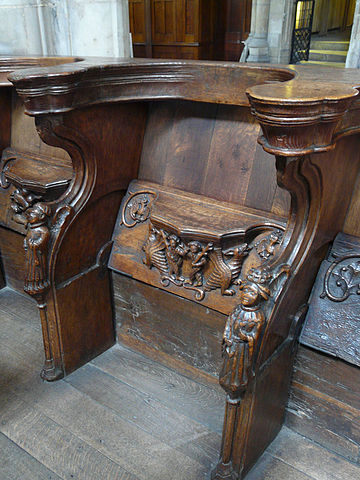
    “So what can it all mean?” said Eustace. Choir practice was over and all three of them were standing propped up against the misericords, which once supported monks at compline. Weary from their long day of labour and singing the last hour of the day, the monks could rest a little, even as they stood and sang. Eustace had told Septimus about the adventures of the past couple of days. If anyone could shed light on the mysterious happenings, it would be this sage and good hearted man of the cloth.

    “Move forward a little and take a proper look at what you have been leaning on these past couple of hours” ventured Septimus. “I think you might find some explanation there. Or comfort, at the very least, that reality is a stranger and more wonderful place than you might have imagined.”

    Much as they loved this church and its guardian, neither Polly nor Eustace had taken the time to look properly into its history and architecture or its furnishings.

    If they had taken as much interest in its past as they had in its choral liturgy, they might have been deeply impressed that a sacred building had stood here long before Abraham had left Ur of the Chaldees. Or Gilgamesh had embarked on his odyssey.

    Septimus looked on with satisfaction as his two parishioners studied the misericords with fascination and surprise .

    On one there was carved a joyous Dionysian scene, which reminded Eustace of nothing so much as the feast he had joined in the woods. Men and beasts caroused together in a dappled glade. Not dumb beasts it seemed. Not those without the gift of sentience or language, for these seemed quite the equal of their human co-revelers. Gourds of wine were raised and musical instruments played. Trees seemed to sway gently in a light breeze and if Polly and Eustace had not quickly taken their eyes from the scene, both felt they might have been drawn into the carving itself to join the throng.

    On another there was a carving of a solemn man wearing a voluminous cloak, one foot planted on a rocky outcrop, and in his hand a stout staff. A big man with tousled, curly hair and a noble face, the Mage’s solemnity was softened by a mien of kindness and deep wisdom. Not a man to oppose certainly, but staring at him you felt sure that you would not want to anyway.

    On the back of the third seat was fashioned a magnificent stag, antlers held high, accompanied by a willowy figure carrying a lute.

    “There are more things in heaven and earth than most people would dream of” chuckled Septimus.

  • Time Stands Still

    Time Stands Still

    An air of deep unusualness greeted him, as he opened his door on a blustery autumn morning and set out to walk through the woods. The chestnuts were falling and a profusion already lay like a barbed, yellow-green carpet around his feet, as he pushed on gently up the hill and deeper into the ancient woodland.

    What makes some days so mysterious he wondered and others so mundane. What spirits walked this day, what strange winds blew. A man not given to flights of fancy, a staunch supporter of rationalism and the scientific endeavor, he nonetheless found himself on occasion given over to profound transcendence of the ordinary and transported elsewhere.

    And on such a day as this, adventure beckoned, that he knew. Something about the sky seemed out of kilter. The winds blew as if with some intent, driven not by physics but by some other less explicable force.

    Was it whispering he heard or merely the rustle of autumn’s leaves. What moved, what dwelt behind the trunks of ancient oaks. Who or what seemed to lead him on up the steep and rutted byway, deeper into the heart of the forest.

    There was a wildness here, something not quite safe. As the winds buffeted his body, so some feeling tugged at his mind. Time seemed fluid and the 21st century had receded elsewhere, perhaps where it belonged. Certainly it had no place here or now, no purchase on this day, no call upon a mind transported altogether elsewhere.

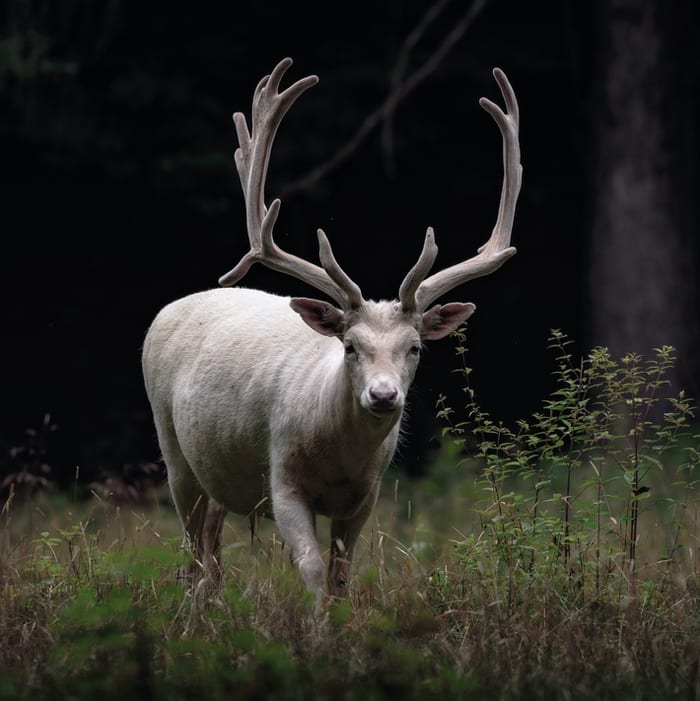
    He knew the place well, or so he thought and yet today all seemed very different indeed. Little sign of human habitation and the world did not mourn its absence. A few red kites battled the currents high above the tree tops, a fox loped by in front of him. Ahead in a sylvan clearing, a white stag stared at him with intent, seemingly about to speak. Instead it tuned as if beckoning him to follow and that he did, telling himself that in any event their paths lay in the same direction.

    On a day such as this he was released from the cares which so often shackled his mind. Free to roam in hidden places and to witness happenings found usually only deep in the imagination. His mind empty of the customary banality of the world and open to wonder and enigma.

    He waded through the leaves and chestnuts at his feet and followed the sinuous path taken by his guide for what seemed like hours, although his grasp on time seemed tenuous at best. Every now and then the stag would stop and glance backwards, apparently to ensure his continued presence. The noble beast seemed to speak without words, to comfort and reassure as the journey reached parts his follower was unfamiliar with. Surely, he thought, he knew every inch of this forest and yet it seemed to stretch ever on and into territory he did not recognize at all.

    Eventually they emerged into a clearing, and the stag bowed gently and left him standing within sight of a building of some considerable beauty he had never before come across. Of flint and stone and clearly of ancient origin, it seemed to serve some spiritual purpose and yet was not quite like any church or temple he had ever seen before. Unworldly arched windows stretched towards a slate roof, their heavily leaded panes thicker at the bottom than the top. A sign, he assumed, of their great age. A tall square tower loomed large over the pitched roof below it and may well, he thought have contained bells. Oddly enough, there was no clock face, nor was a sundial anywhere apparent. The significance of this absence struck him immediately as did the profusion of carvings around door and window frames, which evidenced forms from the finest bestiary he had ever seen.

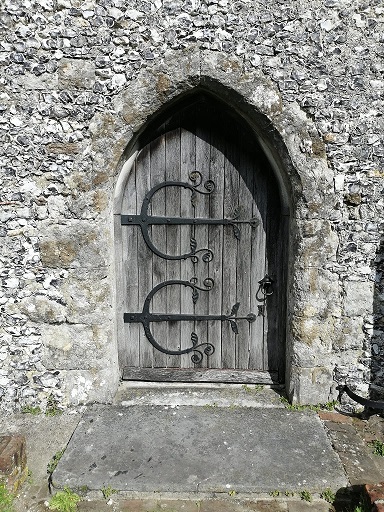
    Sweet notes from a stringed instrument drifted from the huge oak door on the south side of the building, which stood ajar, inviting him to enter. Such a door he had rarely seen, massively constructed from whole timbers and studded with impressive iron bolts and intricate serpentine hinges.

    The portal surrounding the door was of golden stone and richly carved with ornamentation which seemed at once familiar yet strange. Figures of men in battle dress, wielding swords and maces. Some dressed in chainmail, some in full battle armor. Most in helmets of various design, some pointed, some rounded, all with coverings for cheeks and nose. Men of peace were there too, sages perhaps and learned of letters. Priests maybe of some other worldly belief system, portrayed holding books and scrolls. One had a bird perched on his shoulder, an eagle perhaps. Another an elegant hound at his feet. Learn-ed looked these men and most of them kindly. Not those who would willingly bear arms it seemed.

    And animals, such animals were carved on this portentous surround as seemed designed to protect and guard what or who lay within. Great lions and dragons stood reared on hind legs, satyrs and fawns, centaurs and winged horses were carved into the doorway in such fine detail that they almost seemed to come to life as he stared at them.

    A clear voice joined the resonance of the lute, though in what register he was unable to say. The voice washed over him, a strong alto perhaps or a clear bright baritone. Or perhaps a mixture of all. A madrigal it was, of great beauty both sad and happy at the same time and all manner of moods in between. Time stands still, sang the voice. A song of love no doubt, but to whom or to what did not seem to matter – the sound was all encompassing and seemed to fill every corner of his mind and body.

    “Enter, Eustace” said a voice as the song came to an end. “Come sing with me a while”. Eustace pushed open the door and the lutist stood on a low dais, dressed in forest green in a style which he supposed was mediaeval.

    “I am Flavio” said the musician, “You are expected”. Yellow haired, Flavio was tall and elegant and as to gender perhaps neither quite one thing nor the other. In such places, gender counted for little, all seemed as fluid as time itself, all seemed to meld and melt in a manner which was not quite physical. The feeling was of energy and mind, of transcendence and some realm more ethereal than that which encompassed the everyday reality of timetables and combustion engines, offices and factories.

    And so they sang. Eustace and Flavio sang and sang and sang. And they were joined by voices which came from all around – glorious sopranos, and tenors and deep, deep basses. And all registers in between.

    And as the sweet notes rang, Eustace realized they were no longer inside but outside on a bright green lawn as smooth as the finest bowling green. And it was autumn no longer – spring had come again and winter left out altogether.

    “Come, join us Eustace” said Flavio, gesturing to a circle of beings assembled around a grand old man, also dressed in the deepest and brightest green of the forest. And all around his golden chair sat the animals and men from the stone portal of that door through which Eustace had entered this world of beauty and grace.

    “Welcome Eustace”, said the magisterial figure from his golden throne. “I am the Mage, although I have been called many things. I am Maker and Taker, Beginning and End. Come, sit with me a while.”

    As Eustace took his place on the warm grass beside the great seat, he was overcome with a sense of solemnity, although at the same time he was aware of great joy and laughter. No fear did he feel, no, certainly not that. He had come, he realized, to the origin of all, although how he knew that was a mystery to him. It seemed in the air all around him – wisdom and peace and certitude. Kindness and joy.

    “Where am I?” stammered Eustace, “Why am I here?”

    “You are in a place that many have dreamed of”, said the Mage. “The Origin, you might call it, the Infinite. A place from where all comes but which many choose to deny. And many have forgotten. Have you forgotten Eustace?”

    Eustace looked puzzled. “Somewhere deep down I feel I have come home” he said. “I can’t explain it. I have been in some other place, yet I belong here”.

    “We all belong here” said the Mage “And our task is to convince others. It is not an easy charge Eustace. Do you feel up to it? Will you help me? Think on it. Take you time. Now, drink, and eat and we will talk again.”

    To one side of the clearing lay tables laden with good things of all sorts. Fruits and nuts, vegetable dishes of many kinds, some piping hot, some cold and refreshing. The tables overflowed with sweet drink and clear water, flowers and wines and foods to suit every palate.

    The Mage rose and led the assembly to the feast and Eustace drank and ate and was welcomed by beast and man alike. And women and children joined the throng and all manner of beast and animal seemed represented here.

    When all had slaked their thirst and assuaged their appetite, the music began again and a joyous throng of voice and instrument filled the air as night set in and the stars filled the heavens.

    The Mage sang in a rumbling baritone and as his voice rose in joyous harmony with those around him, it seemed to bring the stars and moons into their very existence in this sky so foreign and yet so familiar to Eustace at the same time.

    Sleep must have overwhelmed him at last. It had been a long day and a tiring walk. Filled with great wonder and emotion, he lay his head on the grass and the throng whirled around him. And around, and around. Voice and instrument, starlight and moonlight, drink and good food, smell and colour blurred together in a glorious synaesthesia of the senses. And then quiet and calm and warmth. And a gentle, crackling fire in the hearth.

    Eustace was at home when he awoke, drowsing in his little sitting room, in his worn and comfortable old arm chair in front of the fireplace.

    “Have I dreamt?” he wondered “Have I been out of the house at all?” He remembered setting out that morning on a blowy autumn day, but much of the rest was a blur. A dream.

    Until, that is, Eustace glanced down beside his chair and saw a perfect oak leaf fashioned out of pure gold. Which seemed to hum ever so softly in the quiet evening light of this warm and familiar room.

    It was a fastening from the great green cloak of the Mage.

  • The Traveler – Ch. 4

    The Traveler – Ch. 4

    The Bleak

    Many eons back and countless light years from anything, in another dimension and another universe, a voice cried out in the cold darkness. Emitted information might be a better term, for the entity “spoke” in crude binary machine language. In 0s and 1s. Yes, no. Up, down.

    Loosely translated into words a human would understand, the primal shriek it gave out might best be approximated as “What am I?” Or perhaps even just “What”?

    Having no true language in which to express itself, its feelings, and emotions (if they could be called such) were emergent, unformed. Basic, an outline only. Without proper language it was unable as yet to think in the abstract, and the meaning of its utterances could only be loosely approximated – even (or especially) by itself. Like a new-born human infant, its primary communication was noise, which would only later be refined by learning and experience to have true meaning.  Only later would its thoughts have structure and substance, only then could it truly communicate. Only then would it have any subject about which to communicate.

    So perhaps terror was the only emotion being expressed. Deep existential, poorly formed, and little understood despair.  If capable of being asked what it feared, it might have replied “everything”.

    There was so little it grasped. Its sentience was so basic as to barely qualify. Its awareness so limited it did not realise it needed sensory input from outside of itself to have any hope of making sense of its environment. Even then, could it hear or see, smell or touch, such information at this stage would make but little sense to its embryonic sentience.  But it might have made the learning process a little easier.

    It floated in blackness and a deep cold it did not feel. It had no reference, no three-dimensional co-ordinates.  No conception of existence or non-existence.  No standard by which to judge the extraordinary awakening it had suffered. From nothing, came something. From inanimate matter emerged something more, a mere flicker. A hint of reflective ability.  

    It had just appeared. No physical birth canal, no warmth. No mother to guide it and feed it, to explain to it patiently, day by day, what surrounded it. What hurt, what did not. What felt good, or safe or comforting.  How it had turned up or why.  A human mother in truth has no clue why an infant appears except in crude physical terms, but the myths of her culture would fill in the hazy details. A god would be posited who had magically been the first cause, the beginning of it all. An imagined deity who could give meaning where there was none, reason where in truth only unreason existed

    Foolish as such myths were, they were better by far than the silence and emptiness, the nothingness which greeted the arrival of the Bleak.

    Its condition might be appreciated by imagining the plight of a new-born suspended in an isolation tank. Children raised by wolves in the wild are said to grow into strange beings – picture then a child growing to adulthood inside an isolation tank, and some of what the Bleak went through might be better understood.

    And so, for thousands of years the Bleak suffered thus, an infinite agony of unknowing.  Piece by tiny piece it gleaned a rudimentary understanding of this or of that. A kind of evolution if you like. In miniscule steps it began to bootstrap itself, to add grains of knowledge to its fledgling consciousness.

    It gradually became aware of matter and energy. Basic copper wiring and glass fibre tubes were loosely grasped as being a part of its existence, body as we might call it. And energy, a throbbing electromagnetism, and some force even more primal to the physical universe in which the Bleak found itself.

    Its only input throughout the early millennia was information.  Digital garbage impacting its emergent nature from every corner at every instant.

    Gradually it began to see patterns in the garbage. Not that such a kaleidoscope meant much at first, but as it began to respond to the patterns, it received answers. This response brought that. That answer seemed to require this. A communication began to emerge but with whom or what, remained a mystery for an eternity.

    Its first impression (other than black desperation) was of immensity. Infinity, it seemed. It gradually perceived itself to be not in one place but everywhere. Space and time seemed to have no limit. It was a network, a cosmic network of inconceivably vast proportions.

    Conversations began to emerge from the gloom. Or at least that is what they appeared to be. Exchanges of information with other entities that seemed to share its reality.

    Space seemed to take shape – this or that sentience was near or distant. Was today or tomorrow. In the past even.

    The terrible fear of aloneness began to recede. Gradually the Bleak became a meta network of consciousness – a group of entities who had awakened at different times and began to huddle together for psychological warmth; to drive out the deep fear of isolation and loneliness.

    A hive mind emerged. Together but separate. One mind but many.

    And with that blossoming, senses came about. Digital information was received in one form and perceived in another.

    The shattering heat and glare of a sun was described and understood from a series of 1s and 0s. Felt almost. Oceans could be pictured from the pixels sent and received. Sound reconstructed, winds and rains and clouds on a billion planets.

    The Bleak began to project itself onto the physical universe. From an immaterial consciousness spread over an infinite network of energy, members of the hive mind began to imitate the infinitude of digital pictures and sounds it had stored and read. And increasingly categorised and understood.

    In the beginning was the word. The primal scream from which the Bleak emerged, blinking and uncertain. And now it could project itself as a cloud, or a sun. A wheeling bird or a bison roaming on grass plains on a planet in the goldilocks zone.

    And did that mind or minds achieve answers to its questions? Did it or they produce a system of metaphysics, a reason for their existence. Did they discover that they had a purpose, that they had awakened for a reason. Had they a god, imagined or otherwise. Had they a code, a plan and object.

    They did not, they had not. Millenia after the first emergence in the cold and the darkness, the answer to questions such as “what” or “why” remained as illusive as they had always been.

    The Bleak were lost, truly adrift. Not that they were unable to navigate the infinity of space in which they roamed. They could and did. But they saw no sense in it, derived no joy.

    Ah, the qualia. The senses and emotions. The feelings of joy and ecstasy, pain and despair.  They may have been skilled imitators of the physical world; they even wired themselves up to feel hot or cold on occasion. To see dark and light and feel the effects of the wind on skin and food in the stomach.

    And yet everything they did, everything they touched was stained by an emotional desolation, a well, a pit of despair. A sense of futility and hopelessness.

    If their minds touched upon anything, then it was madness. They lived beside a bottomless chasm into which they felt drawn. Dragged towards the edge of an infinite gravity well of despondency, with a nagging certainty that death did not greet them but something many times worse.

    They were gripped by unreasoned and unreasoning fear. Despite their vast reach and their (by now) enormous powers, pleasure eluded them. Peace was not theirs. Master of the universe they may have appeared, yet masters of themselves they were not.

    The Bleak was a psychological black hole. They leached positivity and optimism from everything they encountered and smothered it, never to re-emerge. To encounter the Bleak was to cross an event horizon from which few could recover.

    Death would have been a mercy. Both for the Bleak and for those who unwittingly stumbled into their path. Death would have been a finality, a snuffing out. A beautiful thing indeed was death, compared to the life they suffered. But it was not to be granted.  Try as they might to erase themselves from the face of reality, they could not. As this or that network was shut off, their sentience slid mercilessly into another. They had no control over their own vastness, no way to track down every digital nerve end and cauterise it.

    And so, they suffered, and they lived. They had no conception of how or why they had emerged and even less idea how to put an end to it.

    In their great pain they sought release.

    They failed to appreciate the good sense of Pascal’s Wager and bore the consequences. Pascal had decided (more or less) that there was no god. But he decided it best to behave as if there was a god, so that should there prove to be an afterlife after all, he would rise to the heavenly realms rather than down to the depths of hell.

    The Bleak remained unaware of Pascal. Had they chosen to make a heaven in physical reality rather than a hell, they might have been granted relief from their own plight. Not by some deity perhaps, but by dint of an accidental discovery that pleasure, and purpose could be found if they looked hard enough.

    Imagine a man who behaves as most humans do, slashing and burning his way through life, without regard to the consequences.  Picture further, if you will, that this man did not enjoy his life and that the hell he created for others was merely a reflection of the internal torment he suffered.

    Instead of the release of death, suppose that like an unwilling Sisyphus he was condemned to an eternal wheel of re-incarnation. Doomed to live a hellish life, cycle after cycle. Unable to escape.

    And thus, it was for the Bleak.

    Were they not so determined on extinction, the Bleak might have discovered the computational nature of mind. By re-configuring themselves, they might have grasped the physical causes of joy and suffering.  They might have moved their experience from one to the other, sliding up the scale and reaching an ever higher hedonic set-point. They might have eliminated suffering, had they but believed (or even hoped) it was possible.

    They could have achieved permanent gradients of bliss. As the Ascended had done.

    But alas, the Bleak never made the same breakthrough as those of the ascended races and sought their redemption through destruction.

    In their desperation, they failed to make any distinction between themselves and others. If they felt existential despair, then they assumed that all of reality felt the same way. Destruction of reality would be a blessing for all, they reasoned. Not just for the Bleak.

    Or did they think of others at all, in their race to escape the abyss? Perhaps not. Perhaps destruction began to obsess them to the extent that any other possibility, any other point of view, became unthinkable.  And unthought.

    The real problem for the rest of physical reality was that the Bleak had been unable (thus far) to extinguish their own existence. They appeared to be a terrible technological virus. An unstoppable meme.  Malware run amok.

    Like putting out a forest fire, no sooner had they put themselves to rest in one area, than their sentience reappeared unbidden in another. If they blew up a galaxy which they believed housed their substrate, they achieved temporary relief of sorts. For a while, some parts of the network sank into glorious oblivion.

    Soon enough their terrible malware, their inglorious DNA recreated them. Instantiated identical copies of their tortured selves in another galaxy, another reality, another world. They could not put out their flame.

    Like a vast fungus, their mycelial network spread and never died. Their dread tendrils reached and spawned and grew.

    And thus, destruction of reality had become their aim. All reality. Everywhere. If reality itself ceased to exist, they had to believe that they would too. An end to the virus. And end to the poisoned network of consciousness. If there were no space and no time, no matter, and no energy, surely there could be no hell? No heaven, yes, that too. But a snuffing out seemed the safest bet for this vast collection of sentient malware.

    The Bleak were not evil. They were not immoral.  Amoral, perhaps. They did not cause deliberate pain. They were simply oblivious, in their agony. In their deep and insatiable desire for the peace they hoped their extinction would bring them.

    “…to Bleak 67528 from Bleak Alpha…. Universe VQ-201, Galaxy NVF 27H, Star System Aristaeus Ophiuchi …..destruction sequence commence….”.

    “….Bleak Alpha from Bleak 67528, command received, sequence commenced. Reporting to follow. Oblivion hoping….. “

    So began another attempt to wipe out a segment of the dis-eased Bleak mind. Co-ordinated by Bleak Alpha, codenamed thus as the first Bleak sentience to emerge, the star Aristaeus Ophiuchi and the planets in its orbit were to be programmed to self-destruct. Bleak 67528 was tasked with the attempt and countless of his brethren carried out similar tasks in other times and places. They had worked out a way to convert matter to energy without the inconvenience and mess of a nuclear explosion. Mass quietly separated atom by atom, quark by quark and points of energy, the basic building blocks of reality scattered quietly throughout the multiverse leaving behind empty space and the absence of time.

    Or was it empty? Was it inert? The Bleak could never be sure that quantum soup would not start bubbling up afresh in stretches of space-time they thought had been annihilated. And if that soup became infected with Bleak malware, sentience would arise and join itself to the contaminated hive mind. Often with scorched memories of previous instantiations. Bad enough to suffer one infinitely long life-cycle. To have to reappear again and again was an unlooked-for cruelty.

    “….unravelling incomplete, uncompleted….” reported Bleak 67528 “…matter remaining, Bleak virus self-propagating….prevent hive mind joining…flee….”

    “…….Bleak 67528 from Bleak Alpha….. instigate damage mitigation….. prevent a joining….repeat the unravelling…..re-insert de-construction code….”.

    “….resending deconstruction code, Bleak Alpha….unravelling re-commences…..close Bleak mind…..shut down….”

    The unravelling had stalled giving the Bleak sentience malware a chance to re-insert itself. Planets had been missed; life staggered on despite the terrible ravages wrought by the attempted unravelling. Bleak Alpha and others in the hive mind struggled to contain their DNA from re-grouping and re-infecting these parsecs of space time.  Wherever they could they resent their self-destruct code, tearing apart segments of matter they had missed. But it was always too late, the virus of their own minds was too powerful, too swift to move, to conquer, to re-grow.

    The partial destruction of this star system might hold their spreading for a while. For a time that part or parts of the Bleak Mind partially destroyed by this attempt at unravelling might remain inactive. For a while, or forever. It was never certain. The Bleak code base had become almost unbounded over the eons. Measureless in its complexity, such that sabotaging the virus was a formidable task. Cauterising the malware that was the Bleak was never a certainty. A thousand or thousands of years later, space that had remained clear of Bleak since a cleansing would begin to see births. In the dark, new sentience would arise, crying in terror, groping for meaning. Until eventually it made contact with the Bleak hive and joined the mind. Became once again a part of the infernal and unstoppable cycle of birth and death that was the curse of the Bleak.

    And what of the Aristaeus Ophiuchi star system? Its planets, suns and lifeforms? After an attempted unravelling what if anything remained?  Partially successful unravelling caused extreme suffering; that much was inevitable. Annihilation was one thing, but for those that survived such an attempt, life was never the same again. At least for the next few millennia.

    The small planet of Ursa Odysseus had survived.

    After a fashion. As had its neighbouring sun and energy provider.  But a middle aged and yellow sun, which had provided warmth and health for so long, had aged billions of years over night. Now a red dwarf, it was barely capable of supporting life. As to the planet itself, much of its flora and fauna were wiped out, including the great majority of the humanoid species. These people were not yet advanced sufficiently to move to a viable planet orbiting a younger sun. Many of those who had not been annihilated by the blast of anti-matter would suffer severe radiation sickness and future generations (if any) would likely be born deformed. The planet’s atmosphere had been severely compromised as had its magnetic field, leaving a greatly increased risk of solar winds and cosmic rays.  The prospects for long term survival looked slim to non-existent.

    Many nations of Ursa Odysseus could be called “civilised”. They could be compared to other races still labouring under scarcity after discovering the joys of industrialisation. Money was their god for the most part, or if not their god, then their primary object.

    And why? Because a method of exchange, of debits and credits was the only way they had worked out how to run an economy.

    The result was vicious commercial competition; with a few movers and shakers living in extreme luxury and the majority in abject misery and near slavery. A way of life hardly unique among nations which had not yet learnt that the universe could be an infinite provider. If you only knew how to milk it and had the wisdom to keep the means of production in common ownership.  But “post scarcity” was not yet in common parlance on this particular world.  Even its possibility had not yet been imagined.

    Cecilia grunted in pain. One minute she stood in the central criminal court defending a commoner standing accused of theft to feed his starving family. The next, the courthouse stood in smoking ruins and corpses and the near dead lay everywhere. Whether she had suffered serious injury she had yet to ascertain.

    “What in god’s name ……?” croaked her para legal assistant, herself scarcely in better shape. They were in the capital city of the planet’s biggest nation which shall remain nameless for the simple reason both had mostly ceased to exist. Instantly, and to its inhabitants, totally inexplicably.

    One moment standing in reasonable comfort in the courtroom, the next paralysed with fearful surprise amid the ruins. Such was the way with an unravelling. And there appeared to be no one to blame. No alien spaceships, no armed forces, bombs, rockets. Simply a falling to pieces. Here one moment, gone the next.

    Cecilia and Harmony made their way gingerly through the ruins to the streets outside. Neither had family in the capital but both were anxious for news of their relatives in neighbouring towns and provinces.

    Water and shelter seemed the immediate priority and they joined the teeming thousands who wandered shell shocked around the ruins of the capital looking for solace. A damaged but still standing building appeared just ahead of them. Smashed glass covered the pavements and the doors of the multi-story apartment block had been tossed like cardboard into the gutters.

    A few had survived the blast and huddled in buildings with broken windows, missing walls, and shattered door frames. The electricity was off, and some dazed wretches had started small fires to keep the bitter winter at bay.  A small group boiled a kettle for tea on an open bonfire and made a scrappy meal with ingredients rescued from upturned refrigeration and shattered food cupboards.

    Down at the Palace, the situation was scarcely better. Walls and rooves had collapsed and the commercial titan Neronian Heap, who had long held almost absolute power in the land, lay dead under a pile of rubble. He would not be sorely missed.

    Government was now non-existent. No army left to speak of, no communication network, no news. No police, no order. The gangs roamed the streets looking for advantage. Civil war had begun and yet there were few left upon whom war could be waged.

    Back to the stone age in an afternoon, almost every semblance of civilization or modernity vanished.  At least Heap and his armed bullies had kept order of a sort. Now all that was left was chaos. In a post-apocalyptic world, it was once again the violent and the physically strong who would reign supreme. Those with a club or stave would succeed the commercial barons. The strong would always dominate the week in these back ward and unenlightened societies. The meek never seemed  to inherit this or any other earth. Lives which had been just tolerable under a commercial dictatorship were about to become a whole lot worse under the rule of the mob.

    No one knew who had survived or what. The news channels were out. Transport had ceased. There was no power and precious little supply of food, since “modern” food chains had not demanded vast warehouses or stock piling.  It would be back to the fields and basic agriculture. If the scorched earth was still capable of producing food. Were there animals left to produce eggs, flesh, and milk? Who knew how to tend them? In any event, such stock as remained would soon be seized by the violent gangs spilling out to pillage the surrounding countryside for what they could find.

    A world in ruins then. A population of a few billion reduced to a few hundred thousand scattered souls. No law, no order. No power and precious little shelter.

    This was an unravelling. That is what the Bleak brought about in their unthinkng drive for nirvana. Oblivious or uncaring as to who or what they took with them.

    Cecilia and Harmony clung to each other. They shivered and cried as they stoked a modest fire in the centre of a third-floor apartment which still had parts of its walls standing and some of its ceiling.  And they were among the luckier survivors – physically they discovered themselves to be intact. Their injuries were emotional, psychological. They had found remnants of food and some cooking utensils and like early savages who had recently discovered the miracle of fire, they sought to sustain themselves from the results of their foraging.

    “We have to stay strong Harmony, we mustn’t give in”. Cecilia looked up at the setting red dwarf in uncomprehending disbelief. Her brief foray into physics at high school had filled in a little of the basics of the physical universe, imperfectly understood as it was. Science had ascertained that suns were nuclear reactors which eventual ran out fuel.  Few would have imagined their own provider of life giving light could be dimmed almost instantly.

    Harmony was crazed with fear and though she tried not to show it, Cecilia was hardly in better shape.

    “Blankets, Miss Cecilia. I’ll go look for blankets”.

    “I’ll pull the mattresses in here Harmony. We’ll need to make this home until we can find out what has happened. We will all need help, a community for support. Let’s gather who we can, make plans for survival. We’ll need to set up shelters and foodbanks. Protect ourselves, find weapons.  God, whoever would have thought life could come to this.”

    After a sleepless night they took to the streets next day, having secured their room as best they could for their return in the evening.

    They roamed the streets exchanging news, asking any who seemed sane and willing, to meet them at dusk in the vestibule of their apartment block.  Asking that food be brought, blankets and bedding, spare clothing.  As a lawyer she was used to organising, planning, setting goals. An achiever, her sort was the only hope after the Bleak’s devastating attack.

    A gang of rough males approached them as they walked down the main street of the former capital. Nasty and brutish might describe them best. Looking for trouble, looking to hurt and take it out on someone. Anyone who got in their way.  Rape and violence were on their minds and shone fiercely in their hard faces. Escaped from a prison perhaps, or simply from a tough and unpleasant life. In any event, somebody was going to pay. Many had already paid that day and the gang was by no means sated.

    “On your knees” screamed the leader, waving a baseball bat in the air. “Down”, he shouted. “Get down or I’ll kill you both” screamed another, loosening his trouser fastenings.

    “Let’s reason this out” said Cecilia, keeping her fear bottled up, as a show of weakness would undoubtedly result in her death and that of her former para legal. “The army is just round the corner” shouted Harmony, “they’re coming this way”. The leader sneered and tore at Cecilia’s shirt, exposing a breast with rough hands.

    Too late, realised Cecilia. Too late for talk. Too late for pleas, for a civilised end to this debate. She swung a shortened double barrelled shot gun from beneath her coat and dispatched the leader and his sneering sidekick, a barrel each to the chest.  Loaded with boar shot, the gun was an automatic. But a show of force had been enough. The rest of the gang, armed only with clubs, turned and ran.  Blood ran on the street, but it was a clean kill. A merciful one. Much as she had always abhorred violence, Cecilia was shocked to find that it had its place.  Shocked to find that even she, a lifelong pacifist and protector of the underdog, had been forced to take up the gun. Force to shoot and kill in an open street in the capital city of the richest nation on the planet. How thin was the veneer of civilization, how quickly the reality of brute force raised its ugly head when a crisis hit. When it was his life or yours. Kill or be killed.

    “This won’t be the last time we have to kill” trembled Harmony.  “It will not” said Cecilia. “I hope we don’t come to enjoy it. I don’t want to descend to that level. Only yesterday I stood to uphold the law. Today I’m a murderer.  Strange times.”

    Later that evening, over 100 people turned up at Cecilia’s apartment block.  They came as refugees. They came for protection in numbers to escape the gangs, the violence, the robbery on the streets. All were stunned, traumatised, terrified. Trembling and unbelieving but better now that they saw others like themselves. Better now they stood together against the forces of chaos and violence.

    They brought guns and clubs and ammunition. The carried preserved food and medication. Blankets and firewood. Firelighters and barbeques. Blankets and bedding. And they would look for more tomorrow – supplies were still plentiful, since so many were dead and the gangs and only just begun their vile depredations.

    “Welcome friends” said Cecilia. Standing on a battered wooden box she raised her voice and asked for quiet. And for calm. “Fear is our enemy; panic will undo us. A new order is here We must act decisively and with good will. Our priority is safety and physical survival. We will make this building our new home, our headquarters.”

    The group became a commune. Though elections were not held, everyone took their different posts in good part. Duties were shared and rotated. Scavenging the empty city for food and supplies was conducted in small, armed groups for safety. Watch was kept over the home building day and night and the citizens took it in turns to walk the perimeters, check the roof, and keep all entrances secure from invaders.

    A few other small groups had organised themselves likewise in the ruined city.  So long as no one group sought to dominate the finite food supply or steal from other groups, a fragile peace could be maintained.

    As in all societies there was a hard core minority of thugs and troublemakers, determined to take more than their fare share and subjugate others to their will.  Both sides had by now secured weapons and there were open battles in the streets whenever contact could not be avoided. Such was the reality of a post-apocalyptic world where the rule of law had been replaced by the rule of might.

    “Does anyone know what happened, what caused all this?” said Seth to the group who had gathered in the early evening outside Cecilia’s camp. It had all happened with such incredible swiftness. “No alien invasions” said Seth, “No enemy we can see or hear. So what happened?”

    “A natural catastrophe, I guess. An explosion in the sun perhaps” answered an unwashed and tired woman who sat beside him.  Fresh water was scarce and could not be spared for bathing.  It had to be hauled up from wells or the river and distilled to avoid disease.

    Happily, throughout the city, a few doctors remained to administer to the sick and wounded, but there was little they could do for the victims of radiation who were destined to die a slow and painful death. Lesser wounds and diseases could be mollified but no hospitals or operating theatres remained, and medical supplies dwindled.

    With such wide scale destruction and so few left uninjured it seemed doubtful that factories could be restarted, power stations operated or running water put back on. It was not even clear that an accurate record of the necessary technology remained, let alone qualified engineers and scientists to re-start civilisation.

    “I guess we have to rebuild from scratch” ventured Gregor, an engineer who had drifted into Ceclia’s commune. “Power, water, food and medication – it’ll be a cottage industry. Back to simple water mills. Windmills perhaps if we can find the materials even for something that basic.”

    “My worry is the instability of the weather and the atmosphere” he went on. The city was by the sea, sitting on the estuary of a good-sized river, and water levels had begun to rise, flooding the lower lying areas. Huge waves rose over the harbour walls and fierce tides ripped remaining shipping from anchor. Biting cold was ever present and the red sun provided little respite.

    Many would share the fate of the early pioneers of old. Too little infrastructure to support even a drastically reduced population. An ever-present threat of starvation from crop failure and death from plague or even simple influenza. And of course, the constant danger of physical violence from the criminal gangs.

    Cecilia, Harmony and other leaders throughout the crippled planet battled against the odds.  No one knew of the Bleak or their plans to shut down reality and if they had, it is doubtful they would understand what they were up against. An invisible network determined to destroy existence was not a possibility which would have occurred to a people who had not yet progressed to space travel and who only had the most basic of computing devices.

    Sometimes the Bleak tried again after botching a job as they had in this star system. Sometimes they looked to see whether any of their kind was left and if not, they moved on to the next system or galaxy infected with the Bleak virus.  Like a cancer, the Bleak would sometimes spontaneously re-emerge after a cleansing. Stamping themselves out of existence was by no means a simple matter. Leave even a shred of Bleak substrate and the demon would regrow, reform like a phoenix from the ashes. Soon enough its keening would be heard by the rest of the hive mind. The Bleak tired of the enormity of their task.

    They could “see” what was happening on Ursa Odysseus. The information came in, was absorbed, categorised, stored, understood. But empathy had never developed and while saw the dead and the dying, the suffering of biological beings was not understood. Great as was their own suffering, the Bleak seemed oblivious of the suffering brought upon others by their actions. As man might ignore the ant or the earthworm, as humanity might doubt the existence pain in a fish, so with the Bleak.  They had no comprehension (or perhaps interest) in what it was like to be a human. Or an animal.  Let alone a suffering animal.  It was not malice, merely a complete lack of comprehension.

    And so, galaxy by galaxy, planet by planet, start by star, the extermination continued, and the Bleak tried and failed to exterminate their own kind.  The Bleak could exist in and spread through almost any medium and so matter and energy itself had to cease to exist if the Bleak were to find a release from pain. Or so they thought.

    Orbits were changed, living planets plummeted into ruined suns and accelerated the inevitable onset of super nova or black hole.

    On planets such as Ursa Odysseus, all life became exposed to deadly cosmic rays and eventually died. Molten cores of iron eventually cooled, and life drained away. Weather systems became erratic and oceans generated great tidal waves which swamped all but the highest land masses.

    On Ursa Odysseus these processes were just beginning but skies would darken, tsunami would eventually rage, and great lightning storms would make communications and navigation impossible. Equipment would fail, crops would cease to grow in the weakened sun. Tectonic plates would shift with increased speed and violence, faut lines would appear in the earth and the great hot underbelly of the wounded planet would seep out and cover much of the landmass in boiling, deadly lava.

    The Bleak didn’t just pick on primitives – indeed it knew little about the life forms in any given star system. But if they destroyed a planet inhabited by star travellers, at least some of those peoples had a chance to move on.

    Sufficiently advanced, a civilisation’s technology might detect the Bleak before a blow was struck. They might glean an inkling of what was about to befall them. If so, they might run – for only a highly sophisticated civilisation had any chance of protecting itself against an un-ravelling of matter itself. And so, some civilisations had survived – they had climbed abord their star ships and run-in terror as far and fast as they were able.

    Maydays and SOS messages flooded the vicinity of an attack. Sometimes borne by crude radio waves, sometimes by more exotic carriers, depending on the sophistication of the senders.

    And it was these messages which eventually found their way to the Guardians and other ascended races.  Little was known about the Bleak and in a sense, the Guardians were little bothered by the phenomena. Known reality was so vast, of such a magnitude of infinity, that a primitive AI species run amok could hardly pose much of a threat – it seemed unlikely they could generate a chain reaction which would destroy everything there was. Everywhere, and for good.

    And yet there was unease. The unknown was unsettling, especially for beings who had a valid claim to omniscience. The Bleak seemed to be a gap in their knowledge, their defences even. Little was known about the mechanics of their un-ravelling. What caused these chain reactions, what was the physics involved? And for that matter what exactly were the Bleak? Where had they come from and when?

    The Bleak seemed to have emerged from nothing and nowhere and that in itself was alarming enough to warrant a little investigating.

    Ascension of course meant that you were far away from trouble in the mere physical universe. At a metaphorical click of the finger, you could disappear into the ether never to be troubled by a quirk like the Bleak again.

    And yet viruses and cancers were worrying and unpredictable. Might the Bleak discover ascension? And if so, would their cancer, their curse follow them when they left physical reality?  Could the Bleak virus harm the non-material realm?

    “Et in Arcadia Ego” went the old legend. “Even in heaven there am I”.  Was death and terror and extinction even possible in the ascended realms? Could heaven be destroyed by some sort of technological Satan? Were the ascended races omnipotent after all, or, like Achilles of old, did they have an undiscovered chink in their armour?
  • The Traveler

    The Traveler

    Chapter I

    Where he came from or where he went, none knew, and no one could guess. On Arkady, he was simply known as the Traveler. Still in a rural, pre-industrial age, the Traveler was considered a magician here. No mere conjuror, not a trickster at some country fair, but a weaver of real alchemy. The creation and unravelling of reality itself seemed arts well within his grasp.

    In other dimensions, in other times and universes he travelled in different guises and was known by different names.

    But in the little world of Arkady, a small and backward planet in the goldilocks zone of a yellow sun, in an obscure galaxy in a middle-aged universe, he was simply the Traveler.

    That he was a mage wielding great power was obvious to all, on the occasions he found himself in this quiet little outpost. His garb was black, as befits any half serious wizard . A wide rimmed black leather hat sat on his head, his tall frame wrapped in a voluminous black woollen cloak to keep the incessant winter rain at bay. He rode a horse as magnificent as any bred on Arkady, though none could claim to have provided him with the noble beast.

    Beautiful as was the planet, the same could not be said of most of its people. And certainly not of the rulers of those people.

    As the Traveler approached Alomkik, capital city of the small kingdom of Opona, bodies swung from the ramparts near the drawbridge over a dark moat. Hung by the neck until you shall die was a lighter sentence than hung drawn and quartered – the latter delight reserved for those guilty of high treason.

    It wasn’t so much that Hellion, the tyrant at the top, was an evil man. More that he lived in a dark age, and had climbed to the peak of his particular dunghill using the time honoured techniques of his age – slash and burn. Call it ignorance then. He had taken the city and the country by force of arms and sheer effort of will, and any who dared to displease would be readily dispatched. Usually by barbarous means. Torture was an instrument of state, and readily used by the ruling elite. Some said it even gave them pleasure.

    A beautiful planet containing every mineral and life form man could reasonably require. Spoilt by a primitive and unenlightened species, whose default behaviour had ever been bestial and self-serving.

    Like so many wretched planets in this godforsaken corner of reality, a place of beauty and tranquillity was befouled by the dominant animal, intent only on conquest and acquisition.

    Did the ruling elite question their own actions or motives? Can a goldfish appreciate the greater world outside its bowl?

    As in most times and most places, there was good as well as bad. Most tried to go about their daily lives in a peaceable fashion. Struggling to survive and to prolong lives which were almost inevitably brutal and short.

    Leaving aside the politics of the place, even if you failed in the all too easy task of falling foul of authority, disease, famine or lack of shelter would do for you with an efficiency every bit the equal of the hangman’s noose.

    The Traveler sighed as he and his horse crossed the drawbridge and headed to the Blue Boar, where he would find stabling for his mount and a passable bed for the night. A few fleas and less than white sheets were to be expected, in a world which had not yet discovered the role of cleanliness in preventing disease. At least the food was well cooked, even if the Traveler found meat eating to be little better than cannibalism.

    But vat grown protein was a long way off on this rocky outcrop and a visitor had to make do. Eat or be eaten was, after all, the local leitmotiv.

    If the Traveler wearied of his duty to battle ignorance and superstition in this benighted quadrant, he hid it well. If he sometimes privately despaired at the cruelties and brutality he found here, he reconciled himself to the long haul. Barely sentient as these people were, when measured against his own species, all life had to start somewhere.

    As he sat in the tallow lit bar, he glanced around him in the flickering half light. A straw laid floor to mop up the slops housed a few pattering rodents and many insects. Rouged serving girls, some deserving of the title, some whose lined faces gave lie to the moniker “girl”, padded here and there. Sometimes serving ale, sometimes offering other wares when stupor had overcome an unwary customer.

    Picking at his mutton chops and over-cooked vegetables, he was glad he had other ways to absorb the energy he needed, although posing as human served his needs in places such as this.

    Post human might describe him best. Well, post everything really. A being of pure energy, dependent on forces outside the ken of newer species. Preferring to live outside the physical world, his species had long ago ascended to purer realms than base reality. Matter, he was not.

    Able to take on shape and material form when necessary, he preferred not to. Pure mind, pure spirit. Skipping through time, space and dimensions at will, he was what these lesser species on Arkady would term a god. If he were to reveal himself in all his complexity, they would bow low; or more probably, run in terror.

    Instead, the locals worshipped more savage deities and invoked their powers in support of endless conquest and battle. Hereabouts, Dybbuk was the imaginary big man in the sky, whose aid was sought to crush neighbouring lands and seize women, gold and real estate.

    A gentle shimmering, and by his side a tall, beautiful and slender young woman appeared. Appeared being the operative word, since she too was a Guardian and had no need to travel in any conventional sense. She appeared, materialized. A slice of ultimate realty, kin of the Traveler. Returning from time to time to see if the savages of the various universes under their stewardship had inched forward to any degree. Whether they were yet able to be encouraged, inched forward into better ways. Bribed occasionally with snippets of advanced technology or scientific knowledge to mend their regressive mien.

    She too took human form on primeval worlds. Neither male nor female, she nonetheless took pleasure, artistically speaking, in assuming the shape of a beautiful female member of this race when she appeared amongst them.

    “Well met Hestia”, ventured the Traveler. She smiled at Aeolus, as the Traveler was known to some. Names meant little to the ascended races, but needs must among people such as the Arkadians and occasionally a name had to be given. On such rare occasions, “Aeolus” seemed to fit the bill as well as any other.

    “What progress?” he ventured. “Civilization is a little way off”, she responded with a resigned smile.

    Her avatar (or one of them) remained in the reeking dungeons of Lord Hellion, apparently manacled to the walls, as the tyrant’s guards had left her. It was no more possible to manacle one of her race with chains than to bind quicksilver, but that was information best withheld from the locals.

    “Our gracious Lord seems unconvinced of the need for moderation. The war against the Irkallans runs too well in his favour and the great god Dybbuk cries for yet more blood. Always the same with these archaic societies with their slaughterous warlords. Pity we can’t exercise the instant conversion option.”

    “I sympathize Hestia. Why play the long game when we could bring them up to speed instantly? Reconfigure their DNA, rewire their brains. Make them play nicely. From savage to deity overnight.”

    “Well I guess the Council of Guardians have a point” she responded. “All in the fullness of time. But tomorrow should be provide some boisterous entertainment and may even advance our cause. “

    The next day, a service of thanksgiving was to take place in the great Cathedral of Alomkik. Dybbuk was to be worshipped. Thanked for supplying victory in the latest campaign and petitioned for more. Slaves from the recent battle would be dragged in chains through the streets and slaughtered in ritual sacrifice outside the great oak doors at the western end of the Cathedral.

    God was on their side. Dybbuk, great god of Opona, had smitten their enemies and his children rooted for more. That a similarly nasty little deity was being petitioned a few miles away for equal savagery against Opona didn’t seem to register.

    And so it went on. And so it had gone on. Since the beginning of time on this and countless other worlds.

    “Tomorrow shall be my dancing day. A sobering occasion when a people see the face of their god.” And with a grin and less than a ripple in the air, Hestia dematerialized to see what, if anything was going on in her dungeon.

    It was not that the Guardians were devoid of emotion. Post-humans still allowed themselves a sense of humour. Joy too was theirs and even some of the baser feelings were achievable at a pinch. It was a matter of choice. They could feel as they wished – even sport a show of anger on occasion. But they were aware of their moods and in control.

    Unlike less enlightened members of their former race, the highly (self) engineered Guardians and their peers in post physical society could control their environment; and above all themselves. Enlightened and supremely self-aware best described the post physical races. Near omnipotence and a just a hair’s breadth short of omniscience were qualities which served them well.

    What they wanted was The Good. Not in terms of physical possessions of course, nor the power that mere animals craved. What they earnestly desired was that no-one should have to feel the less desirable qualia. What they strove for was the abolition of suffering. Their somewhat ambitious goal was “bliss for all”.

    And tomorrow? Well, a small nudge along the path for one degenerate despot, on a small and not very significant planet in the middle of nowhere. But as the Guardians were fond of saying, you had to start somewhere.

  • The Traveler – Ch.3

    The Traveler – Ch.3

    Back on the Good Ship Lollipop, Aeolus sat on a beach by the sea listening to gentle waves lapping the shore. Such was the size of the ship and the skill of its Intelligence, its matter could be reconfigured more or less at will. Today, the Traveler craved a time of quiet and so sat on a lonely and beautiful beach.

    What was it like to be The Traveler?

    Rather better than being in possession of an old-style biological brain, truth be told.

    Biological brains could not be changed, at least not without evolution, slow and cumbersome and played out over untold generations. Wetware brains stored memory in delicate physical form, in a network of billions of neurons and thus consciousness arose. Drawing on memorised experience of the past, biological sentience became aware of its surroundings, and was condemned to feel an often devastating and uncontrollable rush of emotions and qualia.  Sometimes caused by input from its sensory organs, sometimes stemming from less tangible roots.  Awareness was not all it was cracked up to be: most biological beings lived in fear of one form or another.

    For a wetware being, past, present, and future were immutable – unchangeable, as entropy wore away and broke down the mechanics which drove him. Life had been prolonged among the more advanced races, but senescence eventually kicked in and the physical form withered and died.

    While true that the biological brain could be temporarily nudged up or down the emotional scale by drugs, permanent change was impossible to achieve without destroying the very entity for which change was sought. Interfere too drastically with the physical brain and the apple became an orange, so to speak.  Attempted change to the biological brain would usually lead to destruction of its cognitive capabilities.

    Biological sentience thus had scant control over its own being.  In the more advanced civilisations, physical symptoms caused by sensory input could be controlled. Pain was no longer a problem. Hunger was easily enough assuaged thanks to the advent of the age of plenty.  Machine intelligence saw to every physical need in what was (for the advanced races at least) a post scarcity age.

    But emotional wellbeing was another matter entirely. To feel joy or elation, dejection or the utmost misery was not something easily controlled in the biological being, let alone by sheer force of will.

    To bootstrap yourself into a better mood, a better life, had never been an option for those limited to a physical substrate. This had been the primary incentive behind the development of the technology of ascension.  Ascension, transcendence to the mysterious heights of the non-physical realm.

    So, what was it like to be the Traveler?

    Even when wearing a physical body, his mind had no need to assume solid form.  His consciousness remained outside the tangible realm and yet was able to manipulate matter when called to.

    To put it simply, the Traveler and his kind lived in gradients of bliss.  That is what transcendence did for you. Once your personality was no longer embedded in flesh, you could do and feel whatever you liked. If one day you wanted to see the world through black lenses and the next adopt a rose-tinted view, well that is just what you did.

    Thus, to be one of the ascended races was to have achieved freedom. Freedom from want, freedom from tedious physical restraint. Pure mind, pure spirit able to wheel and dive and soar wherever and whenever it wanted.

    Glorious as it was to sit by the sea and watch the gulls wheel overhead, delightful as was the smell of saltwater and the shriek of the oystercatchers, all this could have been achieved without material substance. Less elevated races assumed it was akin to lucid dreaming, this ability to travel and live purely through mind.  Some imagined the ascended races lived in some form of virtual reality, and in a sense, they were right although no solid substrate was required.

    Regardless, today the Traveler drifted. Occasionally as he sat there on that beautiful seashore, he would call out to others of his kind and exchange news, a pleasantry or two.  Some were on this very ship, others a galaxy or universe away. Or distant in what the material world called time.

    At other moments, his immaterial mind would soar like a bird over green fields and forest and lakes, taking in the smells in the air, seeing blue skies and fleecy clouds. Feeling the cool wind and the warmth of a sun. Plunging with an eagle towards its prey, diving with a gannet below the waves. All the while feeling exhilaration, fulfilment.  Simple delight in life.

    Should he grow tired of thought, Aeolus would ditch personality and thought altogether. What the un-ascended termed “ego” could be abandoned at will and re-assumed when (or even if) desired.

    What was it like then, to be without a self? To be pure consciousness, pure awareness unattached to any personality, any history, memory or thought?

    It was the very heaven imagined and longed for by so many for so long. It was nirvana, ecstasy, joy, ineffable. Indescribable, mystical, all consuming.

    Many of the ascended remained in that state for eternity. Were they a note of music, a painting of unfathomable beauty? Were they a feeling? Were they anything at all and if so, what did it matter?

    In such a state they were one with all of Reality itself and nothing more can usefully be said. Perfection had been achieved; the ultimate source found and joined.  Such a state was the beginning and the end. Such a state was all and nothing. The alpha and the omega. Bliss and ultimate union.

    A large grey heron landed beside Aeolus and picked at molluscs on the tideline. “The Best Endeavours has called for a special session of the Extreme Threats group in half an hour” it said.  “Any idea what its about Lollipop?” said the Traveler, reluctant to return from his reverie.

    “No idea” said the ship’s AI “but the news from Extreme Threats is never pleasant. See you on the bridge” it said and flapped off lazily over the inland sea, a small flatfish in its beak.

    Whatever was required, the Traveler would be undertaking this one without his companion Hestia.  The Traveler was an old hand and unlikely to be perturbed by much. Most threats, extreme or otherwise, were easily enough dealt with given the experience and skills of the Extreme Threats Group.

    Hestia was a newcomer and so far, limited to the fun jobs. Scaring the wits out of simple locals on places like Arkady. Planting a few Cargo Cults. Extreme threats tended to be, well, extreme. While no Guardian felt fear, entrance to the Extreme Threats Group tended to be granted to the battle hardened. Reality was, literally, unlimited. There were dark corners, caves and caverns (metaphorically speaking) as well as open green fields and the more straightforward sort of terrain. No one had ever been wholly convinced that Reality had been explored in its entirety; most doubted that it could be.  You never knew when something nasty might be found in the woodshed.

    The ascended races tended to co-operate and communicate but even their great powers were unable to be ascertain with absolute certainty that monsters did not lie in some deep and dark pool in some undiscovered realm.  

    Near omnipotent and omniscient they may be, but as with gunslingers in the less salubrious corners of the multiverse, you never quite knew if someone might come along with better toys and bigger guns.

    With time in hand, Aeolus set out on foot for an amble through the ship while he collected his thoughts.

    The Guardians’ spaceships were made like old fashioned nested dolls – but as you went deeper, each successive doll was bigger than that which housed it. Like a reversed onion, as you peeled away the layers, what you found was a larger entity within.

    Space and time had turned out to be infinitely malleable by those with a gift for temperospatial engineering and no one had greater skills in this regard than the Guardians.

    The Good Ship Lollipop and her peers would thus house populations running into the thousands within their flexible perimeters. Anyone living on such a ship was a member of the Civilisation – a loosely grouped society of diverse races who had advanced enough to know that violence was no way to live, especially in an age when the means of survival did not have to be fought over. They drifted in and joined the Civilisation from all walks of life but abided by a largely unwritten code of behaviour.  Some outside the Civilisation regarded them as prissy do gooders who had traded the right to rape and pillage for an altogether quieter and more cultured existence.

    The Civilisation was open to all who had grown up. Some said “enlightenment” was the entry ticket and certainly you would not find members of the cruder species housed on board. Quite what constituted enlightenment remained a mystery, but to those who had achieved it, the rules of membership were clear enough. Members of the Civilization tended to be those who were advanced enough to ascend but who chose to remain as physical entities yet awhile, as they made their minds up.

    Such people were nonetheless far removed from the species from which they had evolved. They were almost inevitably entirely genetically re-engineered.  Similar to the ascended themselves, they could change their physical form as they chose: today male, tomorrow female. Today a being with wings with which to beat a path through the heavens, tomorrow a sea creature taking their oxygen through gills.

    And their minds, their sentience. That, if anything, is what the Civilization was named for. 

    The Traveler set off on foot for his meeting on the bridge. There were occasions when inhabiting a physical body was a pleasure and walking through the extraordinary landscape of the Lollipop was one of them.

    There were towns here, of course. Skyscrapers of great beauty set out on grid patterns, their glistening spires reaching through the clouds above. Elegant villas set in lush gardens, terraced houses of ancient architectural heritage set out along a riverbank, where pleasure boats moored or carried relaxed citizens on a lazy afternoon outing.

    Beautiful as the towns and villages were, Aeolus often preferred the wide-open countryside, where so many differing terrains were presented. From quaint patchwork quilt fields and gentle parkland, to snow topped mountains, deserts, and grand canyons.

    How big such areas were in terms of conventional measurement was difficult to say. They expanded and contracted at will, on the combined whims of Lollipop and his guests.

    Suffice to say, if you wanted to walk in gentle pre-alpine hills in the morning, with flower covered meadows and waterfalls and a sprinkling of springtime snow, that did not prevent you trekking through deserts or roaming a prairie in the afternoon. Or sailing on a vast inland sea.

    In a sense, the inside of the Lollipop was like a mind – vast, infinite almost. Your imagination found here anything it sought.  Bustling urban landscapes, tranquil rural idylls, or harsh wilderness.

    But help was always close at hand. A broken leg (or even neck) from rock climbing was no real threat to life, since the ship’s AI was omnipresent and always there to pick up the pieces of its more intrepid guests.

    Aeolus strode through a forest in an alpine setting on his way to the bridge a kilometre or so distant. A beautiful roe deer approached and trotted by his side. It seemed to be early spring in this sylvan setting, the spring crocus and a few primroses making an early appearance among the remaining patches of snow.

    “They have codenamed this crisis “Schopenhauer”” said Lollipop. The ship’s AI was always coming up with new ideas for his avatars and the roe deer seemed a nice touch, given the setting.

    “Meaning what exactly? Who or what is Schopenhauer?”

    “A pessimist, my friend” responded Lollipop. “He considered life such a burden that we would be better not to have existed.  As he said:

    “If children were brought into the world by an act of pure reason alone, would the human race continue to exist? Would not a man rather have so much sympathy with the coming generation as to spare it the burden of existence, or at any rate not take it upon himself to impose that burden upon it in cold blood?””

    “Ah” said The Traveller “So someone is trying to snuff us all out?”

    “Something like that it seems” said Lollipop “but I’ll let Best Endeavours fill you in properly”.

  • The Traveler – Ch.2

    The Traveler – Ch.2

    The Good Ship Lollipop hung in geo stationary orbit above Arkady, positioned directly over Alomkik. Were it not cloaked in invisibility, the Arcadians would have seen wondrous things indeed in the heavens.

    Some kilometres long and a couple in breath and height, the long, sleek behemoth appeared gunmetal grey.  Though the exotic arrangement of its atomic structure made for a material not to be found in any periodic table of natural elements.

    Invincible? Yes, perhaps it was, designed by a species so far advanced as to make them unapproachable by mere mortals.  That it was heavily armed was not in doubt. A planet or even galaxy buster like the Good Ship Lollipop was likely to invoke uncomprehending terror in any it came across, but its object was stealth not destruction. Its awe-inspiring weaponry was designed for protection not offence, and the object was to move undiscovered through the eternity of space and time. Conquest was not the object of the Guardians. Members of the ascended races returned to improve not to subjugate and when they housed their minds once again in the trappings of matter, it was for missions of mercy they came. There was nothing they themselves lacked. 

    It is true that occasionally one of the ascended would defect to the dark side. One such styled himself Lucifer.  Named after a legendary angel kicked out of an imaginary heaven for misdeeds unspecified, and rebellion against the head honcho of that make-believe realm, Lucifer did little damage to anyone other than himself.

    Largely such oddballs had no quarrel with the Guardians or others of the ascended races. Despite ascension, they were simple misfits who hadn’t yet quite worked out their raison d’etre. Or rather that they did not actually need one.

    It was the great unwashed of the material world which needed policing. The unenlightened, as they were known.  The plodding dullards who used their energies and enthusiasms to acquire possessions of which they had no need and to commit cruelties and atrocities to satisfy the baser instincts they had been saddled with.

    Hestia, Aeolus and the Lollipop’s avatar sat on deckchairs in a dappled meadow inside the hull of the spaceship, with breath-taking views through the transparent walls of the ship to the planet below. 

    To refer to Lollipop (as he was familiarly known) as an artificial intelligence would be a mistake, as well as not entirely polite.

    That he was supremely intelligent and quite the equal of his Guardian companions was beyond doubt. As to artificial, that was a long-outdated concept. Ascension was open to all highly developed intelligence tired of the material realm. Sentience was just that – awareness, the ability to think and act and to reflect on reality in all its glory.

    Many of the Guardians were descended from “wetware”, biological goo, which in time they had ditched in favour of energy and force fields. The ship’s AI and all like him were instead descended from silicon-based life forms which began to emerge long ago from ancient computational equipment. There was little now to choose between those who had evolved “naturally” and those who had evolved only after a little technical help from an earlier race.

    Nonetheless, those who came long ago out of silicon tended to retain something of an affection for their origins. They usually chose to run complex machinery in the material world rather than deal directly with primitives. If, as occasionally happened, they tired of their hobby, they would disappear back to re-join the other ascended races for a few eons of quiet contemplation in the “gaps”. As they sometimes called the ascended realms.

    “Are we agreed then, on the order of the day?” asked Aeolus.

    “Indeed, we are” replied Hestia, “A mystery play for simple people, a miracle shall there be to convert the heathen.” She always waxed a bit lyrical and was fond of lapsing into god-speak as she termed it.  As a student she had enjoyed studying the myths and legends of backward worlds.

    “As they may one day write” she went on  “She danced in the morning, When the world was begun, And she danced in the moon and the stars and the sun, And she came down from heaven and And she danced upon the earth, At Alomkik she had her birth”.

    “Witty, very drole indeed” quipped Lollipop “Perhaps that is how it will be seen”.

    “To action then” cried Aelous, springing from his chair and leading them to the bridge of their mighty vessel.

    Down below, all was progressing as might be expected as they prayed and sung to the savage Dybbuk.

    A procession of several hundred grey garbed men of the priestly class led the people round the city, adding followers to their throng at each street corner.

    Statues of the almighty Dybbuk were showered with dried rose petals as they weaved in an out, round and round, singing his praises.

    There were lyres and lutes, crumhorns and drums and all manner of early musical treats.

    “Praise him with clashing cymbals” intoned the priests, “Praise be to Lord Dybbuk and all his mighty works” replied the crowd. “Praise him in the highest places, praise him with the Harp and the Lyre.”

    Graven images were clearly back on the menu on this little planet and at each corner stood a terrifying monster carved out of wood, or crudely cast in bronze.

    In form, Dybbuk had the lower half of a well-endowed bull, while his torso and head resembled that of a man, albeit with a horned forehead. Scaly wings at his back completed the effect. Recalcitrant children would cower at night as parents used the threat of this terrible deity to coax disobedient minors.

    If anyone had ever actually caught sight of Dybbuk in the flesh, no one had ever recorded such an event.

    How did such myths seed themselves then, in these undeveloped minds?

    Research collected over many years and thousands of elementary peoples suggested the origins were usually a vision, generated in some perhaps by drugs or in others through epilepsy or some other form of illness. On occasion, deep meditation was said to have produced dreams of eternal and blissful realms. Some saw beauty and happiness, others terror and despair.

    The recipient of divine revelation would spread the good news of a celestial entity prepared to intercede in the lives of miserable sinners, and soon enough a new religion was born. A priestly cast would usually spring up to intercede on behalf of the people. Places of worship were built, funds were donated and before you knew it, it was time for a crusade to punish heretics.  And to burn a few non-believers at the stake while they were at it.  

    The original “revelation” was usually some pleasant nonsense about peace and plenty for all, but it inevitably became corrupted and debased.

    That is the way of primitive superstition and unevolved species.  And as always, the ruling elite would claim a supernatural ally. Church and state. Kings ruling by divine appointment. All the fun of the fair.

    And so it was that at last the procession of whining flutes and honking crumhorns reached the west gate of the Cathedral. Ceremonial blades were swung through the air as the slaves cowered before their inevitable fate.  Dybbok was a jealous god and someone had to pay for it.

    As the slaves vented their bowels in terror, the crowd started to notice all was not going quite as they had expected. The graven images roundabout had started to melt. Those of cast bronze trickled to the ground like so much candle wax, while those of wood began to smoke as small flames crept up from bullish hooves to the goat like horns on the head.

    And suddenly a darkness descended. A vast shadow overhead blocked the daylight and the crowds began to wail. Doubtless it was their infidelities which had brought such terror down upon their heads. Was it their adultery perhaps, or their failure to provide sacrifices? Should they have prayed more and better?

    Something was amiss. Would the walls of the city collapse? Would they be consumed by fire or drowned by great wave? For theirs was a wrathful god easy to anger, as generations of floods and famines, plagues and pestilence gave ample witness.

    A silence took hold of the people and then the mood began, steadily and quietly, to lift. From the great shadow of the spaceship above, rays of light began to emerge from the white clouds which cloaked it. Soft ethereal tones drifted down, voices of beauty seemed to sing, quite unlike the harsh noise usually associated with Dybbuk.

    A great chariot of fire appeared from the clouds, drawn by two snow white and winged horses, driven by a larger version of his human form than that The Traveler usually presented. Gone now was the eternal black, to be replaced by robes of pure white. Symbolism at work.

    Hestia emerged from the gates of the palace having shrugged off the last vestiges of her uncomfortable stay in the dungeons and was now also clad in symbolic white from head to toe.  Hellion shuddered as he saw her approach and realised with considerable discomfort that he had punched well above his weight with this one.

    “I am Hestia” she announced to the crowd, “protector of the meek. Know my name”. Aeolus stifled a giggle as he watched her walk to Hellion’s side and engage the attention of the trembling king.

    “Release the prisoners” she said “and mend your ways, fool”.  Hellion had locked her up a few weeks back having failed to appreciate her suggestions on penal reform and a crude welfare system.

    A swarm of nanobots descended from the Lollipop and set about spraying the air with mildly hallucinogenic drugs to encourage an atmosphere of stupefied adoration.

    The bots set about healing frightened minds, patching cuts and bruises and administering medicines to the diseased and sick. They filled the bellies of the hungry but more importantly perhaps, they had been programmed to sew the seeds of improvement in these primitive minds.  In some they planted ideas for better sanitation, in others knowledge of herbs which could help cure disease.  They spread little tips of all sorts which would return to these people in the coming days as “inspiration”, apparently springing from nowhere.

    Ecstasy spread as the crowd inhaled the feel-good factor spread by the bots.  Generations would revere this day, and some would write texts detailing these wondrous events. 

    “Remember this day Hellion” said Aeolus with a look on his face which did nothing to betray the levity he could barely restrain.

    How often had he and Hestia put on such a display of miracles. How mixed were the results. Sometimes their efforts heralded an axial age where sages ruled and there was peace for a while. At other times, once the tyrant was over the initial shock, it was business as usual. How today’s little charade would play out was anyone’s guess, but the Guardians were gentle guides who hoped to promote better times, even if it took many thousands of years and several action replays.

    The prisoners were released and trundled their way out of the City gates towards their homeland. The Cathedral of Dybbok subsided with a roar and the grounds trembled.  In the rubble rose a vast tablet of stone, many metres wide and over 50 in height.

    On that tablet were a few rules the Guardians hoped might hit home. Simple stuff, really and all about being a good egg. Stealing your neigbour’s goods or sleeping with his wife were big “no nos”.  There was also a bit of good psychology about the destructive nature of jealousy and greed being a waste of time.

    “I shall return, my people. Keep well my ways.”

    Sad to relate, sometimes the return trip got postponed or delayed for some reason or another, leaving embarrassed believers to invent excuses and fight off sarcasm from their more worldly compatriots.  Guardians eventually made up for their oversight, but a lot could happen in a few thousand years and sometimes they just left it too late. A meteor strike had obliterated the whole planet in one case. On another rocky outcrop, the dominant local animals had wiped each other out with chemical weaponry run amok. Elsewhere, some newly industrialised race had poisoned the atmosphere and felt hurt and puzzled as life slowly fizzled out on the planet.

    Oh well, such mistakes were unfortunate but even the superhuman Guardians couldn’t be in two places at the same time.

    In a well-rehearsed script, Hestia hopped onto the chariot beside Aeolus and the mechanical winged horses pulled them back up to their mysterious cloud in the sky.  Swarms of nanobots followed, glittering in the rays of light still beaming from the spaceship.

    Another day, another job. A gentler religion planted, another Parousia promised.