Author: Anthony Garner

  • Dealing with Depression

    Dealing with Depression

    If you can deal with depression at all you need to determine whether your life is causing your anxiety or whether it is your anxiety which is ruining your life. There is a difference although the boundary is far from clear.

    In days gone by I was convinced my way of life was causing my depression. I was in the wrong country, the wrong job, the wrong relationship.  While those factors and more may have had a bearing on the matter, the roots went far deeper.

    Aged 34 having changed jobs and moved all round the world I began to look for those roots and am still doing so (although my moods these days are mild by comparison).

    Weirdly enough I must have had some vestige of fear from a conventional Anglican upbringing back in those days:  were my black moods payback by a wrathful deity for some misdeed?  Having failed to “get Jesus on the line” I dismissed the impostor in the sky as an emperor with no clothes.  If there was a creator then I decided he had done a rotten job and was unable to put things right.

    Science and psychology have no answers as such and all treatment is experimental at best and brutal at worst. We are not so far removed from the lobotomies of the 1950s or 15th Century Bedlam.

    Neuroscience or genetic engineering may one day provide foolproof solutions but until such time you are on your own chum. Treatment is imprecise and experimental.

    So experiment is all you can do. Change your lifestyle in any way which seems to help and try every medically approved drug on offer in the hope of finding one which ameliorates your pain.  Perhaps the superstitious beliefs of a middle eastern desert tribe might help you – by all means get god if it does you any good. Any port in a storm and hang on tight. It will pass. All things will pass; eventually!

  • Peace which the World Cannot Give?

    Peace which the World Cannot Give?

    Can we find peace in this world despite what the Book of Common Prayer says?  The beautiful words of Evening Prayer have a Collect for Peace:

    O God, from whom all holy desires, all good counsels, and all just works do proceed; Give unto thy servants that peace which the world cannot give; that our hearts may be set to obey thy commandments, and also that by thee, we, being defended from the fear of our enemies, may pass our time in rest and quietness; through the merits of Jesus Christ our Saviour. Amen.

    I look to the beauty of evensong as a guide to the way I would like to lead my life and while I prefer to seek my answers in science and meditation, and despite a profound belief in atheism, I can not help but come back to the profound beauty of the religion of my childhood when I am in a contemplative mood.

    It is possible to find profound peace in this world in the moment although soon enough the stark realities come crowding back in.  Illness, poverty, violence to name but a few evils we face as a species.

    Aesthetically you will find moments of true peace in the contemplation of beauty but to extend and merge that into your life over time seems to require rather greater effort.

    I have always found the metaphor of the garden helpful: “we must cultivate our garden” as Voltaire said.  In a literal sense great peace can be found in nature and work on the land, hence our obsession with Gardens of Eden: the walled garden, the monastic herb garden, the enclosed and safe and natural.

    But we can not rely on a divinity for happiness.  Physics and and its emergent disciplines are what we must rely on, together with education and an awareness of the necessity to move from brutal competition to co-operation and equality.

  • Job Satisfaction and Happiness – Pigs’ Ears and Silk Purses

    Job Satisfaction and Happiness – Pigs’ Ears and Silk Purses

    If you are not satisfied and fulfilled by your job it is a fair bet you are not happy.  Certainly not as happy as you could and should be.

    Vicious competition in the grim darwinian struggle for survival dictates that most of us are pushed down the wrong avenue and I suspect most of us never even realise it.

    The wrong avenue begins at school.  We are better these days at counselling and advice for the young but it still happens that choices are made which determine our entire future happiness. Maths is perplexing and so we avoid all sciences in secondary education. History is boring and so we never gain the perspective which its study gives us.

    Worse, we never get properly educated. Circumstances beyond our control conspire to ensure we never have the basic tools for survival in a world of intense competition and ruthlessness.

    Assuming we are lucky and persistent enough to equip ourselves with a satisfactory education we still need to cultivate awareness, self knowledge. Without that we will never achieve satisfaction.

    If we are a pig’s ear we should not try to become a silk purse and vice versa. If we are a square peg we should not try and force ourselves into a round hole.

    Whatever scientists say about the plasticity of the brain, whatever the gurus and philosophers say about the possibility of change, whatever the arguments over nature and nurture, my own belief is that we are stuck with a certain bedrock personality which is not amenable to radical change.

    I have no doubt the much vaunted “singularity” will mean we can change whatever aspect of life or the universe we please, but that time is still a long way off.

    In the meantime self knowledge is our only hope.

    If you are quiet and cerebral don’t force yourself into sales or marketing.  If the ghastly world of commerce appals you, avoid it.  If you love the whole consumerist rat race then by all means join it: perhaps you are the sort of competitive showman who will actually achieve fulfillment that way.

    Know yourself and choose your job accordingly.

  • Self-Help Gurus

    Self-Help Gurus

    Self help gurus are guaranteed fakes.  So are all other self anointed gurus.  Avoid them – run for your life and keep your purse locked.

    I have parked this article under the category “health”,  since I find self help gurus the most insidious but you will find this species of pariah in every walk of life and every area of commerce.

    I first noticed them in finance:  such people are a huge danger to your wealth. They promise you will make millions in up and down markets by buying their absurd courses. It is likely they have never traded in the financial markets and that if they have the exercise was a failure.

    It is all about money: getting yours.

    The Dalai Lama doesn’t need to peddle books, nor does the Archbishop of Canterbury.  They may be worth listening to, they may not. But at least they are not looking for you to finance their expensive lifestyles.  Much the same can be said for qualified doctors or therapists.  At least they have (usually!) had a rigorous training in a recognised discipline.

    The real con artists are those who sell books, courses and seminars telling YOU how to achieve happiness and contentment when THEY have singularly failed to achieve any measure of well being and are as far removed from nirvana as it is possible to be.

    I used to buy the occasional self help book or at least books on what one might loosely define as “spirituality”.  But I have this obsessive compulsion to dig deeper into anything I take on.

    That apparently delightful and wise author on the beauty of Sufi poetry turned out to be someone to avoid.  And pseudo religious nutcases promising revelation, synchronicity, union with the divine – take your pick – always turn out to be cynical fakes out to get your money.

    If you need god (I don’t) then read the canon of your chosen faith. If you need advice on happiness or the avoidance of misery read philosophy and medicine.

  • Science and the Sublime

    Science and the Sublime

    Science fiction has long dreamt of an impossibly sophisticated future where mere intelligence has transcended to the superhuman. Religion through the many millennia of human history has peddled an opiate of post death eternity where all will be well and all manner of things will be well.

    Religion has not made good on its promises: we still await the parousia among other things. And as for bodily resurrection, I visited San Lazzaro degli Armeni and was shown around by an erudite and charming young believer.  We were looking around the monastery’s museum and I rather unkindly quipped that the preserved corpse on display was evidently still awaiting resurrection.

    Unfazed by my sarcasm the young man replied: “It will happen”.

    Will science provide what religion has failed to give us?  According to the “transhumanists” the answer is assuredly yes. Per Wikipedia the most common transhumanist thesis is that human beings may eventually be able to transform themselves into different beings with abilities so greatly expanded from the current condition as to merit the label of posthuman beings.

    I have always been captivated by the transcendent (inspired in childhood by the Narnia Chronicles of CS Lewis and the lore of JRR Tolkein) but in adult life my interest has veered towards the scientific possibility of nirvana and the possibility of different planes of existence and post physical life.

    Mathematical physicist Frank Tipler veers firmly towards religious belief. At the end of time he believes our distant ancestors will be able to re-create every living being that has ever lived in virtual reality. Hence he came to believe in the resurrection and became a Christian.  Perhaps encouraged by the philosophy of Teilhard de Chardin.

    While eschewing religious faith I understand its longings.  I’m with Iain M. Banks.

  • Happiness

    Happiness

    Happiness is perhaps most usefully described as the absence of unhappiness.

    Happiness is not to be found in self help books.  Happiness is not the reward of an imaginary god for following the ways of righteousness.  Happiness is an emotion.  It is a consequence of consciousness. It is a quale.  It almost certainly has a physiological basis as well as a subjective and more elusive cause.

    It is helpful to distinguish happiness from a state of euphoria.  States of euphoria are often described by mystics and can be seen as a transcendence of normal reality – an elevation to another plane of existence perhaps, real or merely perceived.

    Happiness is best thought of as a more “normal” state of affairs and certainly more “easily” achievable.  But perhaps less easily “sought”.  We know how to seek euphoria. We know that it can be attained through meditation and sometimes through an intense reaction to something physical such as music, nature or art.  We know that euphoria can be achieved through the use of drugs such as DMT or psilocybin.

    So far as we know states of euphoria are temporary phenomena – not sustainable over long periods of time. Although we may wish it were otherwise.  Happiness by contrast (certainly as defined by the absence of unhappiness) can continue for prolonged periods.

    If happiness is the absence of misery then we need to eliminate misery. Misery can be caused by hunger, pain, loneliness and many other negative emotions such as envy, hatred and anxiety.

    Hunger can be avoided by meaningful work – meaningful because a lack of meaning in our work can in itself be a cause of unhappiness. Physical pain can often be treated by medicine but sadly not always.

    Hatred and envy may be a matter of choice: do we have to feel envy? Do we have to feel hatred? These may be areas where we can change our mind and our behaviour for the better.

    Above all we need to realise that we do not fully understand emotions and can not entirely explain them. Modern science tends to take a reductionist view of the matter – emotions are physiological and the neural correlates of happiness can be read by an MRI machine.

    You are left therefore with trial and error.  A satisfying occupation, good nourishment, health, physical exercise, beneficial social interaction are all factors which may help to combat negative emotion.  Being fully engaged in a satisfying life may be as close as we will ever get.

  • Don’t Go Down the Rabbit Hole

    Don’t Go Down the Rabbit Hole

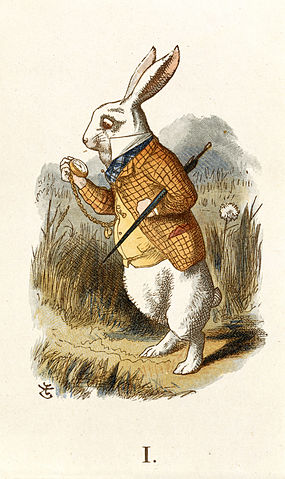
    Alice was beginning to get very tired of sitting by her sister on the bank and of having nothing to do…..when suddenly a White Rabbit with pink eyes ran close by her. Alice started to her feet, for it flashed across her mind that she had never before seen a rabbit with either a waistcoat-pocket, or a watch to take out of it, and burning with curiosity, she ran across the field after it, and was just in time to see it pop down a large rabbit-hole under the hedge.

    In another moment down went Alice after it, never once considering how in the world she was to get out again.”

    Charles Lutwidge 1898, better known by his pen name Lewis Carroll went to Westminster School and Christ Church College Oxford. When I have dinner in the magnificent “Harry Potter” dining hall, I usually take time to stare up at the beautiful “Alice Window”.

    What does it mean to “go down the rabbit hole”? According to one source it is to enter into a situation or begin a process or journey that is particularly strange, problematic, difficult, complex, or chaotic, especially one that becomes increasingly so as it develops or unfolds.

    That definition is an excellent one.

    I cannot prevent myself from disappearing down the rabbit hole whenever the opportunity presents itself and nor would I wish to. One of the great advantages of age (I

    am 62) is that some of us come to know ourselves. I certainly have. I am not always very pleased with what I have found but at least I have done my best in recent years to lessen my very worst characteristics. I’m not so convinced about the plasticity of the brain but I do my best to act as if it were true.

    My interest is in “knowledge”.

    My particular fascination is in the nature of consciousness and the “meaning” (or otherwise) of reality. It has always been so, although I did not always recognise it. If it is to be found anywhere the answer lies in science and the philosophy of science. While the number may not be 42, the “Answer to the Ultimate Question of Life, the Universe, and Everything“, will indeed be calculated by an enormous supercomputer. Except of course “Unfortunately, no one knows what the question is.”

    If I had to name a single book I have found most influential in my life it would be David Deutsch “The Fabric of Reality“. Followed perhaps by Voltaire’s Candide. I will leave my readers to figure out why or read the books for themselves.

    So, let me give a concrete example. I had been trading volatility. I disappeared down the rabbit hole and am still speaking from an underground labyrinth. The trouble is of course it never really stops. I spent months with Python and Excel creating various trading systems. I spent weeks recreating volatility indices and ETFs.

    And then I took a dark turn down the options fork somewhere deep, deep down in the rabbit hole.

    I bought VIX options data from CBOE. I spent weeks understanding it, cleaning it up and manipulating it into a useable format with Pandas and Python. I spent more weeks designing and testing all manner of options systems on the data. Could I use options to hedge my short volatility position in XIV? And then the chaos and madness really set in. I decided to try and fabricate “fake” options data from the spot prices of the S&P 500 index. More weeks of intense fun with the wonderful Pandas (thanks Wes McKinney you are one of my heroes). Endless hours of fun playing with Black Scholes, monte carlo, binomial models.

    But no time is truly wasted unless you really want to make money fast. It lead me into deep speculation on my favourite topics. Predictability, randomness, determinism and on. As did my endless months experimenting with machine learning. The small minority of followers who have “followed” this article so far will be wondering where the ramble ends and what is my point. Well it’s back to philosophy I fear. And the temple of Appollo at Delphi. Socrates said that the unexamined life is not worth living – a gloss perhaps on “know thyself”. I know myself: I know that I love rabbit holes.

    Happiness is being fully engaged in something you find fascinating.

    Looking out at the blogosphere I suspect that those who create great wealth from finance are people who do NOT go down rabbit holes. Or if they do, then they are people who are sensible (or clever enough) to make the journey pay. And kudos to such people. Perhaps the biggest problem in the financial world is that a large percentage of its population is made up of people who would not recognise a rabbit hole if they were to break their leg in one. And such people have no interest in disappearing down it.

    And as for me? Well I’m just an aging cynic. I trade a bit, I scribble down a few thoughts. But mostly I disappear down the rabbit hole for months at a time.

  • Has Iain M. Banks Sublimed?

    Has Iain M. Banks Sublimed?

    Subliming according to Wikipedia is a process that allows a civilization to transfer the consciousness of its individual members (biological and/or artificial) from the material universe that we experience to another plane of existence.

    The bald facts are that Iain Banks was a Scottish socialist and atheist and (in my opinion at least) one of the finest writers and thinkers of our age.  Would he be horrified to see his concept of “sublimation” extended to the almost universal desire throughout human history for the divine? Yes, I think he probably would but he must have been aware of the parallels.  I can do no better than observe: “the sublimed species seem to utilise immense power over the material universe, to the point where sublimed species can be thought of as close to godlike”.

    The Culture is undoubtedly a Utopia but a far from dystopian one. It is a universe where beneficent “Minds” embodied in vast travelling spaceships can and do almost everything. They are undoubtedly godlike.  They look after the universe and try to improve the lot of those they encounter. They are good. They are wise. They are bold and well nigh invincible.  They are everything we ourselves would like to aspire to.

    And in this age of almost overwhelming technological optimism we may hope to become “Minds” ourselves in the (supposedly) coming singularity.

    Yet beyond the Minds there was another universe, another plane – a non physical one. The Minds were still bound to metal; in Descartian terms they were minds but also bodies. Do some of us still think in these terms? Do some still believe that we are more than the sum of our parts and can thus aspire to a post physical world?

    I hope so.

  • Can Artificial Intelligence dream of electric sheep?

    Can Artificial Intelligence dream of electric sheep?

    I have been captivated for many years by the thoughts of David Deutsch and was relieved to hear he is still a believer in the power of science.

    Physics has created the human mind; physics aided by the human mind can certainly create general artificial intelligence.

    Deutsch’s intuition is that general AI will only emerge when we have a shift, a giant leap forward, in philosophy. We need to think about the question differently.

    The Deep Mind program that won at Go, however magnificent the achievement, worked within a closed system, a “game” bounded by rules.  Is the universe merely a game bounded by rules? Perhaps so. And if so, then perhaps however complex and all encompassing, those rules may one day be codified and understood in their entirety.

    If Deep Mind were to teach itself the rules of the universe, would it become a person? Would it have consciousness? Would it qualify as general artificial intelligence?

    Intuitively we know what consciousness is, even if we don’t know how it works. And it would be difficult to argue against the sentience of a program which knew and could apply the entirety of the universe’s ruleset.

    But within the physical, mechanical rule set of the universe, what is it that gives consciousness emotion? Pleasure and pain (in the mental as well as physical sense)?

    It seems to me you can not (or perhaps should not) have general artificial intelligence before ascertaining exactly what it is that makes us human. Or understanding consciousness fully.

    Robert Sapolsky of Stanford University has fascinating views on the biological origins of animal behaviour and yet there is so much further to go.

    A hot water bottle on a cold night gives me pleasure. That is perhaps explainable easily enough in physical, chemical terms.  Animals need a certain temperature to survive.  Warmth and comfort is good for them…and so makes them feel good.  Fine, but how exactly does this good feeling come about?

    Well, the scientists will tell us that it comes about through chemical reactions and electrical signalling.  Fine, that I can accept.  But it is till somehow unsatisfying as an answer.  Am I a mere robot? Perhaps I am.

    The questions become infinitely more complex when we try to understand our attraction to less physical comforts and pleasures.

    How about art?  And music?  What gives us that feeling of transcendence, that feeling of partly physical bliss at the sight of a Van Eck painting? Or on listening to Palestrina  or Allegri’s Miserere?

    Well, yes, it is chemical. It is electronic activity in the brain. It is dopamine or whatever the latest theory is.

    But what does that mean exactly?

    Scientists seem pretty sure that we are NOT more than the sum of our parts and so “qualia” must be solely explicable in physical terms.

    Well if that is the case (and I do not doubt it is) then we will need to ensure that robots “get” qualia as well.  And qualia are surely missing from Deep Mind.

    For Deep Mind to become a person, it must feel qualia. It must be capable of pleasure and pain. It must feel altruism, pride, fear, joy, sadness. It must know emotion.

    Or must it? If it does not, then we do indeed face The Terminator.  But perhaps The Terminator is the way the universe mostly is?  A purposeless place with no up, no down. No right, no wrong?  A place of rock and gasses and quarks and photons…

    Perhaps that is the way we found it.  But something HAS come out of nothing. Consciousness has somehow arisen from gas clouds and super novae. There is a very real sense in which we humans ARE more than the sum of our physical parts.

    So what I would add to David Deutsch’s essay is that we must track down these elusive qualia.  We must understand awe and joy and suffering at all levels.  And we must learn to gift that awe and wonder to our “artificial” people.

  • Dementia – A Carer’s Survival Guide

    Dementia – A Carer’s Survival Guide

    Starting out on the brutal, tragic and savage journey into dementia and caring for those suffering from it (I mean suffering both mentally and physically) one, in all probability will not be aware that “dementia” is simply an umbrella term for a vast and cruel range of hideous and debilitating symptoms.

    It is not purely memory loss, there is the added savagery of profound confusion, difficulties in communicating, disorientation, weight loss, depression, persistent fear, skin infections, seizures, hallucinations, paranoia and the susceptibility to frequent urinary tract infections thus causing yet more confusion– the list is seemingly endless.

    Added to all these symptoms the lives of the entire extended family are shattered, robbing them prematurely of the people they know and love.

    Despite all this turmoil I can say, hand on heart, that it is possible somehow to love, cherish, live and enjoy life after the death sentence diagnosis – you have got to, what else is there?  An immeasurable amount of patience is paramount to peace, calm and success whilst caring and a level of understanding of what a person is suffering is crucial.

    They are definitely “still there” deep, deep down, terrified and desperate for love, care, kindness and nurture.

    Each glimpse of their former self, their character and laughter is cherished and longed for and these moments sadly become further and further apart as the disease progresses and takes hold but never totally impossible to find and coax to the surface at any stage of the petrifying and lonely journey, even if it’s just in a glint of the eye.

    Anything that can help ease the stress and distress for all parties concerned is to be grasped with open arms.  Music is a very strong, useful and available tonic, and even if not enjoyed previously, it can jolt the brain into reducing symptoms of anxiety, agitation and aggression.

    It can prompt laughter and is something that can be a rare shared pleasure whatever the genre.  It is both comforting and enlivening for all, it can induce memories and movement for all to revel in.  Somehow words to long lost songs and ballads can be brought to the forefront, sung and danced to with joy, gusto and fleeting pleasure.

    There are so many “little things” like this that can make the life of the sufferer and carer easier, more bearable, more pleasurable and now seem so obvious to me I forget that others perhaps would overlook them or not realise to what tremendous degree they can help.  Guilt, for no apparent reason, has a massive and oppressive presence in a carers lot!