Tag: Truth

  • Glimpses of “Truth”

    Glimpses of “Truth”

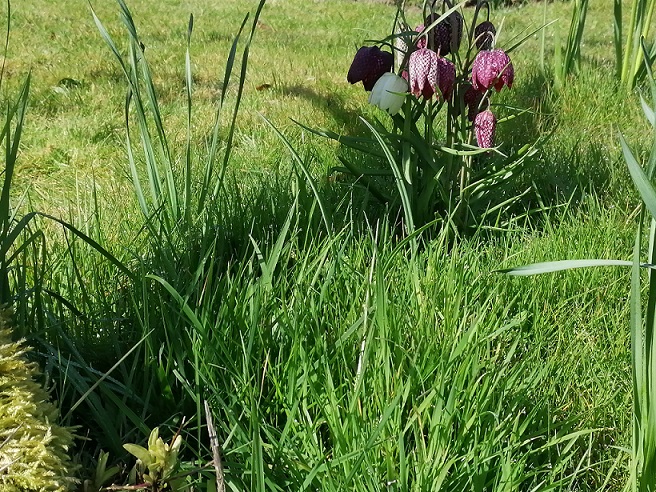
    Enjoying the cool spring sunshine this morning, I had a moment of truth as my eye was caught by dew drops in the long grass. I was sitting in our beautiful patch of wild meadow at the bottom of the garden.

    There was nothing great or overarching about this brief revelation. I did not become either omniscient or omnipotent but I did feel a deep connection with self, or at least the collection of perfectly ordinary atoms I am made of.

    Thanks to a mind which could kindly be described as unquiet, I have spent many years wondering about the koan. What is nirvana and how do you get there?

    The presence of fear has been the greatest barrier to achieving a quiet mind Although I suspect many other destructive emotions have contributed over the years to the tempest which has often raged inside me.

    I started the morning thinking about the meaning of money, its love and its strong connection to fear.

    It is not that I have lacked money over the years but the fear of lack has dominated my life. Which is odd, considering that for many years I have understood the meaninglessness of material possessions. The pointlessness of one small collection of elements from the periodic table feeling the need to control another and larger collection.

    The key of course is fear. The terror evolution has saddled us with to ensure our survival and hence the continuance of our species.

    The objects of our fear come in many shapes and sizes but they all seem to boil down to a fear of annihilation. Pain, hunger, cold. Those might be three of our greatest concerns.

    And perhaps all the other destructive emotions which can overcome us derive from these very basic insecurities. What are jelaousy, anger and envy if not the realisation that somebody else seems to have it better than we do?

    A bigger car, the better to tear around in and dominate others with our undoubted superiority. And so it goes with many other material possessions or indeed our relationships. A more attractive partner, the fitter to reproduce. More land and a bigger house, the better to keep the barbarians at the gate. Power; the power to take what we think we need and to prevent others from taking what we have got.

    The initial realisation of “truth” must necessarily involve silence, isolation and letting go. Some might call that meditation and there are many forms of that practice, not all of which entail sitting on the floor like a vegetable. Although I have no doubt some find that a valid path.

    But back to money and survival for a bit, if I may. There is that hallowed old trope about learning to fish and I think we all need that skill in equal measure if we are ever to create a better society.

    If we had a skill from which we knew we could feed and house and clothe ourselves we may not feel fear. And given such a skill, I suspect most of us would not feel the need to amass wealth. It would become superfluous.

    The problem with our society is that the ability to provide ourselves with the basics of life has always involved conflict and doing down the other. It has never been as simple as learning to fish – someone else will always claim it is his pond, his sea and will kill to maintain his “rights”.

    Fear for our own survival has, since the earliest days, meant violence. Hunter gatherers kept neighboring tribes off their hunting grounds and when agriculture was invented so were property rights.

    Suddenly, fear driven by the need for security meant grabbing land and excluding the neighbors and so it has continued.

    In feudal Britain we still have families controlling hundreds of thousands of acres. And of course we have the more modern equivalent of the feudal landlord – the business titan controlling the means of production and distribution.

    And lo! We are struck by a deadly plague and the grapes of wrath grow fat once again.

    The little man can not fish. He us banged up in a government housing block and his feudal employer has laid him off.

    Neither can the small shopkeepers and business people, purveyors of baubles and mostly useless trinkets, any longer fish for their supper.

    And nor can the myriad of human drones on the antheap. Suddenly our rods are removed and the lakes and seas of commerce are boarded off from us, fences erected to prevent the spread of the plague.

    And that is the precise point at which you recognise how fragile and foolish our society is and always has been.

    The problem is that we are all so far removed from the basic necessities of life. How many of us can literally fish to feed ourselves? Or grow crops or raise animals.

    Most of us these days produce sterile and ultimately useless services. Perhaps we all need access to the means of production. To land, water, the elements.

    I take it as a basic truth that our society needs urgent and drastic reform but I had not intended this piece to become a political diatribe, so let me return to where I started out: sitting in the meadow at the bottom of my garden. Contemplating “truth” and enjoying a series of small revelations.

    And suddenly the nature of my error strikes me as I refocus on the beauties of nature.

    Let go – society is unlikely to change yet a while, and who am I to say that it should.

    Contentment and peace come from withdrawing from the concerns of the world and in focusing on the bigger picture. I can feel, in a real sense, not my “connection” to nature, as I sit here in the middle of it, but my absorption in it. I am nature and it is me.

    Far from wishing the world and it’s peoples to go to hell in a handcart, I wish for all of us a better life.

    But I rather doubt that betterment will come from fiat.

    If it comes at all, my suspicion is that it will come from inside us and not from external utopian upheaval. That the search must be an inner journey and that only from within will the answers be found. A better world must be made individual by individual.

    Given certain basic needs, contentment can be found in simplicity. In silence, in beauty and in nature. In the realization that we are already where we are supposed to be and that there is nowhere to go.

    And the plague? If it can be avoided then well and good. If it takes us, so be it. Perhaps all is as it should be. Perhaps, as Julian of Norwich so beautifully put it:

    All will be well and all manner of things will be well.

  • I know that my Redeemer Liveth

    I know that my Redeemer Liveth

    Success in seeking the Absolute may simply be a matter of altering our minds chemically.

    I’m sorry to disappoint Job and I can not see Handel writing an oratorio about mind altering drugs but that is my belief.

    It is a belief shared by some eminent philosophers and does not represent the mere churning of a mind in chaos.

    Our small minds evolved to seek survival at any cost. Not happiness or knowledge in general.  If we have to kill our neighbor and eat him (literally in some benighted parts of the world) then that is what we will do.  In the West we achieve these aims through capitalism. In less “civilized” parts of the world physical violence still reigns supreme as it does in the animal kingdom at large.

    And yet those blessed with the luxury of reflection (and the time to reflect) may come to the conclusion that it need not always be so.

    In essence it seems that the universe is great simplicity cloaked in overwhelming complexity.  From the vibrations of infinitesimally small one dimensional strings there arises all that we see around us.

    Ourselves included.

    Under the influence of half a teaspoon full of psilocybe cubensis I have found truth in the words of Julian of Norwich.

    The petty concerns of humanity fall away and you can see your way to understanding what the mystics describe. Most people restrict themselves to reading about contentment or the sublime. Reading the words of others is, as the Buddhists would have it, a mere finger pointing to the moon.

    To witness the sublime itself is of far greater value.  No-one should seek to be a junkie. To zone out on heroin or cannabis. Or to psyche themselves up for a day in the urban jungle with cocaine.

    But we should learn that the troubled mind is a mind that is not well.  And we should accept that it need not always be so. Perhaps consciousness is designed to dig its bearers out of the mud.

    In the more likely event that no one designed consciousness, that there is no creator, then we must create ourselves.

    We do not need to live like pigs or jackals. We do not need to suffer. We do not need competition, aggression and violence.

    What we do need is to search, to experiment. Without fear of reprisal and without cease. Peace is to quiet the mind, to quell the never ending stream of pointless thoughts and worries. To see through destructive emotions, to overcome fear and greed.

    My normal state of mind is not “necessary”. It is not useful or kind or nice. To me or to anybody around me.

    I will change. I will become better, kinder, more peaceful. Not just today or yesterday but for all days to come.  I live in the physical world and I need to recognize that I need to take physical actions to achieve my objective.

    I do not shirk from the task and I do not hesitate to step outside the bounds of convention to achieve this.  Remember Edward Jenner, the founder of vaccinology in the West.  Avoid potential harm to others (unlike Jenner) but do not seek to avoid experimentation on yourself if you seek “Truth”.

    If you wish to see the universe as it really is you need to stray from the prison cell in which you have incarcerated yourself.

  • The Doors of Perception

    The Doors of Perception

    If the doors of perception were cleansed every thing would appear to man as it is, Infinite. For man has closed himself up, till he sees all things thro’ narrow chinks of his cavern.

    William Blake, The Marriage of Heaven and Hell

    Is it so strange that a deep interest in science should be combined with an equally deep desire for mysticism and transcendance?

    I think not; the two can be seen as two sides of the same coin.  Reality seen both from the intellect and from the senses. A yearning for transcendance.  Some would say a desire to escape from the base reality.   Which is all that is accessible to most of us in a “normal” state of mind.

    Both science and mysticism offer us infinity. Infinite space and power. Infinite universes and time. Teleportation, downloading the mind into another form of matter, eternal life, time travel. Science is not ashamed to speculate on such matters. To an ancient people, we would appear as gods. In the far future, or in a distant corner of the multiverse, there exists intelligence with powers which even we would consider godlike.

    The mind allows us to travel to such places and such times. To witness infinity,  to feel the mind of “god”.

    These days, few rational men believe in traditional religious systems.  And yet through the ages the mystics have had glimpses of some alternate truth, some reality which in our ordinary minds is denied to us.

    Science struggles to explain consciousness and yet some scientists tell us that consciousness is a law of nature all of its own. That consciousness “is”.

    Not that consciousness is an emergent property of physical elements.  But that consciousness is a law of physics itself.  Universal consciousness, consciousness as the very “self” of the universe.

    So listen to how the mystics describe their experiences.

    Meister Eckhart:

    “To the quiet mind all things are possible. What is a quiet mind? A quiet mind is one which nothing weighs on, nothing worries, which, free from ties and from all self-seeking, is wholly merged into the will of God and dead to its own.”

    Alan Watts:

    “What you are basically, deep, deep down, far, far in, is simply the fabric and structure of existence itself.”

    Siddhartha:

    “The mind is everything. What you think you become.”

    Both science and contemplation seek knowledge.  Self knowledge, truths, the “truth”.

    Science uses instruments and machinery and conducts experiments. Science seeks truth through the intellect.

    The quiet mind seeks experience directly.  To feel the truth, to experience it.

    Neither should be disparaged. Both should be embraced. Neither is complete without the other.

  • “Objective truth” is an illusion.

    “Objective truth” is an illusion.

    Unqualified objective truth can not exist.  Heavily qualified objective truth probably does.

    According to Wikipedia :

    a proposition is generally considered objectively true (to have objective truth) when its truth conditions are met without biases caused by feelings, ideas, opinions of a sentient subject. A second, broader meaning of the term refers to the ability in any context to judge fairly, without partiality or external influence.

    If you consider just this universe that we inhabit, the nearest you can get to objective truth seems to be the very low level basic laws of physics.

    The “law” of gravity suggests that whoever drops a marble from shoulder height to the floor, at sea level on planet Earth, can expect that marble to be attracted to the centre of the earth by gravity. And thus drop to the floor.

    And yet, despite Einstein, we do not yet really know what gravity is.  And what is a “graviton”? Scientists are still looking.

    Whatever it is, it seems reasonably certain to most of us that gravity exists, whatever it is.  But the qualification (and a heavy one) is: “in this universe”.

    Many scientists posit that we are in fact living in an infinitely large multiverse and that there will be universes where the physical laws are completely different from those which attain here.

    “Objective truth” is supposedly something on which we all (or the great majority of us) agree.  The basic sciences contain many such apparently objective truths: the constancy of the speed of light, the number of atoms in a molecule of hydrogen and so on.

    And yet even in many of these basic laws we seems to come across exceptions or revisions of interpretation. Leaving aside the complication of alternate universes where such laws do not apply at all.

    But then consider the “emergent” sciences: biology, psychology, systems theory for instance.  This is where objectivity really begin to disappear down its own throat.

    Aristotle said that “the whole is greater than the sum of its parts” meaning the “whole” has properties its “parts” do not have.  A human being is made of a few basic elements from the periodic table: largely hydrogen, oxygen and carbon.

    It is difficult to understand a human being by reference only to these three elements.  The “whole” (human) is unimaginably more complex than its constituent “parts” (carbon, oxygen and hydrogen).

    Once these three elements (and a few others) get combined and grow into a human, there are a few “truths” about that human which may be called “objective”.  But again, objective in a qualified sense. At present for instance most humans are born with a fairly standard set of organs and none of us can exist without breathing air and drinking water.

    But who knows what life may evolve into.  The “objective truth” that humans mostly have two legs must be qualified by “at present”.

    But now take human behaviour and physiology. And in particular think about drug trials for instance or PTSD.

    Does x drug cure y condition? Does Prozac cure depression? Does cisplatin cure cancer of the bladder?

    Suddenly you are into statistics and probability.  Far from objective truth.

    Or take a complex adaptive system such as the weather or the stock market.  Are they deterministic or random? Predictable or not?

    Now pan out again to the multiverse: will we ever know much that is “objectively true” about the multiverse? Except perhaps that it is big.

    Nothing is certain except uncertainty. Perhaps that is what stops us getting bored.

  • A Secular Epiphany

    A Secular Epiphany

    A Beautiful Question

    Epiphany is usually thought of as the appearance or utterance of a deity to an earthbound mortal but it can equally be a secular phenomena, where one is suddenly struck by some extreme beauty, truth or revelation.

    The beautiful illumination above from Liber Scivias shows Hildegard of Bingen receiving a vision, dictating to her scribe and sketching on a wax tablet.  A classic religious revelation or epiphany.

    We modern Brits in 21st Century London don’t tend to get many religious epiphanies these days but secular epiphanies can inspire equal awe. The illustration below shows Archimede’s Eureka moment: a secular epiphany.  My morning was graced by such a moment; I know how he felt.

    Let me explain. I am engaged in research into the nature of consciousness and have been particularly taken by the approach of the Qualia Research Institute.

    Their hypothesis is that qualia (subjective, conscious experiences such as pleasure or anxiety) can be formalised.  That such experiences can be categorised, precisely described, mapped and explained. In particular they are looking at the pain/pleasure valence and believe that pleasure is caused by harmony or symmetry in the state of the brain. Pain is caused by the opposite: dissonance.  They intend to quantify qualia and believe qualia have mathematical isomorphisms.  It’s all part of our homeostatic control mechanism.

    They recommend Franc Wilczek’s book A Beautiful Question :

    A Nobel laureate and friend of Tegmark, Wilczek asks the question, “Does the world embody beautiful ideas?” and proceeds to explore how looking for beauty & symmetry in the laws of nature has been an extraordinarily successful strategy for physicists. Core takeaway: the Symmetry Theory of Valence is a reasonable extrapolation from the past trajectory of physics.

    I dutifully bought the book and was stunned by the lucidity of a chapter headed “Pythagoras II: Number and Harmony”.

    I have been engaged in classical choral music since childhood and have tried in vain to gain an academic intuition of harmony as well as an understanding of WHY music gives me such intense pleasure.

    Suddenly this morning all appeared to be revealed. It was a Eureka moment.

    The book explains the physical processes involved in the production, transmission and reception of harmonic sound and then ventures an explanation as to why such notes sound so good together.

    The brain receives a repetitive pattern which is predictable and easy to interpret: accurate prediction is essential for human survival.  Success in prediction of the repeating vibrations of the harmony has to be rewarded by the higher functions of the brain as pleasure so that the lower operative brain functions know they have got the task right.

    Discordance and dissonance is not repetitive and predictive and is thus discouraged with a feedback of pain or displeasure.  Its an evolutionary argument: the familiar selfish genes.

    And thus argues the Qualia Research Institute: pain is dissonance and disharmony in brain patterns; pleasure is harmony and symmetry in the brain.

    It’s a theory.  But the intuitive “rightness” struck a sweet chord in my mammalian brain. I was being rewarded for getting something right perhaps.

    So, a secular epiphany. An enjoyable and profound revelation, or thus it seemed.