Tag: Meditation

  • Meditation – a wider perspective

    Meditation – a wider perspective

    So much can be found on the internet on the subject of meditation, and so little of it has any value.

    For better or worse, meditation has become a buzz word and all too often it is used by the “wellness” and “new age” industries to sell less than useful products to the desperate or the foolish and vulnerable.

    Meditation should not be sold. It should be communicated and taught for free.  We would have a better world if this ancient and invaluable spiritual practice was absorbed and above all used by a wider audience.

    How few truly understand the practice. How little I grasped of it when I first started reading the Buddhist scriptures over three decades ago.

    Over the years it slowly dawned on me that meditation was used not just by Buddhists and Hindus but by all other religions worthy of the name.

    To this day however, many remain only vaguely aware of what is involved and there are those who so badly misunderstand the practice that they believe it to be dangerous.

    It will let in evil spirits say some. It is worthless say others. It is the Philosopher’s Stone. A great benefit, a great evil, pointless, life saving. Take your pick.

    But only ever listen to someone who has nothing to sell, no axe to grind. And who has experience culled over some years of practice.

    I can of course only relate my own thoughts, my own experiences but for me this arcane ritual has become ever more essential to my happiness and wellbeing.

    One must not imagine that the practice of sitting quietly for some period of the day and going within is all that is entailed.

    It is an experience which can slowly change your life but without making other far reaching changes to how you think and act and live, it will get you nowhere. In my experience.

    Entwined with the rest of your life, a feedback loop is formed to the extent that cause and effect become indistinguishable.  What is it that has changed your outlook on life, your behaviour? Is it the meditation, or did you make some conscious decision to change your habits, your patterns of thought and follow through on that decision?

    It becomes impossible to tell, since in effect your whole life has become a meditation. Not just those moments when you sit and release your consciousness to wander where it will.

    For some, no doubt their practice will be an attempt at a quick fix, squeezed into their busy schedule of work and play. For others there may be no spiritual element at all – just another spoke to their busy lives, something to tell their friends, something to fit alongside an evening glass of wine. A fashion accessory almost, much in the way that wellness tourists trek to Peru for an Ayahuasca retreat.

    And good luck to such folk. If that is the way they see fit to use meditation, they do no harm to others but equally they gain little benefit for themselves.

    For a few, a life of meditation represents a true retreat from the world.  An all important feature of their very existence. Meditation is much the same as the beauty of endless repetition of psalms in a monastery. Or rosary beads and their accompanying prayer. The whirling of dervishes, ecstatic Kabbala, wailing at the wall in Jerusalem.

    Standing on a mountain in the wild Himalayas playing the solemn dungchen, climbing the Alps and  letting the alpenhorn cast its spell over the glory of the sunlit pastures.

    Of course those who prefer to define their faith within the narrow confines of their own particular dogma would be affronted by such comparisons.  The beauty of Eastern Orthodox prayer is an address to the Christian god only, the rhythmic repetition of the Koran a call to Allah and not a plaything to be enjoyed by an infidel like myself.

    But once you have escaped from the manacles of man made gods and creeds you are free to see the glory of meditative practice as it is.  A release into reality and beauty, a casting off of narrow prejudice and divisive cult.

    A breaking of chains to soar above the dull concerns of man, a window into the mystery at the centre of our reality (however you wish to describe it).

    And from that distance, how small mankind’s concerns seem. How sad the endless struggle for more, how demeaning and foolish the attempt to “own”, to dominate, to control.

    It seems important not to grasp, but to let the process work of it’s own accord.  To let meditation seep into your life, and your life flow into meditation.

    Once you are a little way along the path, it begins to seem unnecessary to travel to Mecca (or anywhere else) to see the face of your “god”. 

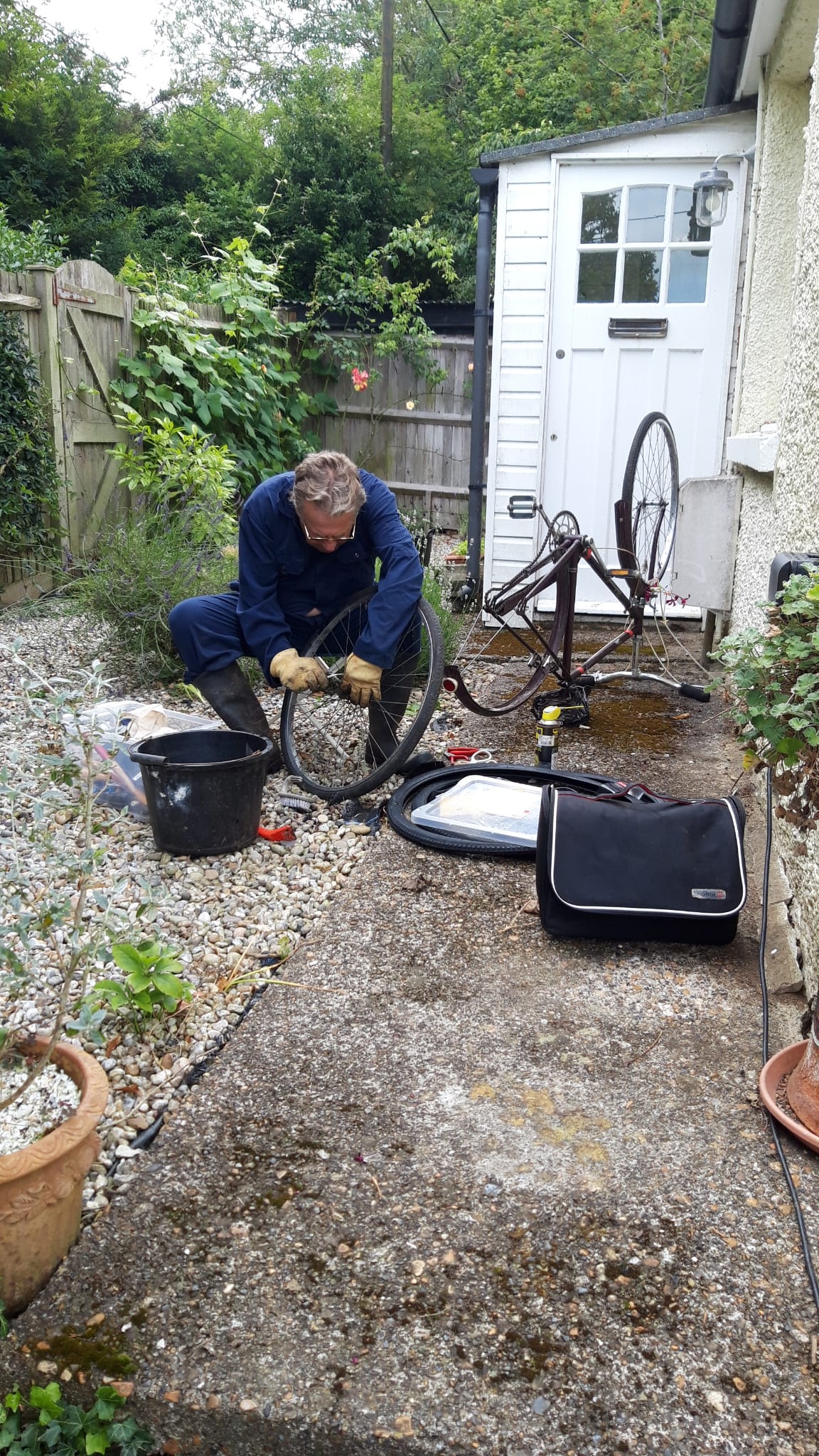
    That face seems suddenly to be all around you whether sitting in quiet meditation….Or mending your old bicycle on a summer’s afternoon in the garden.

    It is quiet, it is slow, it is gentle and so becomes your life. An end to speed, to rash judgements, to self importance. No desire to change the world, or its people and a recognition that if it comes at all peace will only appear at its own sedate pace. If the world is ever to change for the better it will not be at the behest of a politician, it will not be swift or dramatic. If it does occur it will be by the slow uptake of kinder thoughts, a recognition that none of us are so very different, let alone better or of greater value.

    Peaceful thoughts, tranquil habits. An abnegation of the ego.

    Perhaps such a transformation will silently occur, perhaps harmony will descend. Or perhaps like most other species, we ourselves will end before we have had a chance at perfection.

    Does it matter so very much? Somehow once you are on an untroubled path, none of it seems quite so urgent or important. The river of life meanders along in its own way, with us or without us.

  • A Meditative Road to Enlightenment

    A Meditative Road to Enlightenment

    Is it too immodest to suggest that one may have found a path?

    Before I write so much as another word, I must repeat my by now familiar and much used disclaimer. I make no claim to goodness, I am merely a traveller who seems to be making some progress along a much desired road.

    It is hard to fathom what set me on my way. Have I always been mercurial and if so is it the often black side of my moods which made me take my first steps? Have I always sought an escape from a world which seemed (and still at times seems) overwhelming, hostile and incomprehensible?

    I don’t know. All I know is that however the urge arose, I have spent my life seeking something other than what my normal senses tell me is out there, and hence the long journey through religion, philosophy and science to find answers.

    And now at last to committed, regular and serious meditation.

    I can not and will not claim that meditation has provided me with unassailable “truth”, however much it can feel that way in the depths of trance. I am unable to tell you whether there is or is not a god or gods, or when the universe began or will end. I can provide you with no definitive answers on the nature of mind or the existence or otherwise of free will. I can not tell you whether we live in a clockwork universe or whether randomness and uncertainty provide just enough room for a future to be unknown rather than determined.

    Nor can I tell you that meditation is a definitive and certain cure for the melancholy which affects so many millions of people living out their short and small lives on this mysterious little planet.

    What I can tell you, with no trace of hyperbole or exaggeration, is that meditation is a useful and perhaps essential tool for anyone seeking wisdom, a better life. For someone who recognises that while the answers may not all be readily apparent and may never be, quiet contemplation gets you as far as it is possible to go. In terms of balancing your life and finding deeper meaning in a physical universe.

    If it does not make you “good” it does at least encourage you to become “better”.

    And what, for me, does the word “enlightenment” suggest? What do I look for in my search for enlightenment and am I getting there?

    While I would like to see a greater non-physical reality, a godlike power for the good, I have more often seen a vision of what physical reality could look like in the here and now, if we chose to make it so. Equality for all life, an end to poverty, greed and violence. Co-operation, decency, sharing. Care for the planet and its flora and fauna, an end to the virus of human expansion. A focus on happiness rather than the eternal search for more.

    And what of the non material? What of the search for divine revelation, nirvana, moksha, call it what you will. It is there, of that I have no doubt. What it is, I can only speculate, guess, intuit. A vastly expanded consciousness of a type we can only now dimly envisage. Good, bad or indifferent? Perhaps those terms cease to have meaning at that stage; I wonder.

    And practically speaking? How does such a search manifest itself? What do you actually do on a day to day basis in an attempt to ban ignorance and self and let in wisdom and the Good?

    If I led my life again it would be as a full time secular monk, holed up somewhere remote. Living simply and spending my life in reflection.

    And in retirement (when I can tear myself away from my absurd algorithms) that is how I try to lead my life in the here and now.

    My meditation has progressed, developed. Some might call it obsession but more accurately it has become a daily necessity, something I am unable, and certainly unwilling, to do without.

    Each morning I devote two hours to my practice. Mornings seem far the best time for me, since later in the day I tend to drift off in sleep. In the mornings I soon find myself in a cloud of unknowing. A place of fecund emptiness and complete peace. What do I see, what do I feel at such times? Difficult to express really but most days simply good things. Feelings. No particular rhyme or reason, no pattern of thought, simply a contended emptiness where all seems well. And mostly continues to seem well for the rest of the day.

    And then some physical exercise which continues and increases those feelings. And some gentle tinkering at the piano on most days. A few simple classical pieces, the beauty of Bach or Handel or Chopin.

    And that is my life – would that it had always been that way, but better late than never. Always time to turn the page, abandon foolish ways and prejudice.

    And the end? Well it is nigh, of course. But it holds no terror. Hieronymus Bosch was wrong, Dante Alighieri misguided. I do not dream as Gerontius or dread what is to come. A re-absorption in some greater consciousness perhaps or maybe a simple ceasing to be.

    But here and now I determine to live better, to be better and to let what may come arrive in its own good time.

    Illustration: Carnation, Lily, Lily, Rose by John Singer Sargent

  • Communing with the Infinite

    Communing with the Infinite

    It is hard to express the profound experience to be found in meditation without sounding oily and unctuous.

    I continue to write very largely so as to keep a diary, rather to attract an audience with all the vanity that that entails. I find it useful to look back over the five years odd I have been keeping this personal record, to see what progress if any I may have made on my road to nowhere. Or somewhere.

    Let me be clear – I do not wear a beatific smile. I do not seek to preach, to the unwashed or otherwise. I simply seek my own course, pursue it. To escape from a lifetime of impenetrable blackness. To discover meaning in an apparently aimless universe.

    If there is a god, Christian or otherwise, then as creator he must bear sole responsibility for clearing up the ghastly mess he has made. I don’t intend to help him.

    If on the other hand, reality is something of an entirely different and uncreated nature, as seems likely, it is still every man for himself anyway. Or woman, child, creature.

    And yet if what I write, if the tales of my endless journey be of help to some, then I am glad of that. I do not wish ill, nor am I insensitive to the stupefying suffering on this earthly dystopia or elsewhere. My writing is the only contribution I can usefully make, read or otherwise.

    Great works have in any case never led to universal peace and happiness. Simply to further inequality and injustice.

    If there is a way out, it is to be found not through conversion to some man made dogma or foolish cult. But through personal “enlightenment”.

    And lest that word sounds fawning and oleaginous, may I hasten to add I merely intend to convey the process of becoming “unblinkered”. In a psychological sense. In a rational sense. To become able to exercise reason, wisdom and levelheadedness. To see reality as it is.

    Enough of the apologies then, although I do believe they are important to my purpose. To my self exploration. To my journey. To convey what it is I seek and that that I do not.

    I wish for peace. It is that simple. And if there can be peace for all, so much the better. My belief is that inner peace will not of itself be found through science or religious dogma.

    Peace, at least in my own quest, has only begun to emerge through letting go. By looking within. By abandoning pretence. By looking at the futility of what most strive for, and turning in the opposite direction.

    Perhaps for others, the meaning of reality, if only some personal rather than universal reality, will be made clear in other ways.

    In obeisance to a deity perhaps. In a life of ascetic abstinence.

    But peace is certainly unlikely to be discovered in hedonism or the wielding of power. In excess or greed or violence. But who knows, perhaps I am wrong. Perhaps the violent Halls of Valhalla give comfort and certainty to some. Maybe there are those who find truth in pure violence and unspeakable cruelty. In which case, evil may be said to exist after all and the universe is not an inert and blank canvas.

    That is not my belief however. Peace is to be found elsewhere entirely and I have found no more practical route than quiet meditation.

    For many years my meditation was “unguided” and haphazard. Sitting in quiet contemplation on a mountain top or a remote beach. Listening to the sound of the wind or the murmuration of the waves on a remote beach.

    It was a dead end. A pleasant and thoughtful pursuit and yet not one which led me to peace. The abyss remained close by, the darkness ever ready to consume and convert an already tortured soul into something ever more terrified, desperate and unhinged. To stand at the edge of the crevasse, at the very gates of Hades, is not an experience to be savoured. Nor is it by any means simple to stand back, to retreat from that dread precipice and search for kinder climes.

    We may have advanced from the days of Galen, but we are still so very far from understanding the human mind and body. While some may be blessed with quietude and concord at birth, others are forced to travel a harsh and uncertain road beset by uncertainty and doubt. Perhaps none are granted peace from birth – certainly none are spared the vicissitudes of this often grim existence.

    Medicine can not grant peace, although some benefit to an extent from the numbing effect of strong and poorly researched chemicals, produced by big pharma, largely for their own benefit. The Sackler family and Purdue Pharma come to mind.

    Many seek relief and a false peace in alcohol or opium, cocaine or ecstasy. A sure road to damnation as I for one can testify.

    True peace comes from a different direction entirely. A change of lifestyle, the renunciation of harmful pursuits and substances, the gradual accumulation of wisdom. And yet in my own case, none of this ever tipped the balance.

    My daily meditation began to take a very different form. Guided and directed with the express purpose of becoming who or perhaps what I wanted to become. By choosing goals and making them into a mantra. By guiding myself towards a different landscape, a different reality.

    And that different reality has appeared and continues to change and morph day by day. Not every throw wins a coconut, but most certainly do. Most sessions build upon the last and the process is cumulative, becoming stronger every day. It has reached the stage where often a mood can be produced by simply willing it. Imagine it, declare its reality and so it becomes.

    And there is strangeness, of that there is no doubt. An increasing awareness that a different world is there to be had; and I take it. Nothing dramatic, just echoes and glimpses of better things. And pleasure. And peace. Strong images in the mind, feelings, and not voices exactly but a feeling of being in contact with something other.

    I concede that I am given to things “arty”, to beauty and music and feelings. But this is something different, visceral and real.

    There will be those that say it is “mere” chemicals and indeed it may be that meditation produces dopamine or serotonin. As well as slower brain waves. But exactly the same may be said of “normal” day to day existence. Anger, greed indeed any emotion has a chemical signature and yet they are none the less real for all of that.

    Meditation seems to be giving me the ability to experience life in a dramatically different way, to the extent that it feels very much like walking through William Blake’s Doors of Perception.

    There may be an alternate reality – one in which we are living anyway but can not see. One which takes practice and a certain mindset to access.

    That, in any event, is my conclusion so far.

    A conclusion with which I am most satisfied and for which I am most grateful.

    As I continue on my idiosyncratic and unconventional path, as I progress along the road less travelled, I am finding at last a quiet pleasure in my uneventful existence.

    Illustration: William Blake – from the Song of Los

  • Quo Ego Vado?

    Quo Ego Vado?

    Where am I going?

    The reality is that none of really us know.

    But I want to write about my experiences with meditation, in the hope of helping anyone who seeks relief from suffering. And release from the need to seek an answer to that question.

    To express in clear, unornamented terms what I have thus far achieved in an uncluttered and simple meditative practice.

    I first studied Buddhism many years ago.

    Buddhism originated in a simple effort to avoid suffering and to attain a state of inner peace. The prescribed cure for misery is to meditate and to lead life in the “right” manner. A meditative practice then, and a code for right living. A course which follows a middle way, avoiding both harsh ascetism on the one hand and wanton self indulgence at the other extreme.

    What began in utmost simplicity around 2,500 years ago became a confused tangle of many different branches, a multiplicity of different teachings. And as to “enlightenment”, who had ever achieved this rarefied and seemingly unachievable state I wondered? From stringent clarity great confusion arose in Buddhism, along with exaggerated claims as to its benefits.

    At the same time, I studied Christianity and again found myself similarly nonplussed. Prophets ascending into the skies on chariots of fire, people turned into pillars of salt, burning bushes. Can it all have happened and if so, how is that of any benefit to me in the here and now? I never found the answer to the last question, and had a healthy scepticism regarding the former.

    As I looked at yet more faiths, the curious case of Carlill vs the Carbolic Smoke Ball Company (1891) came to mind. I had been a lawyer once upon a time and the case has always come to mind whenever presented with extravagant declarations and inexplicable professions of the miraculous.

    Deadly influenza was wiping out millions and the Carbolic Smoke Ball Company sold a “cure”. The company offered a very substantial £100 to anyone who used the Smoke Ball correctly and still caught Russian Flu. Mrs Carlill did so use it, still caught flu and claimed her reward. The company refused to pay up. They claimed that the offer was mere “advertiser’s puff” and was not contractually binding. They lost, and misleading advertising eventually became a criminal offense.

    And so when you read all the religious puffery (and they are still writing it) please don’t believe that Tibetan monks can literally levitate or that dead bodies of particularly saintly individuals don’t rot.

    Religious writing is sugar coated to boost sales. Especially in the hands of today’s less scrupulous gurus; but it has always been so.

    And so back to meditation. In strong contrast to the immoderate promises of many other faiths, root Buddhism claimed a simple but profound benefit in the here and now. The avoidance of suffering. Today, here on earth. Not in some theoretical afterlife.

    And hence I developed a strong liking for basic Buddhism. Call it a faith if you must, but in my understanding it offers a practical remedy for misery.

    In early days, perhaps some small corner of my mind was expecting supernatural results. Wishful thinking and a hankering after magical realms and other worlds. Disappearance into some manifestation of nirvana. A desire to levitate.

    I only half joke but the hyperbole of some of the Buddhist scriptures is no more absurd than that of its competitors.

    But here is the rub – it does actually work. Not the promise of the supernatural, but the rather more down to earth claim of a relief from suffering.

    For the past two years I have followed a daily meditation routine with unswerving devotion. I will sit three times a day for periods varying from 20 minutes upwards.

    I have read much in the past about the power of positive thought. But then again I have read much hogwash from Freud to Mesmer and beyond.

    Except that I have now discovered a kernel of truth to it all. That, call it what you will, the “subconscious” can be trained. That rumination and damaging thought patterns do become entrenched, laid down in the mind like well worn tracks through a forest. And that they can be replaced by more beneficent patterns.

    With help from my favourite secular priest, I crafted a blueprint for the person I wanted to become. And distilled that plan into a few key words. Or mantras.

    The trance state is something few beginners grasp, and some years ago I too found it puzzling. To know whether I had got there or not.

    The trick is to relax and not worry about it. It’s nothing so very out of the ordinary – to begin with just a state of mild relaxation, which deepens as the meditation gets underway. For some, the repetition of a mantra is enough to induce trance. I prefer to use a hypnotic technique which begins with a bit of pretence but which, after much practice, becomes a reality.

    After relaxing for a short while, you tell yourself you are so relaxed your eyes won’t open. And the pretence is to keep them shut. Even that ceases to be a pretence after you have been through the process often enough.

    And then counting backwards, telling yourself you are becoming more and more relaxed until the numbers disappear. In the beginning you have to make an effort, a further pretence if you like, that the numbers have indeed disappeared. But again with practice they just do disappear, leaving you in a state of pleasant, rather hazy relaxation.

    Which is when I begin to repeat the mantras. Which over time become ingrained into the subconscious and become you, a part of what you are.

    After a time, I find the state of trance deepens and the repetition of mantras stops, seemingly of its own accord. It usually takes up to 20 minutes, in my case, to reach this stage.

    By this time, I am usually far away. In a place where the pure light of consciousness can shine through. A state of awareness without the distraction of thought.

    Any thoughts, day dreams or visions which do arise are unusual ones and, in my case at least, invariably pleasant. Instructive even. The brain seems to operate in a different way under these conditions and the effect is not unlike a mild psychedelic “trip”.

    The effects of meditation spill over into my waking life. I find myself slipping back into that mind state as I am out walking, stuck in traffic or indeed at virtually any time or place.

    Equally, and remarkably, I have found that I have become (at least to some extent) what I set out to become. That the terrible blackness which has plagued my entire life has more or less disappeared. And if it does make an appearance it is less desperate and certainly of short duration.

    I also find that I am more accepting and less impatient and irritable. More tolerant of others and less inclined to venture my own opinions. More retired, more resigned to the way things are, the way I am.

    Of course, in extremis the blackness may return but if it does, at least I seem to have found a way out.

    I also find I am more accepting of myself. That I am not who I thought I was, not as capable, resilient, bright, ambitious. And I am fine with that. It’s just the way things are.

    I don’t think my habits have changed very much, although I am increasingly reluctant to spend my days hunched over a computer. But I live healthily, more so perhaps than at any time in the past. Largely vegetarian, I take at least a couple of hours exercise each day. I play the piano a lot and these days enjoy it more than singing.

    Above all I live quietly. No social whirl, no dinner parties or grand friends. No aimless, frivolous small talk. No news programs, no social media.

    I still “think” quite a bit. Mostly about the meaning of reality. I am far more likely these days to rely on my own contemplation than to read yet another philosopher or scientist with his speculative and incomplete theorems and opinions.

    I have noticed, without any shade or shadow or rag of doubt, great change in my inner self. And for that I am enormously grateful.

    Perhaps that change has come about as a result of a number of factors, but my meditative practice has, I feel certain, played a large part in the much needed metamorphosis.

    Listen to me, or don’t. Take my claims as extravagant or reckon that they contain a grain of truth.

    Quo Ego Vado?

    I don’t know but I’m really not too concerned any more. Perhaps, after all, things are just as they should be.

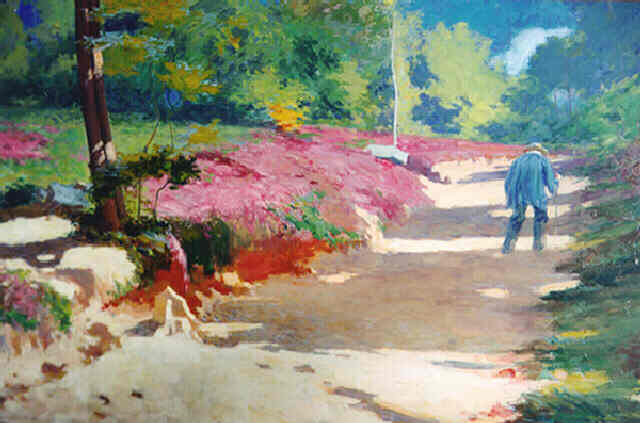
    Illustration: Sunlit Path – By William de Leftwich Dodge

  • Meditation – Nonsense or Nirvana?

    Meditation – Nonsense or Nirvana?

    Almost a year ago, his meditation took a different and far more satisfactory direction.

    And now, many months later the benefits had become evident. It was not that he found himself living in some alternate universe or in a permanent state of bliss.

    But he found himself able to say that his thrice daily practice almost inevitably brought pure peace, bliss almost, for its duration.

    After a stop start dalliance with the practice and with Eastern philosophy in general, the penny had finally dropped. Better late than never.

    He found that his personality, his behaviour, while not “changing” as such, was becoming moulded or fashioned in a manner of his own choosing.

    The process was by no means over and the metamorphosis would continue. Or thus was his fervent hope.

    His past practice had been defective in several ways. In constancy, certainly, but equally importantly in technique.

    He had found few useful guides over the years and had always imagined the process far more complex and ritualistic than it turned out to be. If you see references to the x stages of meditation, the y levels of attainment and so on, his firm advice would be to turn the page.

    The way was made plain to him when he visited hypnotist John Butler, who had provided sage advice over many years. If Mr Butler is able to hypnotise himself and others to feel no pain under invasive surgery (and he can) it seemed obvious that the techiques he taught should be able to attain all sorts of other good things.

    What he had never grasped properly over the years was the power of self persuasion. Never having been able to persuade himself consciously of anything (other than the beastliness of the universe) the true potential of changing his subconscious mind evaded him for years. Despite previous failures, for some reason more recent endeavours paid off.

    Meditation is often thought of as sitting quietly watching your breath. Which is all well and good but in his case achieved no lasting change. Nor any swift onset of a merciful state of bliss.

    The process of self hypnosis is simple enough and can lead to a deep meditative state. It requires belief in the process and endless repetition. In his case for around 20 minutes, three times a day, although his sessions would often extend to an hour if the mood so took him.

    Getting into a state of trance is simplicity itself. Dave Elman’s books or those of Gill Boyne provide endless methods, but eventually you develop your own. And with practice the induction becomes very swift.

    A light state of trance is not so very different from the waking state. A little more peaceful and relaxed, the harsh realities of the physical universe somewhat remote. As a trance is deepened, thought almost disappears and the mind itself seems absent or at least very different. He found truths struck him out of the blue, unusual patterns and feelings became prevelant, and previously forgotten memories often resurfaced .

    In deeper states (which came, inevitably, three times a day) the qualitative experience was not unlike a mild trip on psychedelic drugs. Most satisfying, he felt.

    The work involved was simple enough. Initially much preparation was put into defining a few concise sentences describing how one wanted to be, to become. Those sentences were then summarises by a single appropriate word, and an image.

    When in a state of trance, the key word is repeated in a lazy, dreamy fashion and the image seen, in the minds eye. The key word or words forms a sort of mantra. He found it could be used to both deepen the trance and to expel intrusive thought.

    He felt himself becoming more as he wished to become. Over the weeks and months, the suggestions seemed to have become a part of him, the thoughts took root.

    “As man thinketh in his heart, so is he”.

    He lapsed occasionally. Snapishness or churlish temper might hold sway for a short while, but he found himself better able to recover, as some part of his mind took corrective action, became aware of a digression from the mapped path.

    He became increasingly aware of his ever passing moods and more able to head off those he found less useful, before their grip became entrenched and unshakeable .

    Far from being a chore, the daily sessions became a pleasure. Sometimes he sat in the garden as he drifted off into his private world. Often he would sit on a park bench or in a field . Or in some favoured church or other quiet place. Some say meditation can be successfully undertaken in the bustle of the everyday world but that he found a struggle and a step too far.

    The peace enjoyed during these sessions increasingly spread to the rest of his life and the perennial black moods dissipated. Whether for good or for some brief spell he had yet to find out. Cause and effect, never straightforward, nevertheless seemed to have something to say. His moods and his life seemed improved and he had to put at least some of it down to his practice.

    It would not be accurate or realistic for him to claim that he was transformed. That a gruff and surly fellow had, by means of meditation, become a pious and kindly soul determined to make the world a better place. But at least he was on the right path. At least he felt better about himself and his place in reality.

    More than ever he hoped for a better world. But from an increasing distance and without any real hope that some Parousia or other miracle would bring a swift change for the better. Perhaps he did however have a firmer intuition that in the greater scheme of things, nothing was so vastly important. Perhaps a few more eons would either put paid to the awful race who had named itself human, or change them unrecognisably for the better. He wasn’t too bothered either way.

    He remained contentedly on the sidelines. Watching the world go by with quiet resignation and sometimes amusement. He did not want to see or be seen. To be among the good and the great. To sit with the rich and the famous or to play games of greed and power. Simplicity and silence was all he needed, far from the madding crowd.

    Meditation, guided by his own mantra, was leading him to a very different world where all that mattered was quietly flowing with the stream . And kindness, when it could be offered, was the most precious of commodities.

    Would it yet take him to Nirvana, his practice? He didn’t know but in his current state of mind he wondered whether it really mattered. Perhaps simple peace was enough or perhaps that was Nirvana, after all.

    Perhaps Nirvana awaited him on the other side of a wardrobe door. In a rambling old country house in Shropshire.

    In meditation he could feel himself brushing past ancient fur coats, beginning to feel a crisp chill. And to see an old fashioned lamp post lighting a snow filled clearing in a deep and mysterious forest.

    Perhaps one day he would hear the lion and feast with dancing dryads and naiads in some sylvan paradise.

    Sometimes, the dream seemed almost close.

  • Enlightenment

    Enlightenment

    What is this fabled state of being he wondered. After many years of contemplation, he thought perhaps he might know.

    Is it black or white, true or false, binary or analogue? Wholly on, or altogether off? Or can one claim partial enlightenment, that one has gone some of the way?

    What bold and dramatic claims surround this condition. There was an Age of Enlightenment we are told, but our current age is apparently not so blessed. Saints, gurus and mystics untold are described, or worse, far worse, describe themselves as enlightened. What, one might enquire, is meant by so bold a claim.

    Is light a metaphor? Or do photons thrown out by a raging inferno in distant space have some real part to play in this curious state of being.

    Both perhaps. There are no absolutes it this curious universe, despite the physicists’ assurance that mere matter is all. .

    Enlightenment, he was convinced, was a complex and continuing process, not a blinding flash.

    Perhaps there were those who had sat upon a pinnacle of rock or underneath a tree, in ages gone by, and achieved in some brief instant of time a transformation so absolute that their very nature switched immediately from dark to light. From apathetic banality to saintliness. From a state of ignorance to blissful awareness.

    But somehow he doubted it.

    His own internal landscape veered towards the binary. Periods of intense dark would be succeeded by times when the light of the sun would reappear and pessimism would be replaced, if not by outright optimism, then at least by the conviction that somewhere, not so very far away, lay uplands which basked forever in light. Where a soft wind and gentle luminosity played gently upon alpine meadow and the dizzy white height of towering mountains rose towards a sky forever blue and kindly.

    And yet change had happened, although his metamorphosis had been halting and sporadic, spread over many decades. Slowly still, but with some faint hint of acceleration, pieces of the puzzle appeared to be drifting almost imperceptibly into their designated place.

    Mystery remained – perhaps it always would and yet a clarity began to materialize.

    He had no problem with seeking to improve human life (although it had to be said that these efforts, in his case, had ever been more by thought than by action), but would prefer to seek the betterment of sentient species in general.

    The very search for enlightenment greatly “improves” human life although that is not perhaps the object of mysticism but a side effect.

    He came to believe that gnosis can come by incremental steps and as a result of one’s own efforts. Or at least that had been, and continues to be, his own experience. It had also been his circumstance, that while his inner search had improved his worldly “behavior” it had not (thankfully, perhaps, following St Augustine’s plea) made him any kind of “saint”. Whatever that word is taken to mean.

    And so he had come to a gentle and perhaps slightly melancholic acceptance of life and the way he believed the universe to be. Perhaps his worldview was best reflected by the Book of Ecclesiastes, or the Tao te Ching.

    In any event, meditation and many years of searching lead him (in his more placid moods) to a serene understanding of the way life “is”.

    While wishing for change, he suspected it would occur not through mere human will or in accordance with any individual effort.

    But over eons of time and in accordance with the unseen patterns of the universe itself.

    In which he found his own conception of “god”. And thus, at times, a sense of profound peace.

  • A Mesmeric approach to the Dark Night of the Soul

    A Mesmeric approach to the Dark Night of the Soul

    How many times over the years had he been seduced by the promise of yet another cure, he wondered. Would Mesmerism prove any more effective than any of the other thus far useless approaches which promised salvation.

    Psychedelics they had cried. The miracle cure for all ailments of the soul.

    Not so for his soul, it seemed. Perhaps the wounds were too deep, too old.

    Many joined the great and ultimately useless dance to Widdicombe Fair, in search of the sacred mushroom and the great and the good trampled over Uncle Tom Cobley and All to get there.

    Endless glowing articles in publications which ought to have known better. Hyperbole from the best research facilities in the land. And of course the capitalists hard on their tail. Billions raised. Psychedelic treatment centers everywhere, some charging enormous sums of money for this pipe dream. A course in ketamine therapy for the bargain price of £6,000.

    Those who dared or could afford it, mostly ended up disappointed. Tipped back into blackness when the clinical trials were over and the overly-optimistic papers published.

    Heal thyself said Jesus, cura te ipsum. Know thyself, said the ancient Greeks and perhaps, he thought, it was time to heed such messages. Perhaps he was on his own, the magic potion he sought a mere conjurer’s illusion, an alchemist’s failed experiment.

    And so he turned to meditation. A retreat into silence. After all, the wise men from the East claimed they knew of a way out from suffering for those who would listen. And he sat. And he sat. Sometimes he would wake a couple of hours later and found he had nodded off. Occasionally he would have lucid waking dreams.

    But dawn was never seen. Cracks of light occasionally appeared in the jet blackness of his moods; but it remained night and very, very dark. During such endless absence of joy, the overwhelming desire is to exit. To take that final, irreversible step can seem tempting indeed when one has lived a long life, mostly in deep darkness.

    Abstaining for a while from thoughts of what he macabrely termed the “final solution”, he took up again, after a long absence, with a latter day disciple of Franz Messmer.

    A kindly, intelligent and earnest practitioner, he thought of himself as a priest in secular clothing. For 40 years he had sought to cure souls by means of self persuasion no less. Brought up a Catholic in a rough urban area, he had fought his way to the top against considerable odds and became a healer.

    It is called hypnosis these days and it is said that all hypnosis is self hypnosis. And so this priest would teach, to all who would listen, the art of self hypnosis. A self imposed consent state, where the giving of repeated suggestion is said to be capable of over-writing the destructive scripts which become entrenched in the minds of the wretched.

    Much to his surprise, he found rapid descent into trance a relatively easy achievement. And the deepening of that trance equally feasible. He found himself in a state similar to that which would usually have taken a least an hour of unguided meditation.

    The uninitiated would doubtless scoff at such an endeavor, but those who persevere and allow themselves to believe and want such states, will find them readily obtainable.

    And then comes the use of imagery and suggestion, the imagining (if you like) of the way you would like your life to be. A symbolic word and a meaningful image brings into the mind, during these highly suggestable states, aims and wishes carefully considered and drafted in states of normal waking consciousness.

    Ever a seeker at the doors of perception, long a petitioner begging entrance to other worlds, he found the process altogether satisfactory. While in such states at least, the sun rose and the darkness receded. Sometimes he would find himself in his own past, in a long forgotten room of his childhood. At other times a more fanciful scene would appear – dreams perhaps of strange lands of the past or the future. Occasionally, existence itself seemed to disappear until, sometime later, consciousness would be regained and he would feel puzzled at his apparent absence.

    And so where did he find himself weeks later? In darkness still, or some better lit land. He had ever sought and was still seeking. God perhaps. Some realm where the cruel banalities of human existence had no place. Where original sin had never happened and where fear and want were unheard of.

    With profound gratitude he was aware of the pink glow of rosy fingered dawn. But night follows day in the never ending cycles of the physical world. Need the mind also be ruled by such eternal, destructive cycles he wondered. He hoped that such need not be the case.

  • Meditation – Proof of the Pudding

    Meditation – Proof of the Pudding

    Does it work? If you want to know the “truth” who should you ask? And are you asking the right questions.

    Mathematics, it appears, offers some truths. Incontrovertible rightness, say those in the know. Perhaps science in general deals with “truths” although it will be difficult to tell. As in every other sphere of human endeavor, each has his own opinion.

    Are there truths in psychology I wonder. Or do we still find that a subjective numbers game underlies the over confident pronouncements of the practitioners.

    Subjectivity and small sample size is rightly derided by those seeking veracity in the realm of natural sciences, and yet I must consider what matters more to me. Some universal truth (which will undoubtedly be de-bunked at some stage in the future). Or something which works for me.

    By this means will peace descend upon you, says one self appointed guru and seller of mystical pages by the million. Live in the “now” says another and all your worries will become as wisps in the wind. Again, impressive book sales suggest such a solution is craved, the world over. But is it delivered?

    And so to Buddhism, or rather secular Buddhism, as it happens. My preferred form. A wise old Indian from way back Bihar taught that all life is suffering. But that there is a way out.

    Suffering arises from our cravings, which can never be satisfied. The good news is that our suffering will end if we renounce our cravings, our attachments to the world, our desires.

    How do we do that? By being a good person and following a simple eightfold path . And meditation is central to that path. By concentrating and going deep within, our true nature will be revealed and all suffering will end. Whatever goes on in the outer world, our inner world will be a fortress of calm equanimity.

    Google Buddhism and its Four Noble Truths. Or its Eightfold path. How will you decide what books to buy. Who to listen to. What tutorials to watch on YouTube.

    Good luck with all of that. I came to Buddhism over 30 years ago and wondered what on earth meditation was. How should I do it. How would I know if it was working. Would I disappear into the glorious state of Nirvana. That was certainly where I wanted to end up.

    The proof of the pudding is in the eating. It doesn’t really matter what the Dalai Lama says (or anyone else). What matters (to you at any rate) is does it work?

    Because at heart you see, Buddhism is desperately simple, once you pare away all the religious and supernatural accretions.

    What have I discovered over the past 30 odd years. Is it “true” or isn’t it. Or, more precisely and pertinently, has it worked for me.

    I’m going to equivocate I’m afraid. I’m going to tell you yes. And then again no.

    Have I taken my practice seriously. Well I have certainly tried to be “good” although I will readily confess that at times I have struggled. Have I sat cross legged on a tatami mat for several hours a day for the past 30 years going inwards. I must admit that I have not. And yet contemplation has always been there. It has always been a part of my daily life and I have felt better for it. If I let my contemplation lapse and get too caught up in the world, I always suffer. I do not seem to be able to combine “world” with “meditation”. Mea culpa.

    Recently I have been trying rather harder. Or perhaps not trying would be a better way of putting it – letting go, rather.

    The effects are remarkable when I get it right. When I concentrate. When I refuse entrance to thought and let my mind stay clear as a bell. In such a state all thought becomes clutter – it is there, I can see it but it does not seem to be a part of who I am.

    I seem to be a “consciousness” at such times, a being which is wholly independent of the mental constructs I perennially wear. I feel apart, something different entirely than the ceaseless worrying concerns which so often fill my day. I would not be stating my case too strongly to claim that at such times I am indeed, however temporarily, in a state a Buddhist might call nirvana.

    My suspicion would be that I can make such states last, or at least spill over into the more active periods of my day. I have observed my mind work so closely that I can instantly sense the customary nonsense creeping back in. And often these days I can dispel such unwelcome intrusion by the power of will.

    Over optimistic nonsense or real progress? I am hoping for the latter while remaining wary of the former.

    Bin the books and videos and gurus. The rules are simple and the proof of the pudding is in your eating of it. Either it works for you or it does not.

  • Meditation

    Meditation

    To sit in dappled shade in the late summer sunshine. To breathe the soft cool wind, to close eyes and let the mind wander where it will.

    To watch soft white clouds glide overhead. To hear silence, to heed its quiet message.

    At such times, the mind does not seem to snag on the rocks and if it does, a gentle undulation of warm seawater soon nudges it loose.

    A time to be. A time not to do.

    The “real” world seems ever more distant and ever less real. Perhaps true reality is to meld with what is. Not to fight strong physics but to weave and duck and flow with these primal forces.

    To picture a world where flow is honoured and we cease to fight it. A world where we cease to dominate and where our needs are met by bending with that flow and using its power rather than opposing it.

    All seems possible in the clarity of mediation. And much seems pleasantly impossible.

    There is no return once you have crossed that imaginary river. The Styx, the Rubicon, call it what you will.

    Anything other than a life of silent retreat and quiet contemplation becomes, not impossible, but unacceptably difficult to imagine.

    Simple tasks continue to work well. Picking the fruit from heavily laden trees. Washing the dishes.

    Oh – and writing! That seems to work too. Not as a tool, god forbid. Not as a weapon to convince others. Not as a display of wisdom. And certainly not to sell muddled dreams as a cure for anybody’s suffering soul.

    Just as an adjunct to the weft and weave of meditation. Just as a way to record for myself what matters. What matters to me and what, given half a chance, might matter to anyone else who can detach themselves from doing.

    I have long sought and been unclear what I have been seeking. A god perhaps, or at least some higher meaning and force. Or has it been the path which has been so long hidden to me. Yes, perhaps the way was unclear, not the destination.

    If the destination remains far off, the way at least seems better defined now. And, who knows, perhaps it is the path that matters and the destination as illusory as the rainbow’s end.

    If that is the case, then better to accept it and enjoy the journey, in recognition that you are already where you are meant to be.

    Perhaps the journey is all and beginning and end are merely part of its flow. A paradox, a koan through which truth will shine. Alpha and Omega in the here and now.

  • Lost in Thought

    Lost in Thought

    Lost is often a good thing. Thought may not be so good. You can choose how to lose yourself and into what you wish to become immersed.

    Choose wisely and the result will be happiness. Choose without wisdom and the result will be misery.

    There are many different types of thought and you are better to switch most of them off any time you can. Unthought, you might say, is usually better for the soul than thought.

    The most damaging type of thinking is worry. Fearful speculation as to your future. Guilt and regret about your past. The destructive, repetitive patterns become automatic, deeply embedded. Therein lies the route to mental illness and depression.

    The most life affirming thought process is passive awareness. Drifting lost in life, drinking in the silence and wind and natural beauty. Does this even count as thought? Possibly not but it does require some mental effort to enter and remain in that state.

    Another important category of thought is that mental exertion necessary to provide you with the day to day means of survival. Work thought, one might call it. It can not be avoided but it can at least be rendered less harmful. Or more positive.

    Work thought for many can be a mental hell, torture of the worst kind. Largely because work for most people involves thinking thoughts and undertaking tasks they find boring, distasteful or abhorrent.

    Work thought is usually made much worse by the sort of activities which it entails and the people you need to work with. Or, worse, much worse, work for.

    Work should be pleasure (can be a pleasure) but for most it is a grind at best or a very hell at worst.

    The young need to prepare for work by knowing themselves and understanding what type of life will bring them fulfilment as well as basic needs.

    If the young ignore their soul they are unlikely to be happy adults. Some, perhaps, will get genuine satisfaction out of commerce. If they approach commercial life honestly and without greed, then there is no harm in that.

    Where would we be without the village butcher, the baker, the candlestick maker? Not that butchery is a palatable occupation these days; nor ever was.

    The problem of course is that even such simple traditional occupations have now become all but impossible to pursue as an individual. Eaten up as society is by chains and big business. Who wants to end up on the factory floor or, worse perhaps, the office. It is one thing to be a jolly village baker, quite another to be swallowed up into the belly of some leviathan churning out loaves by the million in glowering industrial gloom.

    So if you want good work thoughts, which will enhance your life rather than lead you down the path of black depression and futility, you need to choose your occupation very carefully.

    Some, like the Stylites, will find fulfillment sitting on a pillar of stone in the desert. Living perhaps on bugs and rodents and rainwater. A perfectly valid choice.

    Some may find satisfaction in academia. Others may actually enjoy life in a competitive investment bank where greed is good and the wolf rules the Street.

    Although that is hard to believe.

    But lost in good thoughts, lost in reverie, barely aware of anything but the silence and the wind in your face. That is the right kind of lost. And the right kind of thinking. For those who seek true happiness anyway.

    That is where you should spend most of your time. Hearing the crashing of waves on the deserted sea shore, being aware of the shrill cry of the gulls.

    Being engulfed in the scent of the flowers in the fields around you, with thought (if it exists at all at such times) restricted to finding your path and keeping yourself upright.

    Wherever and whenever possible, anneal your mind. Heat it up and let it settle in new and better ways. Shake the snow globe and let the fresh, new, beautiful white water crystals cover and heal the rigid patterns which develop as our mind seeks to automate and deaden our lives.

    Meditation is the key. To put your mind into such a state that the old lines of thought melt away and life can be started from a new beginning each day. To churn up your mind and to allow it to reset itself in new and healthier patterns. To lose dull work thoughts and damaging obsession. To let go, to fly, to swim, to soar and preferably never to land.

    Or if you have to land then to do so as a fledgling, a child. A being not weighed down with useless prejudice, habit and stultifying routine. A reborn adult who has replaced damaged, rigid thinking with new paths. New joy and hope. Clear spring water in place of industrial sludge. Optimism and novelty. Newness, not decay.

    It can be done and for some of us this becomes our life’s work. Or at least, the most important part of our lives.