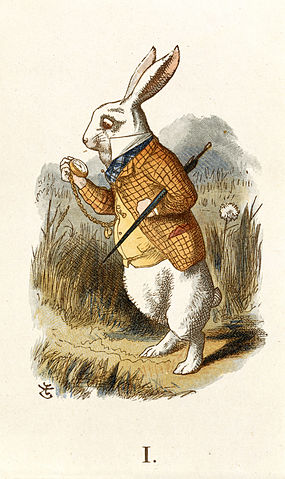
“Alice was beginning to get very tired of sitting by her sister on the bank and of having nothing to do…..when suddenly a White Rabbit with pink eyes ran close by her. Alice started to her feet, for it flashed across her mind that she had never before seen a rabbit with either a waistcoat-pocket, or a watch to take out of it, and burning with curiosity, she ran across the field after it, and was just in time to see it pop down a large rabbit-hole under the hedge.
In another moment down went Alice after it, never once considering how in the world she was to get out again.”
Charles Lutwidge 1898, better known by his pen name Lewis Carroll went to Westminster School and Christ Church College Oxford. When I have dinner in the magnificent “Harry Potter” dining hall, I usually take time to stare up at the beautiful “Alice Window”.
What does it mean to “go down the rabbit hole”? According to one source it is to enter into a situation or begin a process or journey that is particularly strange, problematic, difficult, complex, or chaotic, especially one that becomes increasingly so as it develops or unfolds.
That definition is an excellent one.
I cannot prevent myself from disappearing down the rabbit hole whenever the opportunity presents itself and nor would I wish to. One of the great advantages of age (I
am 62) is that some of us come to know ourselves. I certainly have. I am not always very pleased with what I have found but at least I have done my best in recent years to lessen my very worst characteristics. I’m not so convinced about the plasticity of the brain but I do my best to act as if it were true.
My interest is in “knowledge”.
My particular fascination is in the nature of consciousness and the “meaning” (or otherwise) of reality. It has always been so, although I did not always recognise it. If it is to be found anywhere the answer lies in science and the philosophy of science. While the number may not be 42, the “Answer to the Ultimate Question of Life, the Universe, and Everything“, will indeed be calculated by an enormous supercomputer. Except of course “Unfortunately, no one knows what the question is.”
If I had to name a single book I have found most influential in my life it would be David Deutsch “The Fabric of Reality“. Followed perhaps by Voltaire’s Candide. I will leave my readers to figure out why or read the books for themselves.
So, let me give a concrete example. I had been trading volatility. I disappeared down the rabbit hole and am still speaking from an underground labyrinth. The trouble is of course it never really stops. I spent months with Python and Excel creating various trading systems. I spent weeks recreating volatility indices and ETFs.
And then I took a dark turn down the options fork somewhere deep, deep down in the rabbit hole.
I bought VIX options data from CBOE. I spent weeks understanding it, cleaning it up and manipulating it into a useable format with Pandas and Python. I spent more weeks designing and testing all manner of options systems on the data. Could I use options to hedge my short volatility position in XIV? And then the chaos and madness really set in. I decided to try and fabricate “fake” options data from the spot prices of the S&P 500 index. More weeks of intense fun with the wonderful Pandas (thanks Wes McKinney you are one of my heroes). Endless hours of fun playing with Black Scholes, monte carlo, binomial models.
But no time is truly wasted unless you really want to make money fast. It lead me into deep speculation on my favourite topics. Predictability, randomness, determinism and on. As did my endless months experimenting with machine learning. The small minority of followers who have “followed” this article so far will be wondering where the ramble ends and what is my point. Well it’s back to philosophy I fear. And the temple of Appollo at Delphi. Socrates said that the unexamined life is not worth living – a gloss perhaps on “know thyself”. I know myself: I know that I love rabbit holes.
Happiness is being fully engaged in something you find fascinating.
Looking out at the blogosphere I suspect that those who create great wealth from finance are people who do NOT go down rabbit holes. Or if they do, then they are people who are sensible (or clever enough) to make the journey pay. And kudos to such people. Perhaps the biggest problem in the financial world is that a large percentage of its population is made up of people who would not recognise a rabbit hole if they were to break their leg in one. And such people have no interest in disappearing down it.
And as for me? Well I’m just an aging cynic. I trade a bit, I scribble down a few thoughts. But mostly I disappear down the rabbit hole for months at a time.