Category: The Inner Path

  • A Meditative Road to Enlightenment

    A Meditative Road to Enlightenment

    Is it too immodest to suggest that one may have found a path?

    Before I write so much as another word, I must repeat my by now familiar and much used disclaimer. I make no claim to goodness, I am merely a traveller who seems to be making some progress along a much desired road.

    It is hard to fathom what set me on my way. Have I always been mercurial and if so is it the often black side of my moods which made me take my first steps? Have I always sought an escape from a world which seemed (and still at times seems) overwhelming, hostile and incomprehensible?

    I don’t know. All I know is that however the urge arose, I have spent my life seeking something other than what my normal senses tell me is out there, and hence the long journey through religion, philosophy and science to find answers.

    And now at last to committed, regular and serious meditation.

    I can not and will not claim that meditation has provided me with unassailable “truth”, however much it can feel that way in the depths of trance. I am unable to tell you whether there is or is not a god or gods, or when the universe began or will end. I can provide you with no definitive answers on the nature of mind or the existence or otherwise of free will. I can not tell you whether we live in a clockwork universe or whether randomness and uncertainty provide just enough room for a future to be unknown rather than determined.

    Nor can I tell you that meditation is a definitive and certain cure for the melancholy which affects so many millions of people living out their short and small lives on this mysterious little planet.

    What I can tell you, with no trace of hyperbole or exaggeration, is that meditation is a useful and perhaps essential tool for anyone seeking wisdom, a better life. For someone who recognises that while the answers may not all be readily apparent and may never be, quiet contemplation gets you as far as it is possible to go. In terms of balancing your life and finding deeper meaning in a physical universe.

    If it does not make you “good” it does at least encourage you to become “better”.

    And what, for me, does the word “enlightenment” suggest? What do I look for in my search for enlightenment and am I getting there?

    While I would like to see a greater non-physical reality, a godlike power for the good, I have more often seen a vision of what physical reality could look like in the here and now, if we chose to make it so. Equality for all life, an end to poverty, greed and violence. Co-operation, decency, sharing. Care for the planet and its flora and fauna, an end to the virus of human expansion. A focus on happiness rather than the eternal search for more.

    And what of the non material? What of the search for divine revelation, nirvana, moksha, call it what you will. It is there, of that I have no doubt. What it is, I can only speculate, guess, intuit. A vastly expanded consciousness of a type we can only now dimly envisage. Good, bad or indifferent? Perhaps those terms cease to have meaning at that stage; I wonder.

    And practically speaking? How does such a search manifest itself? What do you actually do on a day to day basis in an attempt to ban ignorance and self and let in wisdom and the Good?

    If I led my life again it would be as a full time secular monk, holed up somewhere remote. Living simply and spending my life in reflection.

    And in retirement (when I can tear myself away from my absurd algorithms) that is how I try to lead my life in the here and now.

    My meditation has progressed, developed. Some might call it obsession but more accurately it has become a daily necessity, something I am unable, and certainly unwilling, to do without.

    Each morning I devote two hours to my practice. Mornings seem far the best time for me, since later in the day I tend to drift off in sleep. In the mornings I soon find myself in a cloud of unknowing. A place of fecund emptiness and complete peace. What do I see, what do I feel at such times? Difficult to express really but most days simply good things. Feelings. No particular rhyme or reason, no pattern of thought, simply a contended emptiness where all seems well. And mostly continues to seem well for the rest of the day.

    And then some physical exercise which continues and increases those feelings. And some gentle tinkering at the piano on most days. A few simple classical pieces, the beauty of Bach or Handel or Chopin.

    And that is my life – would that it had always been that way, but better late than never. Always time to turn the page, abandon foolish ways and prejudice.

    And the end? Well it is nigh, of course. But it holds no terror. Hieronymus Bosch was wrong, Dante Alighieri misguided. I do not dream as Gerontius or dread what is to come. A re-absorption in some greater consciousness perhaps or maybe a simple ceasing to be.

    But here and now I determine to live better, to be better and to let what may come arrive in its own good time.

    Illustration: Carnation, Lily, Lily, Rose by John Singer Sargent

  • Getting it Badly Wrong

    Getting it Badly Wrong

    Reading through my last few posts I became very aware that I extended criticism over matters which should not trouble me. And that such criticism is neither kind nor warranted.

    If you want to retire from the world, which I most certainly do, then you should at least be gracious enough to let other people get on with their lives in the way they choose. Without offering frequent and unwarranted adverse comment.

    There are a number of things in the human world which infuriate me and yet I should be big enough and forgiving enough to simply ignore such irritation.

    If I wish to be a better person then it is foolish to harbour ill feelings about the behaviour of others. It is unjustified, unwarranted and harmful both to myself and to the victims of my ire.

    My frequent rants against the “religious” are largely a result of visits to evensong at my local High Church C of E establishment. Which I do solely to hear their superb choir and to indulge in the beautiful words of the Book of Common Prayer.

    The Vicar, while doubtless well meaning and good, does specialise in the sort of behaviour and mannerisms which I find less than helpful to my invariably irascible mood.

    The sermon (which I usually avoid by quietly slipping out down a side isle) is invariably depressing. And delivered in that oh so Church of England pious mode. A quiet and dismal voice tells me that the world is terrible and that we are all so sinful and have been ever since the mythical Eve was dumb enough to eat from the tree of knowledge. And many of my fellow “worshippers” are equally pious and oh so humble. Even if away from the sacred portal they are guilty of the most heinous sin. Like so many of those good priests unable to resist the lure of each other or the under age pupils supposedly in their care.

    We are then treated to a series of ghastly readings concerning an insane and vicious old testament god who does his best to make his people’s lives a misery. And we are supposed to see some relevance to our own lives and the condition of our awful species.

    I can take much of the Gospels and get meaning out of it. The Sermon on the Mount being top of the pops.

    But Acts and all the dreary Epistles simply don’t get my vote. A bunch of simpering crackpots telling me not to shag other people’s wives’ for the most part. Who are asinine enough to get themselves put down by the authorities for peddling their depressing drivel.

    But there I go, making the same mistake yet again.  Just because “worship” doesn’t get my vote there is no cause or justification in mocking others who quite sincerely take all that tosh as “gospel”.

    And so it goes on. Wokeness is something I particularly dislike. I am supposed to embrace 64 different genders and call people “them” or “they”. Or it. Or something.  I am supposed to rejoice in sexual variety I have no experience of and sing that I’m glad to be gay. Unless I grow or graft sexual organs other than those I was born with I am unworthy to read the Guardian or join the Labour Party.

    I must wring my hands in anguish and pay out vast sums of money all because some ghastly people several hundreds of years ago used fellow humans as slaves.  Horrible but that was then. And in any event, since the practice continues, let’s stop it now rather than whining about what happened hundreds of years ago.

    Oh, and then there is a current religion which is growing like billyo which I’m not supposed to mention except in tones of admiration and quiescence. Despite the fact that what was once something very fine indeed has become a hideous instrument of terror and repression in the hands of politically inspired madmen. Whose most extreme adherents treat women as fifth class citizens and who beat and rape and torture all those who disagree with their savage and backward law.

    Hmm…what else do I loathe and despise about the world. Well, most of it I guess. Or rather anything which touches on the human race.

    I’m very happy with birds and bees and butterflies and natural beauty.

    But there you see is my error. I am allowing my own likes and dislikes to make me into something just as unpleasant and unacceptable as those that I criticise.

    It’s a human failing of course but one that must be overcome if one wishes to live up to one’s ideals.

    I have often stated that I am not as such a “good” person and that becomes only too evident when I look at my own attitudes and behaviour. But at least I recognise it as wrong. Which must surely go some way to redress the balance in favour of my fractured and imperfect soul.

    Note to self: “Must try harder”.

  • The Road to Nowhere

    The Road to Nowhere

    I could have said “Damascus” but I am ever wary of expressing any of my experiences, even metaphorically, in the idiom of any particular faith.

    As I have always taken great pains to point out, I am not a particularly good person. Or bad, come to that. Just a middle of the road and by now rather aged Englishman who has had a series of what others of a more conventionally religious persuasion might call revelations.

    It could of course be that I experience what I want to see or hear, or that which I expect. Although I do not believe that to be the case.

    It is by no means on every occasion I meditate that I seem to sense a different reality, perhaps a higher level of consciousness. It is highly unusual not to feel peace and warmth when I turn inward, but it is not every morning that I feel a connection with something other.

    Mornings are best for me. I wake, have a very large cup of coffee, flick through the headlines (ignoring the great majority of what is offered up as news) and then meditate for an hour. My mind in the morning is very clear and soon after waking, my mood is suitable. In the afternoon or evening I sometimes fall asleep when I meditate (although I am often unaware of my state) and my mind does not have that clarity it usually has first thing in the morning.

    I recall some time ago writing that I was often refused entrance at the gate to some alternate or other reality. That I would approach the gates and be refused entrance, usually by a form which seemed to be human. A black knight, once, in mediaeval armour plate would not let me pass. Wise men I had assumed were sages of some sort were unable to show me the way. All very symbolic – in a sense, perhaps I was not ready.

    More latterly, the human element seems to have disappeared but I am in some difficulty to describe what has taken its place. And yet I become irritated by those who talk of the inexpressible, the ineffable, the numinous. What I felt is describable in words; the difficulty may be that I am uncertain exactly what it is I felt. Feel. It is becoming clearer, more pressing perhaps but there is still a vagueness to it.

    In any event, this morning I did read one article of interest. The Guardian’s John Norton had written an article “OpenAI boss Sam Altman wants $7tn. For all our sakes, pray he doesn’t get it“.

    Now I have been a man of science in the past. An admirer of human ingenuity. Convinced like physicist Frank Tippler that the way to “god” is through science. I had always been somewhat impressed by Teilhard de Chardin – I still am. He was a scientist as well as priest and believed the universe’s purpose is to evolve to supreme consciousness, an omega point, unity with god. God will be ‘all in all’.

    But that article in the Guardian made me lean far further towards de Chardin and away from Tipler. And my meditation seemed to support the conclusion.

    I had been toying with an article entitled “Water into Wine” pointing out that the process is far from miraculous. And that the only surprise at Cana was the instantaneous nature of the transformation. Otherwise its just physics and chemistry. And these days no doubt, the process of creating C2H6O is pretty well instantaneous. Carbon, hydrogen and oxygen. Big deal.

    But reading that depressing tale in the Guardian made me forcibly and strongly aware that I had simply missed the point. The point being that science has a great, gaping hole in it. It lacks a soul. It is bereft of meaning.

    Like so many tech Titans, Sam Altman claims to be a messiah, a saviour of humanity.

    “Most of them belong to the church of technocracy, of which Altman is a charismatic member. Devout members of this sect believe that the world is terminally screwed-up, and that the only way to fix it is with tech. They are ecstatic about AI because finally a technology has arrived that apparently could fix everything – economic growth, healthcare, productivity, education, even the climate crisis. Strangely, though, warfare seems to be missing from the list.”

    OpenAI seems to be backsliding on its previous insistence that its technology should not be used by the military. Hmm, how very depressing. Altman is seeking $7 trillion and seems to be set on owning the entire world.

    And then I closed my eyes and drifted off for an hour. I sensed a something which put Mr Altman and all his Titanic companions into a small box in a far corner of the room. Mere greedy children whose supposed altruism has a very hollow ring.

    What was it I felt? Oddly similar to what my friend Keith Hancock describes. A reality so vast and so superior that humanity, its petty cruelties and vanities, became utterly insignificant, meaningless. I’m no so sure that what I felt was wholly benign. Certainly in no way evil, but way above and beyond human concepts of benignity or good and bad.

    And I felt with great conviction that Julian of Norwich was right: “all shall be well, and all shall be well, and all manner of thing shall be well”.

    Like de Chardin, Keith talks of evolution. Of greater things to come for consciousness. A rising up, a meeting, a confluence with reality, a deity, call it what you will.

    And I’m with him on that, as I have always been with de Chardin. Perhaps technology and science are good things but their goodness pales in comparison with what is really “out there”.

    And those who create and wield technology can be very flawed indeed. Their true aim certainly does not seem to be to connect with the divine, to move to something bigger, better, greater. Further up, further in. For all their talk, for all their Brave New World, in my peregrinations this morning the technosaurs, the Titans were revealed as mere pygmies.

    Sorry Sam, but that’s just the way it is.

    And love, what of love? So many mystics, so many seekers of the divine write of love. I can not. The word doesn’t suit me although the concept does. So yes, I sensed something great and outrageously good this morning but I can not bring myself to call it love. Semantics maybe, but love seems such a human word. Benignity perhaps, something overarching and extraordinary. Perhaps after all that is what people mean when they talk of love. Personally I find the word oleaginous, but maybe that’s my mistake.

    Anyway, there you have it. Call it what you will, make of it what you will. I was left with a strong feeling of having arrived. Got there, got the point, seen through the veil.

    And I hope and expect my journey to continue.

    “I have come home at last! This is my real country! I belong here. This is the land I have been looking for all my life, though I never knew it till now…Come further up, come further in!”

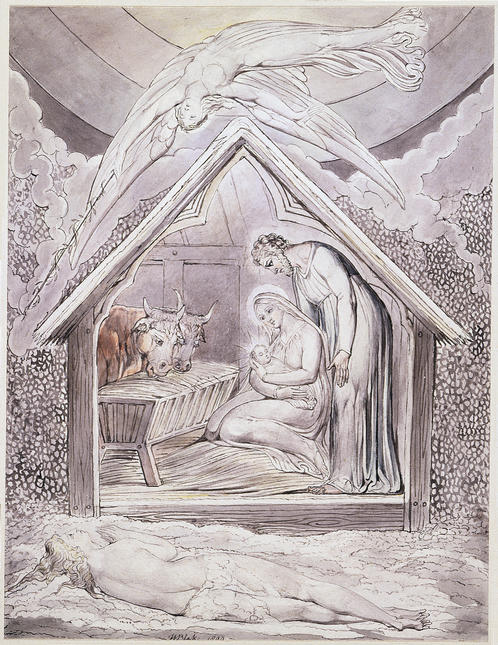
    Illustration: William Blake, The Annunciation to the Shepherds, illustrations to Milton’s “On the Morning of Christ’s Nativity”, the Thomas set (composed 1809)

  • Communing with the Infinite

    Communing with the Infinite

    It is hard to express the profound experience to be found in meditation without sounding oily and unctuous.

    I continue to write very largely so as to keep a diary, rather to attract an audience with all the vanity that that entails. I find it useful to look back over the five years odd I have been keeping this personal record, to see what progress if any I may have made on my road to nowhere. Or somewhere.

    Let me be clear – I do not wear a beatific smile. I do not seek to preach, to the unwashed or otherwise. I simply seek my own course, pursue it. To escape from a lifetime of impenetrable blackness. To discover meaning in an apparently aimless universe.

    If there is a god, Christian or otherwise, then as creator he must bear sole responsibility for clearing up the ghastly mess he has made. I don’t intend to help him.

    If on the other hand, reality is something of an entirely different and uncreated nature, as seems likely, it is still every man for himself anyway. Or woman, child, creature.

    And yet if what I write, if the tales of my endless journey be of help to some, then I am glad of that. I do not wish ill, nor am I insensitive to the stupefying suffering on this earthly dystopia or elsewhere. My writing is the only contribution I can usefully make, read or otherwise.

    Great works have in any case never led to universal peace and happiness. Simply to further inequality and injustice.

    If there is a way out, it is to be found not through conversion to some man made dogma or foolish cult. But through personal “enlightenment”.

    And lest that word sounds fawning and oleaginous, may I hasten to add I merely intend to convey the process of becoming “unblinkered”. In a psychological sense. In a rational sense. To become able to exercise reason, wisdom and levelheadedness. To see reality as it is.

    Enough of the apologies then, although I do believe they are important to my purpose. To my self exploration. To my journey. To convey what it is I seek and that that I do not.

    I wish for peace. It is that simple. And if there can be peace for all, so much the better. My belief is that inner peace will not of itself be found through science or religious dogma.

    Peace, at least in my own quest, has only begun to emerge through letting go. By looking within. By abandoning pretence. By looking at the futility of what most strive for, and turning in the opposite direction.

    Perhaps for others, the meaning of reality, if only some personal rather than universal reality, will be made clear in other ways.

    In obeisance to a deity perhaps. In a life of ascetic abstinence.

    But peace is certainly unlikely to be discovered in hedonism or the wielding of power. In excess or greed or violence. But who knows, perhaps I am wrong. Perhaps the violent Halls of Valhalla give comfort and certainty to some. Maybe there are those who find truth in pure violence and unspeakable cruelty. In which case, evil may be said to exist after all and the universe is not an inert and blank canvas.

    That is not my belief however. Peace is to be found elsewhere entirely and I have found no more practical route than quiet meditation.

    For many years my meditation was “unguided” and haphazard. Sitting in quiet contemplation on a mountain top or a remote beach. Listening to the sound of the wind or the murmuration of the waves on a remote beach.

    It was a dead end. A pleasant and thoughtful pursuit and yet not one which led me to peace. The abyss remained close by, the darkness ever ready to consume and convert an already tortured soul into something ever more terrified, desperate and unhinged. To stand at the edge of the crevasse, at the very gates of Hades, is not an experience to be savoured. Nor is it by any means simple to stand back, to retreat from that dread precipice and search for kinder climes.

    We may have advanced from the days of Galen, but we are still so very far from understanding the human mind and body. While some may be blessed with quietude and concord at birth, others are forced to travel a harsh and uncertain road beset by uncertainty and doubt. Perhaps none are granted peace from birth – certainly none are spared the vicissitudes of this often grim existence.

    Medicine can not grant peace, although some benefit to an extent from the numbing effect of strong and poorly researched chemicals, produced by big pharma, largely for their own benefit. The Sackler family and Purdue Pharma come to mind.

    Many seek relief and a false peace in alcohol or opium, cocaine or ecstasy. A sure road to damnation as I for one can testify.

    True peace comes from a different direction entirely. A change of lifestyle, the renunciation of harmful pursuits and substances, the gradual accumulation of wisdom. And yet in my own case, none of this ever tipped the balance.

    My daily meditation began to take a very different form. Guided and directed with the express purpose of becoming who or perhaps what I wanted to become. By choosing goals and making them into a mantra. By guiding myself towards a different landscape, a different reality.

    And that different reality has appeared and continues to change and morph day by day. Not every throw wins a coconut, but most certainly do. Most sessions build upon the last and the process is cumulative, becoming stronger every day. It has reached the stage where often a mood can be produced by simply willing it. Imagine it, declare its reality and so it becomes.

    And there is strangeness, of that there is no doubt. An increasing awareness that a different world is there to be had; and I take it. Nothing dramatic, just echoes and glimpses of better things. And pleasure. And peace. Strong images in the mind, feelings, and not voices exactly but a feeling of being in contact with something other.

    I concede that I am given to things “arty”, to beauty and music and feelings. But this is something different, visceral and real.

    There will be those that say it is “mere” chemicals and indeed it may be that meditation produces dopamine or serotonin. As well as slower brain waves. But exactly the same may be said of “normal” day to day existence. Anger, greed indeed any emotion has a chemical signature and yet they are none the less real for all of that.

    Meditation seems to be giving me the ability to experience life in a dramatically different way, to the extent that it feels very much like walking through William Blake’s Doors of Perception.

    There may be an alternate reality – one in which we are living anyway but can not see. One which takes practice and a certain mindset to access.

    That, in any event, is my conclusion so far.

    A conclusion with which I am most satisfied and for which I am most grateful.

    As I continue on my idiosyncratic and unconventional path, as I progress along the road less travelled, I am finding at last a quiet pleasure in my uneventful existence.

    Illustration: William Blake – from the Song of Los

  • A Great and Mighty Wonder

    A Great and Mighty Wonder

    Few would dispute that an extraordinary mystery lies at the heart of our reality. But that enigma is interpreted in a multitude of different ways.

    Many will not be familiar with the words of St. Germanus or the music of Praetorius. To God on high be glory and peace on earth to men, he proclaimed, lauding the virgin birth of the infant Jesus by Mary, a first century Jewish woman from Nazareth.

    To Christians, that birth is the great and mighty wonder. At the centre of their universe.

    Other cultures view our world through a different lens and interpret the riddle in another way.

    All such traditions are, as the Buddhists might say, fingers pointing to the moon. Attempts to capture that central reality, not the mystery itself.

    Science too is one such “finger” and the Buddhists in particular have been keen to allow their views and beliefs to be informed by this method of investigating reality.

    For many years I have been intrigued by science. At its very core, reality is empty of all but energy we are told. Not even science can tell us what that energy is or how it got there.

    Whether that energy has purpose or consciousness is an intriguing question. What it “means” if anything is another.

    As a non scientist I have nonetheless been intrigued by what science is revealing and how it seems that all material reality can be bent to our will. And yet there is a hollowness in pure reductionism, which scientists seem unable or unwilling to fill. In addition I am of an age where even the rapid pace of scientific discovery is too slow. I am unlikely to see a theory of everything in my lifetime.

    And a reductionist “theory of everything” would be a sad and empty thing, unendowed as it would doubtless be with any existential content.

    And so back to faith, or faiths. My only faith is the belief in something rather than nothing and the firm conviction that consciousness plays a central role in reality. And further that our animal consciousness can and may evolve into something “godlike”, should we take the trouble to examine ourselves and choose our goal wisely.

    God was made in man’s image.

    Our faith, our religion has always sought explanation and a better way of living. An existence beyond the bestial, where all is calm, all is bright.

    And to that extent I am and always have been deeply “religious”. A mystic who seeks a reality beyond the mundane and thoughtless brutality of animal existence. A believer in a great and mighty wonder.

    I believe that we can and should rise to godhood. It is our choice and hopefully our destiny to put aside greed, violence and every other venal aspect of animal existence and, aided by science, create a very different world.

    A world such as faith has always imagined.

    For thousands of years religious terrorists have used and abused the beauty, the central mystery of reality for their own purposes and I will have no part in it.

    Christian and most other faiths have amassed great wealth and committed appalling atrocity in the name of their “god”. They have forcibly converted the heathen, they have committed genocide. They have insisted on their rightness, and the wrongness of everyone else who has the effrontery to think or believe differently.

    None of that destroys the truth of a great and mighty wonder. It merely shows how humanity can and does twist and corrupt the best of ideas in search of power and possessions.

    But yes, I am a Christian. A “cultural” Christian whose entire life has been enriched and enhanced by the magic of the better bits of the New Testament. And indeed the Old. Whose very language and pattern of thought have been deeply influenced by the idiom of Christianity. Whose life has been enhanced and made richer by the music, language, art and architecture of 2000 years of this admirable but ultimately flawed effort to explain the unexplainable.

    To those who might say I am not a Christian I would say fie. At heart, Christianity is but one attempt to explain the central mystery and I value what it has to say. As myth, as parable, as a finger pointing to the moon.

    I am a Christian because I believe in a better world. Because I believe in a central mystery so beautifully described by so many different faiths. I am a Christian because I can see that it is meet and right to invent a good god and to seek to become that beneficence.

    I am a Buddhist. A Muslim, a Jew, a Taoist, a Hindu and a Shintoist. I am every faith that seeks a better world and evolution towards the divine.

    And to those who would reject me, I understand. I do not seek to convert you, I am not right nor you wrong.

    Of any whose faith sees a great and good mystery at the heart of reality and who seeks to emulate it, to move towards it, I claim kinship. And towards those of no faith who nonetheless renounce the way our world has so often been, and who seek something better, I claim kinship also.

    Life is a struggle, of that there is no doubt. It is an uphill battle to smile every day in the face of adversity. To be pleasant to those around you. To be good tempered and well behaved. To resist greed and base materialism.

    We must seek reality, whatever and wherever it is. We must move on if we can, upwards and away from our past.

    We must seek the central mystery.

    I need my faiths, all of them.

    Illustration: William Blake – an illustration for Milton’s poem “On the Morning of Christ’s Nativity”

  • Quo Ego Vado?

    Quo Ego Vado?

    Where am I going?

    The reality is that none of really us know.

    But I want to write about my experiences with meditation, in the hope of helping anyone who seeks relief from suffering. And release from the need to seek an answer to that question.

    To express in clear, unornamented terms what I have thus far achieved in an uncluttered and simple meditative practice.

    I first studied Buddhism many years ago.

    Buddhism originated in a simple effort to avoid suffering and to attain a state of inner peace. The prescribed cure for misery is to meditate and to lead life in the “right” manner. A meditative practice then, and a code for right living. A course which follows a middle way, avoiding both harsh ascetism on the one hand and wanton self indulgence at the other extreme.

    What began in utmost simplicity around 2,500 years ago became a confused tangle of many different branches, a multiplicity of different teachings. And as to “enlightenment”, who had ever achieved this rarefied and seemingly unachievable state I wondered? From stringent clarity great confusion arose in Buddhism, along with exaggerated claims as to its benefits.

    At the same time, I studied Christianity and again found myself similarly nonplussed. Prophets ascending into the skies on chariots of fire, people turned into pillars of salt, burning bushes. Can it all have happened and if so, how is that of any benefit to me in the here and now? I never found the answer to the last question, and had a healthy scepticism regarding the former.

    As I looked at yet more faiths, the curious case of Carlill vs the Carbolic Smoke Ball Company (1891) came to mind. I had been a lawyer once upon a time and the case has always come to mind whenever presented with extravagant declarations and inexplicable professions of the miraculous.

    Deadly influenza was wiping out millions and the Carbolic Smoke Ball Company sold a “cure”. The company offered a very substantial £100 to anyone who used the Smoke Ball correctly and still caught Russian Flu. Mrs Carlill did so use it, still caught flu and claimed her reward. The company refused to pay up. They claimed that the offer was mere “advertiser’s puff” and was not contractually binding. They lost, and misleading advertising eventually became a criminal offense.

    And so when you read all the religious puffery (and they are still writing it) please don’t believe that Tibetan monks can literally levitate or that dead bodies of particularly saintly individuals don’t rot.

    Religious writing is sugar coated to boost sales. Especially in the hands of today’s less scrupulous gurus; but it has always been so.

    And so back to meditation. In strong contrast to the immoderate promises of many other faiths, root Buddhism claimed a simple but profound benefit in the here and now. The avoidance of suffering. Today, here on earth. Not in some theoretical afterlife.

    And hence I developed a strong liking for basic Buddhism. Call it a faith if you must, but in my understanding it offers a practical remedy for misery.

    In early days, perhaps some small corner of my mind was expecting supernatural results. Wishful thinking and a hankering after magical realms and other worlds. Disappearance into some manifestation of nirvana. A desire to levitate.

    I only half joke but the hyperbole of some of the Buddhist scriptures is no more absurd than that of its competitors.

    But here is the rub – it does actually work. Not the promise of the supernatural, but the rather more down to earth claim of a relief from suffering.

    For the past two years I have followed a daily meditation routine with unswerving devotion. I will sit three times a day for periods varying from 20 minutes upwards.

    I have read much in the past about the power of positive thought. But then again I have read much hogwash from Freud to Mesmer and beyond.

    Except that I have now discovered a kernel of truth to it all. That, call it what you will, the “subconscious” can be trained. That rumination and damaging thought patterns do become entrenched, laid down in the mind like well worn tracks through a forest. And that they can be replaced by more beneficent patterns.

    With help from my favourite secular priest, I crafted a blueprint for the person I wanted to become. And distilled that plan into a few key words. Or mantras.

    The trance state is something few beginners grasp, and some years ago I too found it puzzling. To know whether I had got there or not.

    The trick is to relax and not worry about it. It’s nothing so very out of the ordinary – to begin with just a state of mild relaxation, which deepens as the meditation gets underway. For some, the repetition of a mantra is enough to induce trance. I prefer to use a hypnotic technique which begins with a bit of pretence but which, after much practice, becomes a reality.

    After relaxing for a short while, you tell yourself you are so relaxed your eyes won’t open. And the pretence is to keep them shut. Even that ceases to be a pretence after you have been through the process often enough.

    And then counting backwards, telling yourself you are becoming more and more relaxed until the numbers disappear. In the beginning you have to make an effort, a further pretence if you like, that the numbers have indeed disappeared. But again with practice they just do disappear, leaving you in a state of pleasant, rather hazy relaxation.

    Which is when I begin to repeat the mantras. Which over time become ingrained into the subconscious and become you, a part of what you are.

    After a time, I find the state of trance deepens and the repetition of mantras stops, seemingly of its own accord. It usually takes up to 20 minutes, in my case, to reach this stage.

    By this time, I am usually far away. In a place where the pure light of consciousness can shine through. A state of awareness without the distraction of thought.

    Any thoughts, day dreams or visions which do arise are unusual ones and, in my case at least, invariably pleasant. Instructive even. The brain seems to operate in a different way under these conditions and the effect is not unlike a mild psychedelic “trip”.

    The effects of meditation spill over into my waking life. I find myself slipping back into that mind state as I am out walking, stuck in traffic or indeed at virtually any time or place.

    Equally, and remarkably, I have found that I have become (at least to some extent) what I set out to become. That the terrible blackness which has plagued my entire life has more or less disappeared. And if it does make an appearance it is less desperate and certainly of short duration.

    I also find that I am more accepting and less impatient and irritable. More tolerant of others and less inclined to venture my own opinions. More retired, more resigned to the way things are, the way I am.

    Of course, in extremis the blackness may return but if it does, at least I seem to have found a way out.

    I also find I am more accepting of myself. That I am not who I thought I was, not as capable, resilient, bright, ambitious. And I am fine with that. It’s just the way things are.

    I don’t think my habits have changed very much, although I am increasingly reluctant to spend my days hunched over a computer. But I live healthily, more so perhaps than at any time in the past. Largely vegetarian, I take at least a couple of hours exercise each day. I play the piano a lot and these days enjoy it more than singing.

    Above all I live quietly. No social whirl, no dinner parties or grand friends. No aimless, frivolous small talk. No news programs, no social media.

    I still “think” quite a bit. Mostly about the meaning of reality. I am far more likely these days to rely on my own contemplation than to read yet another philosopher or scientist with his speculative and incomplete theorems and opinions.

    I have noticed, without any shade or shadow or rag of doubt, great change in my inner self. And for that I am enormously grateful.

    Perhaps that change has come about as a result of a number of factors, but my meditative practice has, I feel certain, played a large part in the much needed metamorphosis.

    Listen to me, or don’t. Take my claims as extravagant or reckon that they contain a grain of truth.

    Quo Ego Vado?

    I don’t know but I’m really not too concerned any more. Perhaps, after all, things are just as they should be.

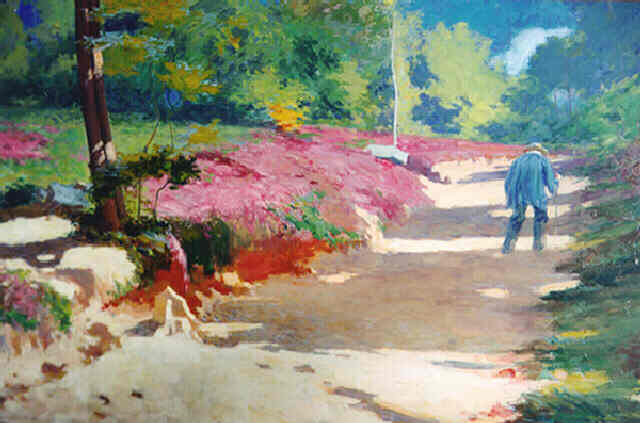
    Illustration: Sunlit Path – By William de Leftwich Dodge

  • Peace

    Peace

    Internal or external, the path to peace is the same.

    It is difficult to imagine a world at peace without its inhabitants first having found tranquility within themselves.

    And it is difficult to imagine a person achieving equanimity within, without conducting himself in the right way in the physical world .

    It is hard to believe that anybody would have difficulty in establishing the “right way” to conduct himself, if he really thought about it. But in that unlikely event one need only consult some of the more benign schools of thought which have been around for many thousands of years. Do unto others as the Christians might say, or follow the Buddhist Eightfold Path. Cultivate the beautiful tenets of the Tao. Practice the spiritual and ethical traditions of Sufism, follow the Dharma of the Hindus.

    Or frankly, follow your own good sense. Do no harm to any sentient being, be kind and generous in spirit.

    And above all do not insist that yours is the only way, that your belief system is unique. And that everyone else has it wrong. To do so is assuredly not “right thinking”, not “right action”.

    The exclusive claims of different religions are merely variations of universal truths that have been taught since the origins of man.

    Can inner or external peace arise if I insist I am right and those who do not agree with me are wrong? Can peace in the world be achieved when one set of people believe their god or philosophy is the only truth and seek (often by violence, of thought if not of deed) to convert the heathen?

    History would suggest not.

    But who am I to say? If I were to insist upon the rightness of my own thinking, I would be falling into the same trap as those who have led crusades and jihads. Of those who considered Jews vermin and dealt with them accordingly.

    I can only repeat that these are my views, that this is the way I choose (or, more realistically, try) to lead my life and this seems to be drawing me to a place of peace where I can live and let live. My external actions affect my inner world and vice versa. An increasing level of inner peace is giving me an increasing awareness of the importance of following my own path both within and in the external physical world. And letting others follow theirs.

    The two must go hand in hand – as man thinketh in his heart, so is he. I can not expect tranquility within if I am a beast without. If my inner thoughts and my worldly actions are those of peace, then I can hope to become what I want to be.

    Those without introspection will find it difficult to develop peace within or without. Those who continue to follow the often unconscious desires humanity has traditionally pursued are also unlikely to find lasting contentment.

    I have no need surely, to point out that greed, envy, anger or pride are unlikely to lead to a life well led or to a sense of serenity.

    Read the Noble Eightfold Path and the Four Noble Truths if you are in any doubt. If you can not fathom good or bad. If you are unable or unwilling to separate the ethical wheat from the moral chaff. If you can not find the way to happiness.

    Wrong thoughts and wrong actions lead to suffering.

    I have felt much change within my self in the months and years since I began this blog. In the beginning there was much anger. A conviction that the world was wrong. That it must change.

    Today I feel that I have been wrong and I hope that I am now “right”. Or at least that I will continue to feel less and less need to be critical or vociferous. And that I will continue to develop a detached understanding and acceptance of all around me.

    Today I feel it of utmost importance that I mind my own business, that I retire from a world I have always found wholly unsatisfactory. And from behaviour that leads and always has led to conflict and misery in a world dominated by self.

    Mea culpa, I have been at fault as much as the next man. Through fear perhaps, or through the inner blackness which has so often plagued my life.

    And yes, through greed, through envy and perhaps one or two other unwise emotions.

    Life is so easy in hindsight but if I had my time again, I must not fool myself that I would live in a better way.

    For most of us, wisdom can only come through experience and that perhaps is the one and only benefit of age. The ability after many years of effort to admit that I was wrong. And to have the energy and courage to start again.

    It will be obvious to any who have been kind enough to follow this, my diary, that I have long known what my path ought to be. That in reality my weltanschauung has been the same throughout my life. That, intellectually, I have always felt the same, known in which direction my true path lies. But it is only very late in the day that I have come to admit this to myself. That I have begun to make an honest and very internal effort to realize within what I have long understood in the abstract.

    For me, the path lies within. Contemplation, reflection, silence and above all coming to know myself is leading me to a place of equanimity. To a place where I can be free not to judge, to a state of mind where I can feel pity and compassion for a beautiful world torn and tortured by ignorance. And self.

    There will be those who insist that I must look to their god. That without worshipping Ganesh or Gilgamesh, without bowing down before some other deity, I will never reach the afterlife but will instead find myself cast into the darkness, or worse into some fiery pit, the likes of which even Hieronymus Bosch failed to to depict with sufficient severity.

    I would say to such people that I do my best in life and if their god can not accept my efforts and will not allow me access to his version of a heavenly afterlife, then I reject him and will happily take the consequences.

    If there are gods, I reject those that are jealous.

    And so back to peace, or rather my version of it. I have meditated in Gothic Cathedrals, in Zen Buddhist monasteries in Japan, in Hindu temples in Singapore. And in our garden shed. In Battersea Park by the pagoda. On mountain tops, in gardens, in fields.

    Does it matter so very much whether I choose to repeat a mantra of my own choosing or to dwell upon the goodness of this god or that. Whether I believe in an emptiness of infinite fecundity or a creator god who stuck it all together in six days around six thousand years ago. Whether I concentrate my mind on loving kindness or upon some representation of The Good of Plato. I think not. But you are welcome to think otherwise.

    What matters is that I seek to be a “better” person in the external world and a happier and more tranquil being within.

    I plod my way towards my goal by the simple means of putting my mind at deep rest and softly repeating mantras of my own making. Soon enough, images appear unbidden and a deep peace settles upon my quietened mind. Such tranquility increases in depth and duration day by day. It often appears unbidden in my waking world and a sense of infinity can stretch before me and around me.

    Seek your own path. Choose or reject a god or a philosophy. But in the end, your way may end up being not so very different to my own.

  • Credo

    Credo

    Too often have I pronounced upon that in which I do not believe.

    Better by far to renounce negativity and to declare instead that in which I do believe.

    I was told over the weekend that I am a believer by someone who has been kind enough to read much of what I have written over the past few years and who knows that I have often struggled with impenetrable blackness.

    We were talking more probably of belief in meditation, rather than faith in general. And yet for me meditation is an inextricable part of the route towards meaning. It always has been but of late I have been more diligent in my practice.

    I have been puzzled by the trend towards Mc Mindfulness in our secular age. It may “work” for some, yet I find its emptiness an arid detraction from what for me is without doubt a search of more serious intent.

    The truth is that I have always been a mystic. Somebody in search of the face of god, reality or meaning. I have never been one to follow anybody’s path but my own, and most of those with more conventional faith may well question my beliefs and practices. And yet if they read me correctly, they will see that our paths are not so different. Nor our core credence. In uno deum may not be for me, but for those who really look, the paths of mystics east and west are identical, as are their objects and goals.

    And so, Credo. But in what?

    Well firstly I have come to believe in the efficacy of meditation to heal both body and mind.

    My long time guru John Butler uses such techniques on his own behalf and that of clients to undergo surgical operations without the use of anesthetics. He expresses a conviction that the mind governs the body in a far more powerful fashion than most believe. And hence can procure much of what is needed in a physiological and indeed spiritual sense to secure and comfort both mind and body.

    I have never seen meditation as a mere tool for medical use, but rather as a guiding light to navigate through doubt and darkness and to arrive at a state of gnosis.

    How grand this sounds (pompous perhaps) but as always I use language in a poetic and metaphorical sense to convey my meaning. Perhaps because a bald and more prosaic description can not get across the strength of my feelings or indeed what it is that I do feel, that I do believe. Language can be a poor tool to describe the indescribable but try one must – it is the tool we have at our disposal to convey inner thoughts and meanings which are not readily susceptible to an exactitude of words.

    I know that there will be some who read this post and will strongly disagree with most of what I believe, but to such people I would say these are my beliefs and they can not in any sense be said therefore to be wrong. For me, for my own subjective reality. Yes, you may not share them or indeed like them. Your reality may take on a different hue to mine or you may be a materialist who denies any possibility at all of a god or of meaning or purpose in this universe.

    I can respect all such views, honestly held. And would expect therefor that people should respect mine. I have no desire to argue. Equally I have no desire whatsoever to persuade or convert or proselytize.

    I believe that god is within. Or, if you so choose, reality, Brahmin, nirvana, call it what you will. I believe with utmost conviction that those who seek quietly within themselves, whatever their race, colour or creed, come to a somewhat similar conclusion. Or at least such people would not take objection to my own feelings on the matter.

    I do not need to read or consult books of learning or faith. Time spent in quiet repose gives me such answers as I need. Other of course will have different needs, other requirements. They will have strong conviction in revelation, in an external force who gives tablets of stone or dictates books of law to his prophets and disciples. But at heart they are unlikely to come up with answers so very different to my own.

    What is it that I discover within? Above all that there is meaning, a goal and that we should head towards it.

    De Chardin’s Omega Point. Frank Tipler’s if you prefer a less ornate version.

    And that despite the views of the materialists, there is right and wrong – at least so far as sentient beings are concerned. We think, we feel, we are. Consciousness has emerged (never mind where from) and it is a nonsense to deny its reality. Whatever it may turn out to be.

    So there you have it. I believe. I may struggle to live up to my beliefs (are there any who do not?). I may not serve the poor or give comfort to the oppressed, but I stand in admiration and support of those who do. I believe that I know the difference between right and wrong and as far as I am able I will try to head towards the former and away from the latter.

    Credo.

    I believe there is meaning.

  • Meditation – Nonsense or Nirvana?

    Meditation – Nonsense or Nirvana?

    Almost a year ago, his meditation took a different and far more satisfactory direction.

    And now, many months later the benefits had become evident. It was not that he found himself living in some alternate universe or in a permanent state of bliss.

    But he found himself able to say that his thrice daily practice almost inevitably brought pure peace, bliss almost, for its duration.

    After a stop start dalliance with the practice and with Eastern philosophy in general, the penny had finally dropped. Better late than never.

    He found that his personality, his behaviour, while not “changing” as such, was becoming moulded or fashioned in a manner of his own choosing.

    The process was by no means over and the metamorphosis would continue. Or thus was his fervent hope.

    His past practice had been defective in several ways. In constancy, certainly, but equally importantly in technique.

    He had found few useful guides over the years and had always imagined the process far more complex and ritualistic than it turned out to be. If you see references to the x stages of meditation, the y levels of attainment and so on, his firm advice would be to turn the page.

    The way was made plain to him when he visited hypnotist John Butler, who had provided sage advice over many years. If Mr Butler is able to hypnotise himself and others to feel no pain under invasive surgery (and he can) it seemed obvious that the techiques he taught should be able to attain all sorts of other good things.

    What he had never grasped properly over the years was the power of self persuasion. Never having been able to persuade himself consciously of anything (other than the beastliness of the universe) the true potential of changing his subconscious mind evaded him for years. Despite previous failures, for some reason more recent endeavours paid off.

    Meditation is often thought of as sitting quietly watching your breath. Which is all well and good but in his case achieved no lasting change. Nor any swift onset of a merciful state of bliss.

    The process of self hypnosis is simple enough and can lead to a deep meditative state. It requires belief in the process and endless repetition. In his case for around 20 minutes, three times a day, although his sessions would often extend to an hour if the mood so took him.

    Getting into a state of trance is simplicity itself. Dave Elman’s books or those of Gill Boyne provide endless methods, but eventually you develop your own. And with practice the induction becomes very swift.

    A light state of trance is not so very different from the waking state. A little more peaceful and relaxed, the harsh realities of the physical universe somewhat remote. As a trance is deepened, thought almost disappears and the mind itself seems absent or at least very different. He found truths struck him out of the blue, unusual patterns and feelings became prevelant, and previously forgotten memories often resurfaced .

    In deeper states (which came, inevitably, three times a day) the qualitative experience was not unlike a mild trip on psychedelic drugs. Most satisfying, he felt.

    The work involved was simple enough. Initially much preparation was put into defining a few concise sentences describing how one wanted to be, to become. Those sentences were then summarises by a single appropriate word, and an image.

    When in a state of trance, the key word is repeated in a lazy, dreamy fashion and the image seen, in the minds eye. The key word or words forms a sort of mantra. He found it could be used to both deepen the trance and to expel intrusive thought.

    He felt himself becoming more as he wished to become. Over the weeks and months, the suggestions seemed to have become a part of him, the thoughts took root.

    “As man thinketh in his heart, so is he”.

    He lapsed occasionally. Snapishness or churlish temper might hold sway for a short while, but he found himself better able to recover, as some part of his mind took corrective action, became aware of a digression from the mapped path.

    He became increasingly aware of his ever passing moods and more able to head off those he found less useful, before their grip became entrenched and unshakeable .

    Far from being a chore, the daily sessions became a pleasure. Sometimes he sat in the garden as he drifted off into his private world. Often he would sit on a park bench or in a field . Or in some favoured church or other quiet place. Some say meditation can be successfully undertaken in the bustle of the everyday world but that he found a struggle and a step too far.

    The peace enjoyed during these sessions increasingly spread to the rest of his life and the perennial black moods dissipated. Whether for good or for some brief spell he had yet to find out. Cause and effect, never straightforward, nevertheless seemed to have something to say. His moods and his life seemed improved and he had to put at least some of it down to his practice.

    It would not be accurate or realistic for him to claim that he was transformed. That a gruff and surly fellow had, by means of meditation, become a pious and kindly soul determined to make the world a better place. But at least he was on the right path. At least he felt better about himself and his place in reality.

    More than ever he hoped for a better world. But from an increasing distance and without any real hope that some Parousia or other miracle would bring a swift change for the better. Perhaps he did however have a firmer intuition that in the greater scheme of things, nothing was so vastly important. Perhaps a few more eons would either put paid to the awful race who had named itself human, or change them unrecognisably for the better. He wasn’t too bothered either way.

    He remained contentedly on the sidelines. Watching the world go by with quiet resignation and sometimes amusement. He did not want to see or be seen. To be among the good and the great. To sit with the rich and the famous or to play games of greed and power. Simplicity and silence was all he needed, far from the madding crowd.

    Meditation, guided by his own mantra, was leading him to a very different world where all that mattered was quietly flowing with the stream . And kindness, when it could be offered, was the most precious of commodities.

    Would it yet take him to Nirvana, his practice? He didn’t know but in his current state of mind he wondered whether it really mattered. Perhaps simple peace was enough or perhaps that was Nirvana, after all.

    Perhaps Nirvana awaited him on the other side of a wardrobe door. In a rambling old country house in Shropshire.

    In meditation he could feel himself brushing past ancient fur coats, beginning to feel a crisp chill. And to see an old fashioned lamp post lighting a snow filled clearing in a deep and mysterious forest.

    Perhaps one day he would hear the lion and feast with dancing dryads and naiads in some sylvan paradise.

    Sometimes, the dream seemed almost close.

  • Pilgrim

    Pilgrim

    Why do they do it, what are they seeking? And what is a shrine, a holy place? Many are put off by such language, reeking as it does of mediaeval incense and crusader’s crosses. Costly and false relics. Rigid and inevitably meaningless dogma.

    To him however, language was a poor medium in which to express the holy. The ineffable, as some would have it.

    In any event, he found himself in Vézelay and perhaps, despite his misgivings over etymology, he found himself after all to be a pilgrim. He sought no cure, although such would have been welcome. He simply sought. As he had done his entire life.

    For miles around, endless forest stretched. A family of wild boar grunted and trundled off, mercifully in the opposite direction. Overhead red kites wheeled in search of their prey. Wild deer roamed the meadows, a pine marten sat, bold as brass on the path in front of him, and stared.

    Each perfect village seemed to have its turreted castle, or at least a fortified manor house. And bridges and streams and soft green fields. And above, the ubiquitous forest. It was not too great a stretch of the imagination to place oneself there as Romanesque and later, Gothic churches were being built. Not a better time to live, but a world unspoiled by pollution, a world where the human virus had not yet so befouled a wondrous planet. Violence, plague, hunger was the lot of man, and that at least has lessened a little in the modern age.

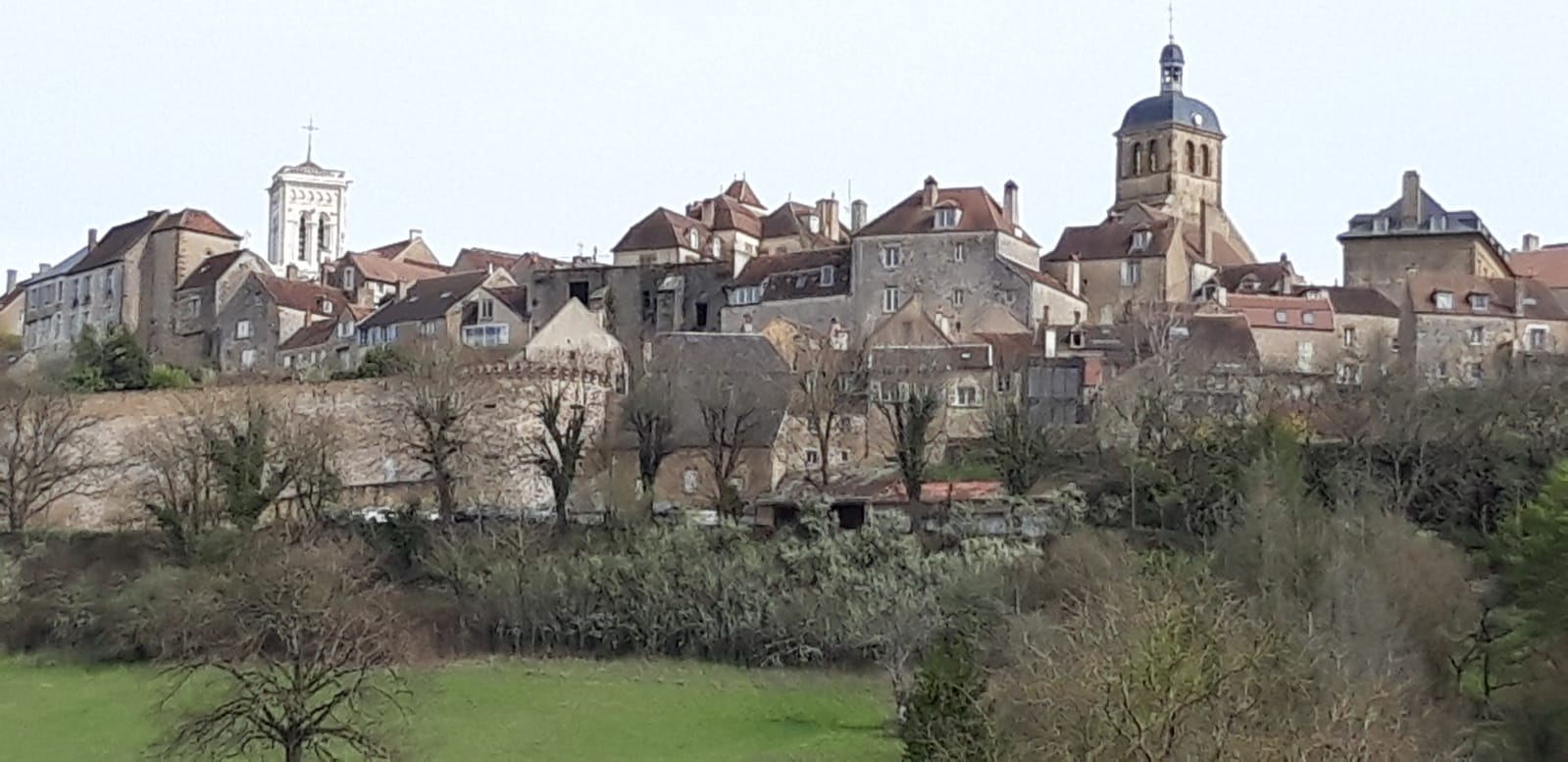
    Vézelay itself was a place of wonder. A walled town on a hilltop, perfectly preserved and seemingly little touched by modernity. Its history was as bloody as that of any town in Europe, but in days of peace there is no finer place to sit and brood upon the infinite, far from brutish commerce and pointless politics.

    A recluse, he was delighted to find the Abbey was still tended by monks, some Franciscan and others from a more recently founded order, whose curious liturgy involved bending to touch the ground and then standing up, opening their hands in supplication and praise to their god above.

    In over four decades he had never before known his wife content to sit still and look in awe. Still, and spellbound. But sitting in the nave of the Abbey, the two of them looked, transfixed, at the Gothic choir and ambulatory, while the sound of soft chanting from Vespers in the nearby cloisters washed over them.

    Increasingly, he came to believe that the object of his search was at hand. That he had found and need seek no longer. Acceptance was the key and renunciation also. What of? Acceptance of the way things are. Renunciation of the effort to change the world. A simple decision to go with what is, with nature, with the wider universe. And to view animal struggling as a meaningless by product of evolution.

    Around him lives were crumbling, as they inevitably do. Friends and relatives were dying, succumbing to the sad state of dementia. Losing all their money, forced into stacking supermarket shelves.

    And the world continued as ever, corrupt capitalists and politicians, murderers, criminals and torturers. The sick, the hungry, the homeless. Vicious competition for scarce resources, the victory of the strong and determined over the meek and the weak.

    He practised gratitude daily but realised his own place in the world was secured by luck not by effort or the kindly care of some deity. And yet none of it seemed to matter much anymore, especially as the days and years rolled by with an ever quickening pace.

    The pilgrimage then was a form of acceptance. A disappearance into a place and state of beauty and peace. A renouncing for good and all of the absurd and destructive Mammon and a realisation that someplace, somewhere a different world existed.

    Or perhaps a different state of mind. The same world maybe but a different attitude to it. An entirely altered state of consciousness. An awakened sense of being, where peace and cooperation gave solace and refuge. Where humanity’s vices were jettisoned and the lion sat down with the lamb.

    Fanciful perhaps, ridiculous even, to those who still clung to the mores so long afflicting the human animal. And yet to him, a truth had been discovered, a long life of mistakes had been revealed. An end had been found to his seeking and the basic truth of the scriptures had been revealed.

    Reality was something else. Something different entirely. And the only way to grasp it was to let go, to dissolve into it.

    Life after death, the matrix, gods and demons, who knows? The seeker simply had to let go. Perhaps one day all would be revealed, perhaps not. Maybe a greater reality existed or perhaps the physicalists were right after all.

    But peace was acceptance of what is. Of that he was sure. And an abandonment of almost all of what man thought he wanted or needed.